1. Introduction: The Stability Paradox
Growers often assume that if their reservoir is well-aerated, their nutrients are stable. The common belief is: High DO = Healthy Water.
However, chemical stability is governed by solubility limits, which are primarily dictated by pH and Oxidation-Reduction Potential (ORP), not just the volume of oxygen gas dissolved in the water. We conducted a controlled experiment to isolate these variables and understand why nutrient solutions precipitate (become cloudy) even under heavy aeration.
2. Experimental Methodology
To test the correlation between aeration, pH, and stability, we set up a controlled environment independent of plant uptake (to isolate chemical reactions).
- Vessel: 5-Gallon buckets (food grade).
- Nutrient Source: Athena Pro Line (commercial hydroponic fertilizer), mixed to 2.0 EC.
- Aeration: Standard air stones driven by an air pump.
- Duration: 72 Hours.
- Measurement: Continuous logging of pH, EC, DO, and Temperature using Atlas Scientific industrial probes.
- The Hypothesis: We posited that mechanical aeration would maintain high DO, but the physical agitation would strip Carbon Dioxide (CO2) from the solution, altering the carbonic acid equilibrium and forcing a pH rise that destabilizes the fertilizer.
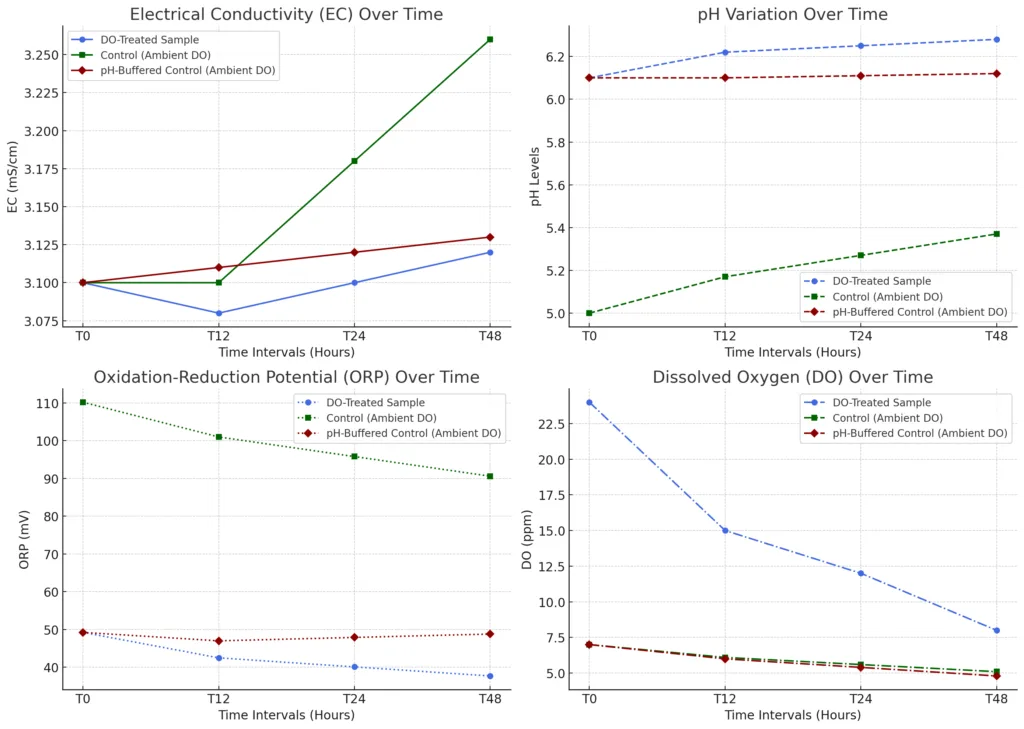
3. Key Finding A: The "Air-Stripping" Effect and pH Drift
The most significant finding was the rapid, uncontrolled rise in pH caused by standard aeration.
- Starting pH: 5.9 (Ideal range).
- Ending pH (72h): > 8.0 (Precipitation zone).
The Chemistry Behind the Drift:
Water naturally contains dissolved CO2, which forms Carbonic Acid (H2CO3). This weak acid acts as a natural buffer, keeping the pH lower.
When you introduce vigorous bubbling (air stones):
- You increase the surface area for gas exchange.
- According to Henry's Law, the system seeks equilibrium with the surrounding atmosphere.
- The bubbles physically "strip" the dissolved CO2 out of the water and release it into the air.
- As CO2 leaves, the Carbonic Acid concentration drops.
- Result: Without the acid buffer, the pH spikes dramatically.
At a pH of 8.0+, many essential ions (specifically Calcium and Magnesium) become insoluble and begin to bond with Phosphorus, dropping out of the solution.
4. Key Finding B: The DO vs. ORP Disconnect
Crucially, our data showed that High Dissolved Oxygen does not equal High ORP.
- Dissolved Oxygen (DO): Remained high (near saturation) due to constant aeration.
- ORP (Oxidation-Reduction Potential): Dropped significantly over time, from ~400mV down to ~200mV.
Why this matters:
ORP measures the "health" or sanitizing potential of the water—its ability to oxidize pathogens and organic waste.
Even though the water was full of oxygen, the low ORP indicated that the oxidative power was declining. This allowed biological contaminants (bacteria/biofilm) to begin forming, contributing to the cloudiness of the water. This proves that simple aeration adds oxygen but does not necessarily maintain the sterility or chemical energy of the solution.
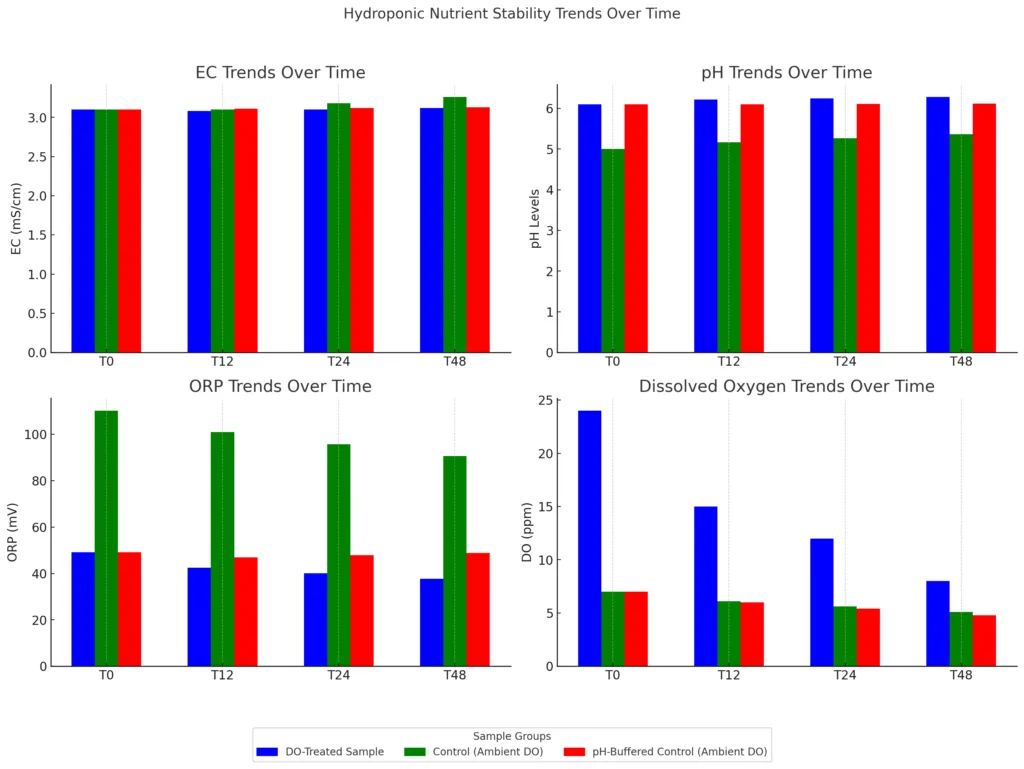
5. Visual Evidence: Turbidity and Biofilm
By the 48-72 hour mark, physical changes were observable:
- Cloudiness (Turbidity): The solution lost clarity. This is visual proof of precipitation. Elements like Calcium Carbonate or Calcium Phosphate were forming solids.
- Biofilm: A slick coating began to form on the bucket walls and air tubing.
Interpretation:
The rise in pH (caused by air-stripping CO2) pushed nutrients out of solution. Simultaneously, the dropping ORP allowed biological activity to thrive on those precipitated nutrients. The result is "sludge"—nutrients that the plant cannot absorb, which eventually clog emitters.
6. Conclusion: Beyond Simple Aeration
This experiment confirms that maintaining a stable hydroponic reservoir requires more than just bubbling air into water. In fact, aggressive bubbling can be detrimental if it causes pH drift.
Key Takeaways for Cultivators:
- pH is the Master Variable: Solubility is strictly gated by pH. If aeration drives pH above 6.5-7.0, precipitation is inevitable, regardless of oxygen levels.
- Monitor ORP, Not Just DO: A high DO reading can be misleading. If ORP falls, your system is vulnerable to pathogens and instability.
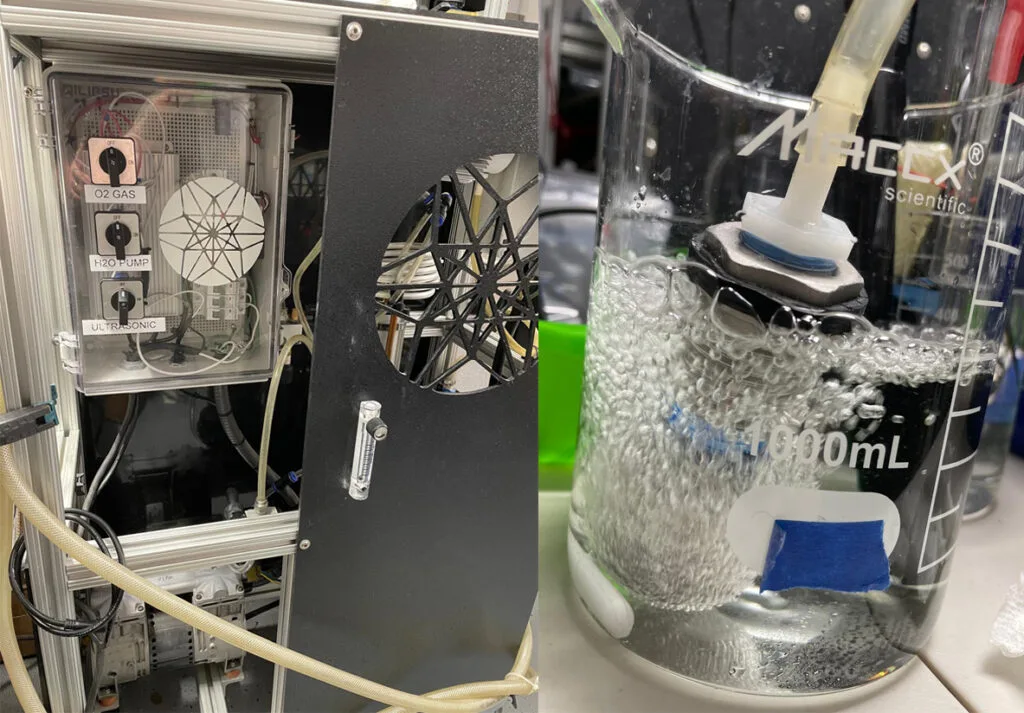
- The Solution - Advanced Nanobubbles: Unlike macro-bubbles that strip CO2 and burst (causing pH spikes), nanobubbles are stable and do not aggressively off-gas CO2. They provide high oxygenation without the violent turbulence that alters chemical equilibrium, helping to stabilize both pH and ORP.
Next Steps:
In Part 2, we will explore how Hydrodynamic Cavitation mitigates these issues by homogenizing the mix and preventing the crystallization of precipitates.
References:
-
Hydroponic Solutions for Soilless Production Systems: Issues and Opportunities. Sambo et al., 2019.
-
Effect of CO₂-Air Mixtures on the pH of Air-Stripped Water. Krauter et al., 1998.