1. Salinity Stress Management
Mechanism of Action: Ionic Adsorption and Osmotic Regulation
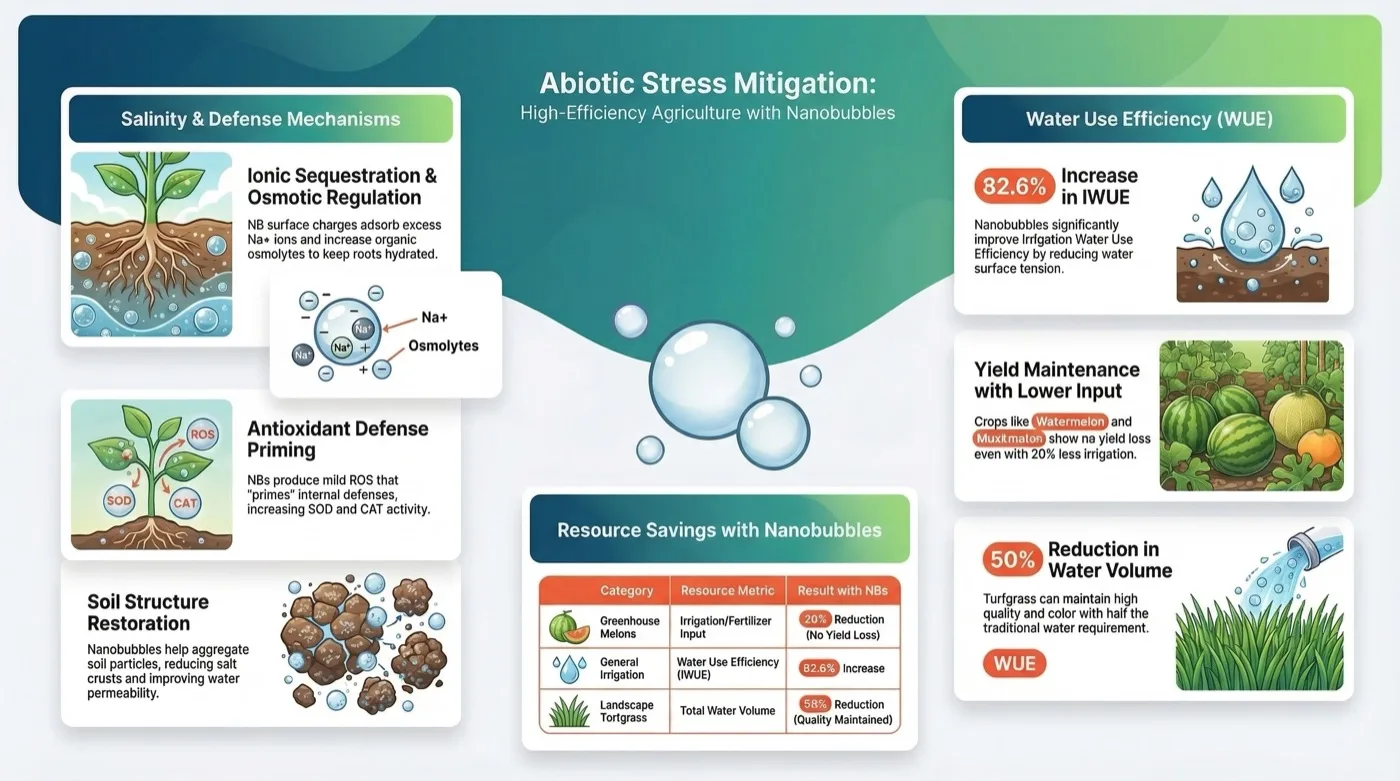
Nanobubbles mitigate salinity stress primarily through the physicochemical properties of their gas-liquid interface. NBs typically possess a high negative Zeta potential. In saline environments, this negative surface charge attracts and adsorbs excess cations (such as Sodium, Na^+) from the soil solution. This adsorption effectively "sequesters" harmful ions, reducing their direct contact with and uptake by crop roots, thereby alleviating ionic toxicity Zheng and Wang, 2025.
Furthermore, oxygenation via NBs helps plants regulate intracellular osmotic pressure. Under salt stress, plants typically suffer from osmotic imbalance. Irrigation with oxygenated brackish water via NBs has been shown to increase the content of soluble sugars and proteins in leaves. These organic solutes act as osmolytes, enhancing the water absorption capacity of plant cells despite the high osmotic potential of the saline soil solution Zhu and Zhang, 2021.
Crop-Specific Evidence:
- Tomato: Research indicates that while high NaCl concentrations generally inhibit root water absorption and mineral accumulation in tomatoes, the application of NB-oxygenated water improves root respiration and nutrient uptake efficiency, counteracting the physiological drought caused by salinity Zhu and Zhang, 2021. Additionally, NB treatment in saline soils has been observed to aggregate dispersed soil particles into stable micro-aggregates, reducing salt crusts and improving permeability for tomato roots Zheng and Wang, 2025.
- Faba Bean: While specific salinity stress data for faba beans is less prevalent than for cereals, Ahmed et al. demonstrated that NBs significantly enhance the germination and growth of faba beans compared to tap water. The mechanism involves the efficient delivery of nutrients and oxygen, which is critical for overcoming the metabolic inhibition typically seen in salt-sensitive legumes during early development stages Ahmed et al., 2018.
2. Antioxidant Enzyme Production
Role in Combating Oxidative Stress
Abiotic stresses (drought, salinity, heavy metals) trigger the overproduction of Reactive Oxygen Species (ROS) within plant cells, leading to oxidative damage of lipids, proteins, and DNA. Nanobubble treatment functions as a "priming" mechanism. It induces a mild, manageable level of exogenous ROS that signals the plant to upregulate its internal antioxidant defense system without causing damage Yan and Zhang, 2023.
Specific Enzyme Activity:
- Superoxide Dismutase (SOD), Peroxidase (POD), and Catalase (CAT): Studies on Alternanthera philoxeroides under heavy metal stress revealed that treatment with air NBs (at 25% concentration) significantly amplified the activity of SOD and CAT. This enzymatic boost facilitated the scavenging of excess superoxide anions (O_2^{\•-}) and hydrogen peroxide (H_2O_2), thereby reducing malondialdehyde (MDA) content—a marker of cell membrane damage Yan and Zhang, 2023.
- Regulation of Redox Homeostasis: In wheat seedlings exposed to zinc oxide nanoparticle stress, NB irrigation enhanced root activity and regulated the ascorbate-glutathione cycle enzymes (such as APX and GR). This regulation maintained cellular redox homeostasis, allowing the plants to maintain growth despite the external stressor Zhang and Li, 2024.
3. Water Use Efficiency (WUE)
Biomass Production with Reduced Water Input
There is strong empirical evidence that NBs significantly enhance Water Use Efficiency (WUE), defined as the ratio of crop yield/biomass to the volume of water applied. NBs reduce the surface tension of water, improving soil infiltration and retention in the root zone, which allows plants to produce equal or greater biomass with significantly reduced irrigation volumes Arablousabet and Povilaitis, 2024.
Evidence of Reduced Water Requirement:
- Watermelon and Muskmelon: A pivotal study by He et al. demonstrated that when irrigation volume was reduced by 20% using NB water (compared to 100% conventional irrigation), the crops suffered no yield loss. In fact, under the reduced irrigation regime (80% water), the Irrigation Water Use Efficiency (IWUE) improved by 82.6% for watermelon and 70.2% for muskmelon, accompanied by significant increases in fruit yield and Vitamin C content He and Li, 2022.
- Greenhouse Tomatoes: In controlled greenhouse trials, micro-nano bubble oxygation increased the WUE of tomatoes by 16.9% to 34.5% compared to non-aerated controls. The enhanced oxygen availability in the rhizosphere allowed the plants to maintain high photosynthetic rates and dry matter accumulation even under optimized (lower) water regimes Zhou and Li, 2022; Liu and Li, 2019.
- Turfgrass: In turfgrass management, using oxygen NBs allowed for a 50% reduction in irrigation volume without compromising turf quality or visual appearance compared to full irrigation with conventional water. This suggests NBs can be a vital tool for water conservation in landscaping Calvo and Acuña, 2024.