1. Hydrodynamic Cavitation (HC) Mechanism
Generation of "Hot Spots" and Hydroxyl Radicals Hydrodynamic cavitation (HC) functions as an intensification technology that creates localized "hot spots" through the formation, growth, and violent collapse of vapor-filled cavities. This occurs when the local pressure in a liquid drops below its vapor pressure (typically via constrictions like venturis or orifice plates) and subsequently recovers.
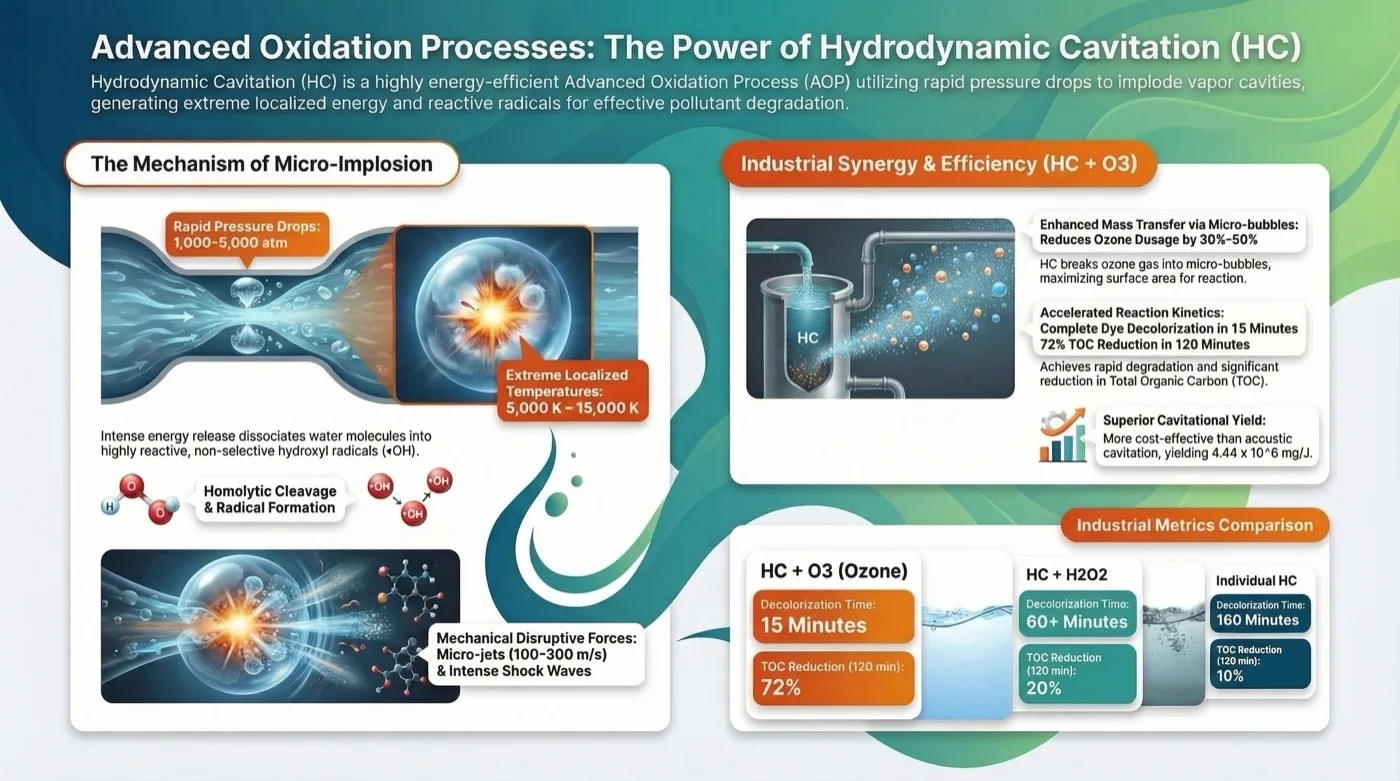
- Extreme Conditions: The implosion of these cavities is nearly adiabatic, generating transient extreme conditions. Research indicates localized temperatures ranging from 5,000 K to 15,000 K and localized pressures between 1,000 and 5,000 atm (approx. 100–500 MPa) within the collapsing bubbles Wang and Cui, 2022; Darandale et al., 2023.
- Radical Formation: Under these extreme thermodynamic conditions, water molecules trapped inside the cavity undergo thermal dissociation (pyrolysis) to generate highly reactive free radicals, primarily hydroxyl radicals (\• OH) and hydrogen atoms (\• H). The reaction is described as: H_2O \\rightarrow \• H + \• OH Mohod et al., 2023; Wang and Cui, 2022.
Bond Breaking in Complex Pollutants The degradation of complex chemical structures, such as textile dyes (e.g., Rhodamine B) or pharmaceutical residues, occurs through two primary pathways driven by this physical energy:
- Pyrolytic Decomposition: Volatile pollutants that can penetrate the cavitation bubble are thermally decomposed directly by the extreme heat inside the cavity during collapse. This effectively breaks strong covalent bonds within the pollutant structure Wang and Cui, 2022.
- Radical Attack & Physical Shear: Non-volatile pollutants accumulate at the gas-liquid interface or remain in the bulk liquid. They are degraded by the \• OH radicals ejected from the bubble upon collapse. Additionally, the cavity collapse generates intense shock waves and micro-jets (high turbulence and shear forces) that physically break down macromolecular contaminants and reduce mass transfer resistance, making the pollutants more accessible to oxidative attack Yeneneh et al., 2024; Wang and Cui, 2022.
2. Synergy with Ozone (HC + O3)
The Synergistic Effect Combining HC with O3 (Ozonation) creates a hybrid AOP that significantly outperforms individual processes. The synergy index for such reactions often ranges from 1 to 4, and in some cases exceeds 10, depending on the pollutant and operating conditions Wang and Cui, 2022.
- Enhanced Mass Transfer: A major limitation of traditional ozonation is the low solubility and high mass transfer resistance of ozone gas in water. HC induces intense turbulence and micro-circulation, which effectively eliminates this resistance, breaking down ozone gas into micro-bubbles. This increases the interfacial area and solubility of ozone, reducing the required ozone dosage by approximately one-third to one-half Wang and Cui, 2022.
Radical Generation Mechanism Cavitation accelerates the decomposition of ozone gas into non-selective radicals much faster than bubbling alone.
- Ozone Pyrolysis: Within the cavitation bubbles, ozone undergoes pyrolysis at lower temperatures than required for water, generating atomic oxygen (O) and oxygen molecules (O_2). The atomic oxygen rapidly reacts with water to form hydroxyl radicals: O(^{3}P) + H_2O \\rightarrow 2\• OH Wang and Cui, 2022.
- Depletion and Regeneration: The cavitational effects cause the rapid depletion of ozone molecules into nascent oxygen and hydroxyl radicals. This continuous dissociation maintains a high concentration of \• OH radicals available for attacking persistent pollutants like triazophos and dyes, yielding degradation rates significantly higher than individual ozonation Mohod et al., 2023.
3. Industrial Efficiency
Reduced Reaction Times and Improved Removal The integration of HC with AOPs demonstrates superior kinetic performance compared to traditional methods.
- Reaction Kinetics: In comparative studies for dye wastewater (e.g., Reactive Blue 13), the HC + O3 process achieved complete decolorization in 15 minutes and a 72% reduction in Total Organic Carbon (TOC) in 120 minutes. In contrast, individual processes required significantly longer times to achieve comparable results Wang and Cui, 2022.
- Degradation Rates: The specific degradation rate for combined ozone and hydrodynamic cavitation has been reported as high as 915.94 \\times 10^{-3} \\text{ min}^{-1}, markedly higher than rates achieved by single unit operations Mohod et al., 2023.
Energy Efficiency (Yield in mg/J) HC-AOPs are recognized for their cost-effectiveness and energy efficiency, particularly when compared to acoustic (ultrasonic) cavitation.
- Cavitational Yield: HC is more energy-efficient than acoustic cavitation. For example, in the degradation of methyl parathion, the cavitational yield for HC was reported at 4.44 \\times 10^{-6} mg/J, compared to only 2.098 \\times 10^{-7} mg/J for acoustic cavitation Mohod et al., 2023.
- Cost Reduction: The combined HC/O3 process is noted to be more cost-effective than individual processes. By enhancing the oxidative capacity and reducing the required oxidant dosage (e.g., reducing ozone consumption), the overall treatment cost and energy requirements are lowered significantly, making it a viable option for large-scale industrial effluent treatment Yeneneh et al., 2024; Wang and Cui, 2022.