1. Oxygen Diffusion in Chronic Wounds
Overcoming the Hypoxic Barrier in Diabetic and Venous Ulcers
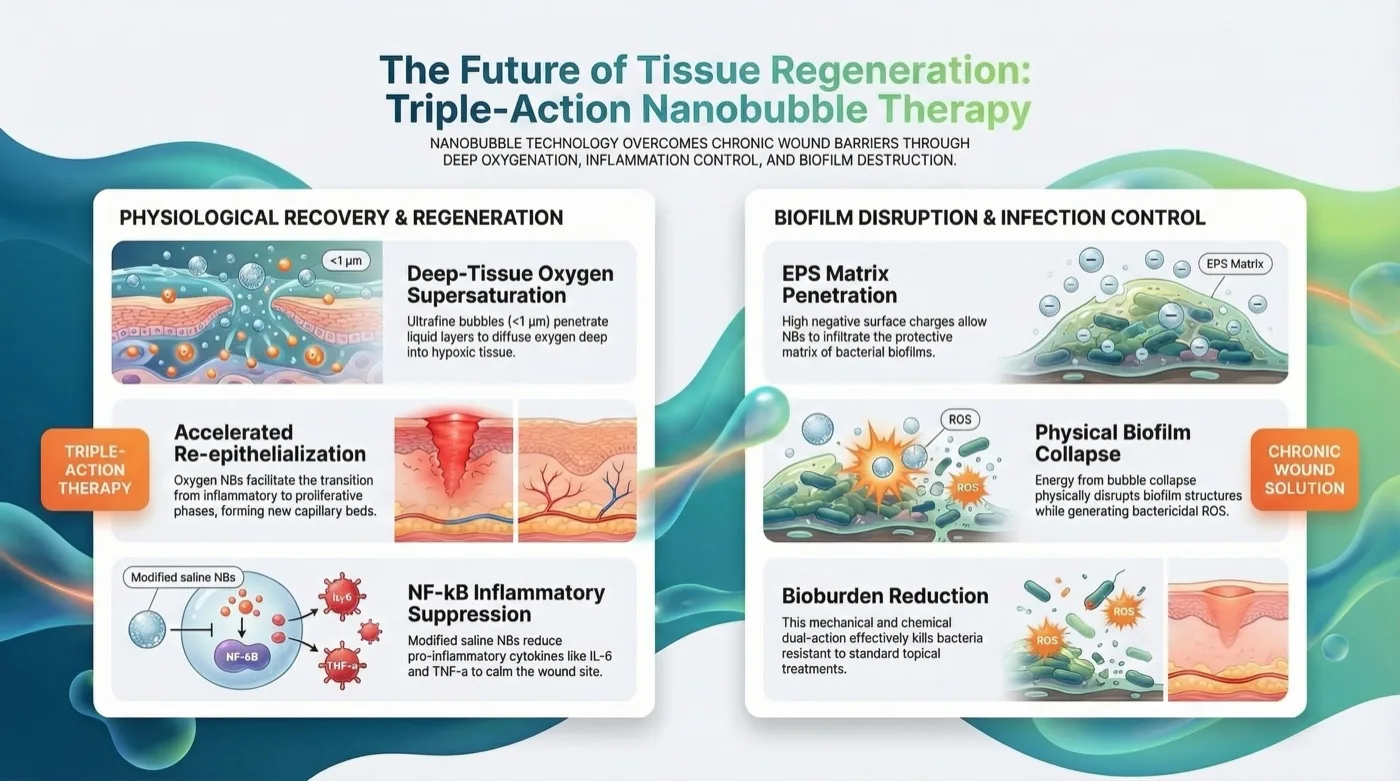
Chronic wounds, such as diabetic foot ulcers and venous stasis ulcers, are characterized by a persistent hypoxic microenvironment (pO_2 < 30 mmHg) that arrests the healing process in the inflammatory phase. A major limitation of traditional Topical Gaseous Oxygen (TGO) is its inability to penetrate the liquid exudate and necrotic slough covering the wound bed.
- Superior Penetration: Nanobubbles (NBs) function as a Topical Dissolved Oxygen (TDO) delivery system. Unlike macrobubbles, NBs are small enough (<1 µm) to penetrate the liquid boundary layer and diffuse deep into the interstitial tissue. Due to their high internal pressure (governed by the Young-Laplace equation), NBs act as high-density gas reservoirs that supersaturate the wound fluid, maintaining elevated pO_2 levels significantly longer than conventional aeration Sayadi & Widgerow, 2018; Ebina et al., 2013.
- Physiological Acceleration: High dissolved oxygen levels provided by NBs have been proven to act as a "safe accelerator of growth." In vivo studies demonstrated that oxygen NB water significantly promoted somatic growth (weight and length) in mice and fish, suggesting that NBs can drive the metabolic demands required for rapid tissue regeneration without toxicity Ebina et al., 2013.
Epithelialization and Angiogenesis
Oxygen is a critical cofactor for collagen synthesis and angiogenesis.
- Mechanism: Adequate oxygenation is required for the hydroxylation of proline and lysine residues in procollagen, a necessary step for collagen cross-linking and wound tensile strength. Furthermore, oxygen regulates Vascular Endothelial Growth Factor (VEGF) expression. By reversing hypoxia, NBs facilitate the transition from the inflammatory phase to the proliferative phase, accelerating re-epithelialization and the formation of new capillary beds Sayadi & Widgerow, 2018.
2. Inflammatory Response Modulation
Modulation of Cytokines and Inflammation Markers
Nanobubbles do not merely supply oxygen; they actively modulate the cellular inflammatory response, shifting the wound environment from a chronic, stalled state to an active healing state.
- NF-kB Suppression: Research indicates that physically modified saline containing nanobubbles (specifically hydrogen or oxygen) can suppress the activation of Nuclear Factor-kappa B (NF-kB). NF-kB is a central regulator of inflammation; its downregulation reduces the overexpression of pro-inflammatory cytokines (such as IL-6 and TNF-\\alpha), thereby mitigating excessive inflammation that damages tissue and prevents healing Zhao & Cao, 2016; .
- Growth Factor Promotion: While hypoxia induces Hypoxia-Inducible Factor-1\\alpha (HIF-1\\alpha), chronic hypoxia leads to a pathological persistence of this factor. Oxygen NBs downregulate HIF-1\\alpha to physiological levels while simultaneously supporting the metabolic pathways necessary for growth factor efficacy (such as IGF-1 and VEGF), effectively "unlocking" the wound's healing potential Sayadi & Widgerow, 2018; Ebina et al., 2013.
3. Bacterial Bioburden Reduction
Biofilm Disruption and Infection Control
A primary reason for delayed healing in chronic wounds is the presence of bacterial biofilms, which consume available oxygen and create a physical barrier to antibiotics and immune cells.
- Mechanism of Removal: NBs possess a high negative surface charge (Zeta potential) and generate free radicals (ROS) upon collapse. This allows them to penetrate the extracellular polymeric substance (EPS) matrix of biofilms. Once inside, the physical energy of the bubble collapse (shock waves) and the oxidative power of the gas (especially if Ozone NBs are used) disrupt the biofilm structure and kill bacteria, preventing infection Sayadi & Widgerow, 2018; Hayakumo & Izumi, 2013.
4. Salud Dental y Fisiología Sistémica (Dental Health & Systemic Physiology)
Hygiene Applications (Periodontitis & Oral Care)
Nanobubble technology has shown remarkable efficacy in oral hygiene, particularly in the management of periodontitis and the removal of oral pathogens.
- Periodontal Treatment: In a randomized controlled trial, irrigation with Ozone Nanobubble Water (NBW3) as an adjunct to mechanical debridement significantly improved clinical parameters. Patients treated with NBW3 showed a greater reduction in Probing Pocket Depth (PPD) and a significant gain in Clinical Attachment Level (CAL) compared to water irrigation. Microbiologically, NBW3 significantly reduced the total bacterial count in subgingival plaque, including key pathogens like Porphyromonas gingivalis Hayakumo & Izumi, 2013; Hayakumo & Izumi, 2014.
- Bacterial Removal Efficiency: Experiments utilizing high-density stainless-steel mesh nozzles to generate nanobubbles have been reported to remove oral bacteria under optimized flow and mesh conditions. This suggests NBs are a potent tool for daily oral hygiene and biofilm management .
Systemic Effects (Neuro-protection & Anti-fatigue)
Beyond local applications, nanobubbles (particularly hydrogen and oxygen) exhibit systemic physiological benefits.
- Neuro-protection: Physically modified saline containing nanobubbles has been shown to protect against neuro-inflammation and neuro-degeneration. By suppressing NF-kB activation in microglia (the immune cells of the central nervous system), NBs may offer therapeutic potential for neurodegenerative conditions like Alzheimer's and Parkinson's disease, as well as protecting against ischemic injury Zhao & Cao, 2016; Chaurasia, 2023.
- Growth and Vitality: The systemic absorption of oxygen nanobubble water has been linked to promoted growth and vitality in animal models, likely due to enhanced blood oxygenation and improved metabolic efficiency Ebina et al., 2013.