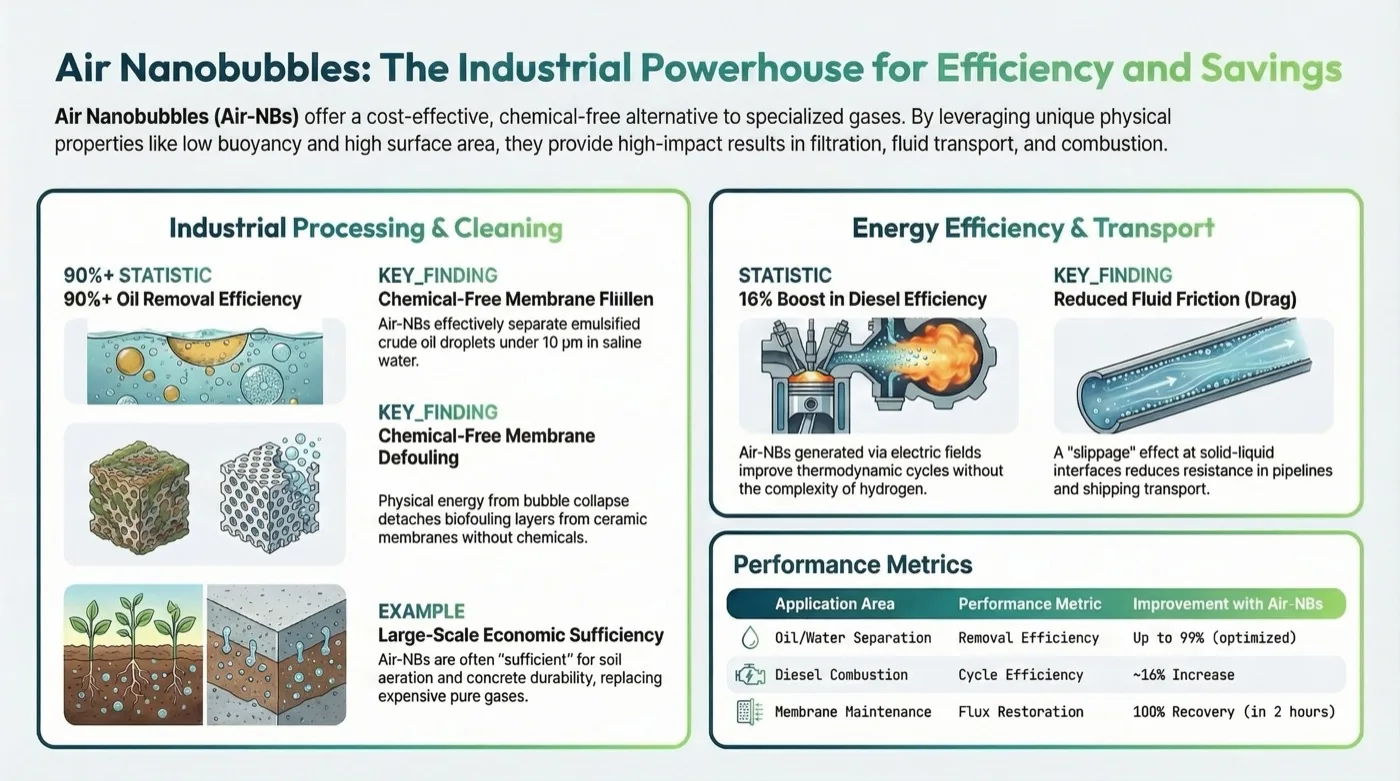
Air nanobubbles (Air-NBs) represent the most economically viable option for industrial-scale applications where specific chemical reactions (like those of ozone or hydrogen) are not required, but physical effects are beneficial.
General Industry: Dissolved Air Flotation (DAF)
- Oil/Water Separation: Air-NBs are superior to conventional microbubbles for separating emulsified crude oil in saline water. Due to their low buoyancy and high surface area, they effectively attach to ultrafine oil droplets (<10 µm) that typically escape standard DAF systems. Studies show Air-NBs can achieve oil removal efficiencies greater than 90% (up to 99% in optimized conditions) Etchepare et al., 2017; Shen et al., 2022.
- Membrane Cleaning: Air-NBs are also utilized for ceramic membrane defouling, providing a chemical-free method to detach biofouling layers through the physical energy released during bubble collapse Ghadimkhani et al., 2016.
Drag Reduction: Fluid Transport
- Friction Reduction: The presence of nanobubbles in a liquid flowing through micro-orifices or pipes reduces the frictional resistance (drag). This "slippage" effect at the solid-liquid interface allows for energy savings in fluid transport systems, particularly in shipping and pipeline industries Ushida et al., 2012 cited in Nirmalkar & Barigou, 2018, 2018, 2018, 2018; Latorre, 1997 cited in Gurung et al., 2016, 2016, 2016, 2016.
Cost-Benefit: Sufficiency vs. Pure Gases
- Economic Viability: Air-NBs are a cost-effective and highly efficient solution that can be produced at a large scale using hydrodynamic cavitation or hydraulic air compression. They are often "sufficient" for applications like soil aeration, basic water quality improvement (reducing Chemical Oxygen Demand), and enhancing concrete durability, where the high cost of pure oxygen or ozone generation is unjustified Arablousabet & Povilaitis, 2024; Wang & Wang, 2023.
- Fuel Efficiency: Recent data indicates that Air-NBs generated via electric fields in diesel can boost thermodynamic cycle efficiency by approximately 16%, offering a significant sustainability advantage without the complexity of hydrogen injection English, 2025.