1. Hydrodynamic Cavitation (HC) as Pre-Treatment
Cell Lysis and Floc Disintegration
Hydrodynamic cavitation serves as a high-energy physical pre-treatment that mechanically disrupts waste activated sludge (WAS).
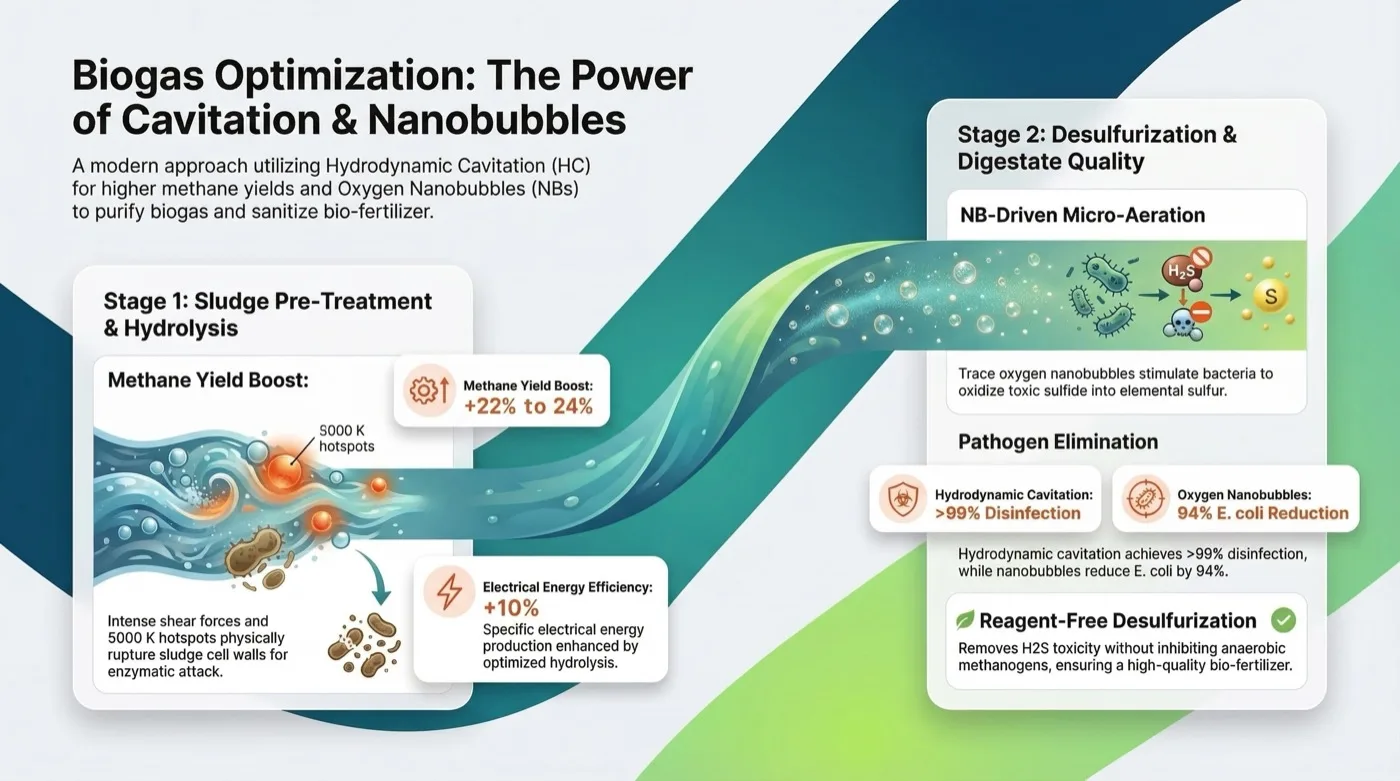
- Mechanism: The process creates rapid pressure drops (below vapor pressure) followed by pressure recovery, leading to the violent collapse of cavitation bubbles. This implosion generates intense shear forces, shock waves, and localized hotspots (temperatures up to 5000 K). These forces destroy the structural integrity of sludge flocs and rupture microbial cell walls (lysis), causing the release of intracellular materials (cytoplasm, enzymes, and nucleic acids) and extracellular polymeric substances (EPS) into the aqueous phase Mancuso et al., 2020; Cako et al., 2022.
- Solubilization: This physical disintegration transforms particulate chemical oxygen demand (PCOD) into soluble chemical oxygen demand (SCOD), significantly increasing the bioavailability of the organic matter for downstream biological degradation Mancuso et al., 2020.
Hydrolysis Acceleration
Hydrolysis is widely recognized as the rate-limiting step (bottleneck) in the anaerobic digestion (AD) of semi-solid wastes like sludge.
- Surface Area Expansion: HC pre-treatment reduces the particle size of solid organic matter, thereby vastly increasing the specific surface area available for enzymatic attack by hydrolytic bacteria. By disrupting complex lignocellulosic barriers and floc structures, HC accelerates the conversion of macromolecules (proteins, carbohydrates) into simpler monomers (amino acids, sugars), effectively speeding up the digestion kinetics Szaja et al., 2022; Mancuso et al., 2020.
Methane Yield Enhancement
The solubilization of organics directly correlates to improved biogas production.
- Yield Data: Full-scale applications of HC pre-treatment in agricultural biogas plants have demonstrated a sustained increase in specific electrical energy production by approximately 10% (from 1.31 to 1.44 kWhe_{el}/kg VS_{input}). Furthermore, lab-scale studies utilizing nanobubble water (a related cavitation phenomenon) to pre-augment sludge showed methane yield increases of 22% to 24% compared to controls, driven by enhanced electron transport system activity Sun et al., 2023; Wang et al., 2020.
2. Nanobubbles for Desulfurization (Micro-Aeration)
H2S Removal via Micro-Aeration
Hydrogen sulfide (H_2S) is a toxic byproduct of AD that inhibits methanogenesis and corrodes equipment. "Micro-aeration" involves introducing precise, trace amounts of oxygen into the digester.
- Selective Stimulation: Oxygen or Air Nanobubbles (NBs) are ideal for this application due to their high gas mass transfer efficiency and stability. They provide a controlled oxygen source that selectively stimulates Sulfur-Oxidizing Bacteria (SOB). These bacteria oxidize toxic sulfide (S^{2-}) into elemental sulfur (S^0) or sulfate (SO_4^{2-}), which are non-toxic. Because NBs dissolve slowly and maintain high dissolved oxygen (DO) availability at the interface without creating bulk aerobic conditions, they do not inhibit the strict anaerobic methanogens responsible for biogas production Fan et al., 2021; Unger & Michael, 2022.
Reduction of Toxicity
- Mechanism: High concentrations of H_2S are toxic to methanogens and can arrest biogas production. By precipitating sulfur or converting it to sulfate, the toxicity is removed. While recent studies have successfully used nanoparticles (such as Zinc Silica Nanogels) to reduce H_2S gas volumes by >92%, the principle of micro-aeration using nanobubbles offers a reagent-free alternative to achieve similar detoxification by shifting the redox potential to favor sulfur oxidation over sulfate reduction Sarker et al., 2019; Fan et al., 2021.
3. Digestate Quality
Pathogen Reduction and Sanitization
The final digestate must be sanitized before land application to prevent the spread of diseases. HC and Nanobubbles provide a chemical-free disinfection method.
- Physical Stress Mechanism: The collapse of cavitation bubbles generates powerful shock waves and shear forces that physically rupture the cell membranes of pathogens. Additionally, the implosion generates oxidative species (Hydroxyl radicals, \• OH). This dual physical-chemical attack effectively destroys pathogens such as Escherichia coli and Salmonella.
- Efficacy: Research indicates that Oxygen Nanobubbles (ONBs) can reduce E. coli concentrations by 94% due to free radical generation upon collapse. Similarly, hydrodynamic cavitation devices (like vortex diodes or orifice plates) have demonstrated >99% disinfection rates for E. coli under optimized pressure conditions (e.g., 0.5 to 10 bar), ensuring the digestate meets safety standards for bio-fertilizer use Ahmed et al., 2023; Mancuso et al., 2020; Lei et al., 2024.