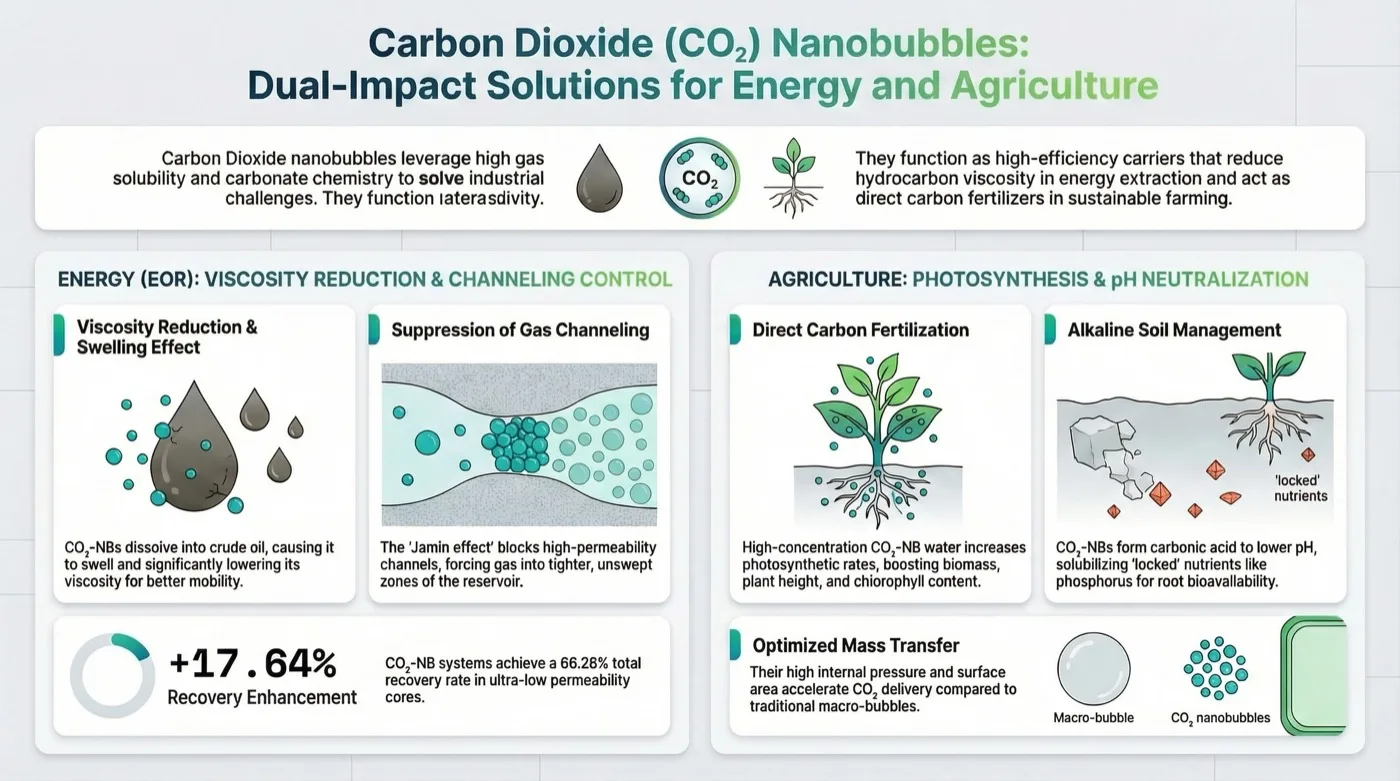
Carbon Dioxide nanobubbles (CO2-NBs) leverage the high solubility of CO2 in both water and oil, along with its ability to alter pH and carbonate chemistry, driving applications in tight oil reservoirs and alkaline soil management.
Energy (EOR): Viscosity Reduction and "Swelling Effect"
- Mechanism in Tight Reservoirs: CO2-NBs are particularly effective in extra-low-permeability (tight) reservoirs where direct gas injection suffers from channeling.
- Viscosity Reduction & Swelling: CO2-NBs dissolve into the crude oil, causing it to swell and significantly reducing its viscosity. This improves the mobility ratio between the displacing fluid and the oil Cai et al., 2024.
- Channeling Suppression: Stabilized CO2-NB systems (e.g., using modified nano-SiO2) effectively block high-permeability channels (gas channeling), diverting the flow into tighter, unswept zones. This "Jamin effect" in pore throats forces the gas into the low-permeability matrix Cai et al., 2024.
- Recovery Enhancement: Core flooding experiments demonstrate that CO2-NB systems can enhance oil recovery by 17.64% over water flooding followed by conventional CO2 flooding, achieving a total recovery rate of 66.28% in ultra-low permeability cores Cai et al., 2024.
Agriculture: Carbon Source and pH Neutralization
- Photosynthesis Enhancement: CO2-NBs act as a direct carbon fertilizer. High-concentration CO2-NB water applied to crops (e.g., via foliar spray or hydroponics) increases the photosynthetic rate, leading to improved biomass accumulation, plant height, and chlorophyll content Pal & Anantharaman, 2022.
- pH Neutralization: In alkaline soils or waters, CO2-NBs release CO2 which forms carbonic acid (H_2CO_3), effectively lowering the pH. This process helps solubilize essential nutrients (like phosphorus and micronutrients) that are otherwise locked in insoluble forms at high pH, making them bioavailable to plant roots Wang & Yang, 2021; Pal & Anantharaman, 2022.