1. Dental & Oral Health
Periodontal Disease Management
Nanobubbles, particularly Ozone Nanobubbles (NBW3), offer a potent adjunctive therapy for chronic periodontitis, addressing the limitations of mechanical debridement in deep gum pockets.
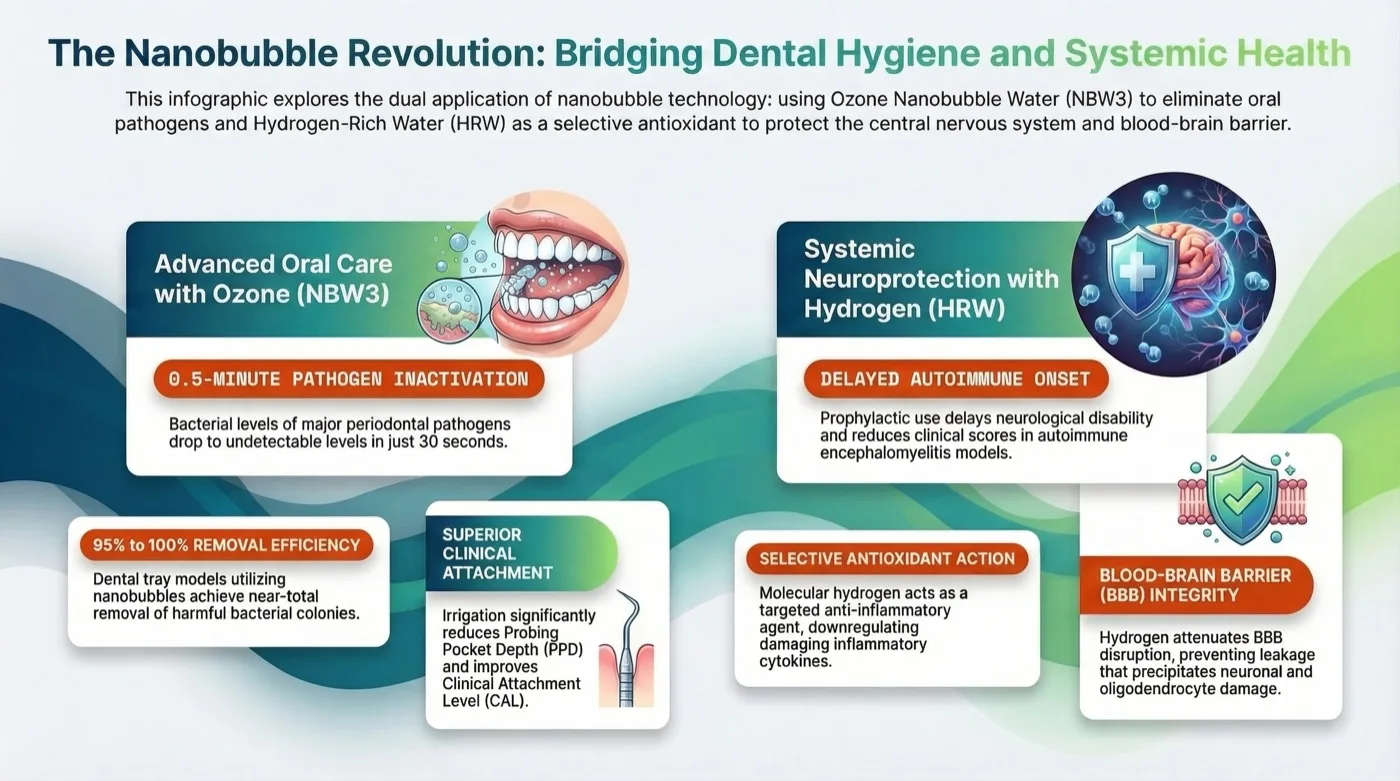
- Pathogen Inactivation: Hayakumo et al. demonstrated that Ozone Nanobubble Water (NBW3) possesses strong bactericidal activity against major periodontal pathogens such as Porphyromonas gingivalis and Aggregatibacter actinomycetemcomitans. In in vitro time-kill assays, the colony-forming units (CFUs) of these pathogens dropped to undetectable levels (<10 CFU/mL) within just 0.5 minutes of exposure to NBW3. This rapid efficacy is crucial for clinical irrigation where contact time is limited Hayakumo et al., 2014.
- Clinical Efficacy (Deep Pockets): In randomized controlled trials, subgingival irrigation with NBW3 alongside mechanical debridement significantly improved clinical parameters compared to water irrigation. Patients exhibited greater reductions in Probing Pocket Depth (PPD) and significant gains in Clinical Attachment Level (CAL). The NBW3 treatment also resulted in a statistically significant reduction in the total bacterial count in subgingival plaque, maintaining low levels of P. gingivalis for up to 8 weeks Hayakumo et al., 2013.
- Physical Removal: Beyond chemical inactivation, the physical properties of nanobubbles facilitate hygiene. Experimental dental tray models utilizing high-density stainless-steel mesh nozzles to generate nanobubbles showed bacterial removal efficiencies between 95% and 100%. The nanobubbles are small enough to access irregular surfaces and deep pockets that brushes miss, physically detaching biofilm through fluid dynamics and bubble collapse energy Lin 2020, 2020.
Bone Regeneration and Implant Osseointegration
Emerging evidence suggests that Oxygen Nanobubbles (ONBs) can influence bone metabolism and implant maintenance.
- Bone Loss Prevention: Research indicates that the administration of oxygen nanobubble water can prevent bone loss. Specifically, ultrafine oxygen bubbles (approx. 200 nm) have been shown to suppress osteoclast differentiation, thereby preventing bone loss in mouse models of glucocorticoid-induced osteoporosis. This suggests a potential application in preserving alveolar bone in periodontal patients Thi et al., 2020.
- Implant Maintenance: Carbonated water nanobubbles have been explored for cleaning dental implants. The intensified cavitation generated by these bubbles around ultrasonic scaler tips significantly enhances the removal of biofilms from implant surfaces compared to standard water, offering a method to prevent peri-implantitis without damaging the implant surface Lian et al., 2024.
2. Neuroprotection & Systemic Health
Hydrogen-Rich Water (HRW) in Autoimmune Models
Molecular hydrogen (H2) acts as a selective antioxidant and anti-inflammatory agent. Zhao & Cao (2016) investigated its effects on Experimental Autoimmune Encephalomyelitis (EAE), a model for Multiple Sclerosis (MS).
- Clinical Improvements: Prophylactic administration of Hydrogen-rich water (HRW) significantly delayed the onset of EAE and reduced the maximal clinical scores of neurological disability. HRW treatment also reduced the cumulative disease score and shortened the duration of symptoms compared to control groups Zhao & Cao, 2016.
- Mechanism of Action (Immune Modulation): HRW exerts its protective effects by modulating the immune response. It inhibits the development of pathogenic Th17 cells (T helper 17 cells), which are critical drivers of autoimmune inflammation in the central nervous system (CNS). Furthermore, HRW treatment significantly reduced the infiltration of CD4+ T lymphocytes into the CNS, thereby limiting the inflammatory cascade that leads to demyelination Zhao & Cao, 2016.
Neurological Function and Blood-Brain Barrier (BBB)
- Attenuating Disruption: In autoimmune conditions like MS/EAE, the disruption of the Blood-Brain Barrier (BBB) allows immune cells to infiltrate the CNS. By suppressing oxidative stress (ROS) and downregulating inflammatory cytokines, hydrogen attenuates this BBB disruption. While Zhao & Cao focused on reduced infiltration, related reviews highlight that hydrogen improves neurological function specifically by preserving BBB integrity in stroke-prone models, preventing the leakage that precipitates neuronal damage Chaurasia, 2023.
- Oxidative Stress Reduction: Oxidative stress is a major mediator of axonal damage. HRW acts as a free radical scavenger, reducing the levels of reactive oxygen species (ROS) in the CNS. This antioxidant activity protects neurons and oligodendrocytes from apoptosis, contributing to the observed functional recovery Zhao & Cao, 2016.