1. Produced Water Treatment (Oily Wastewater)
Nanobubble Flotation Efficiency Nanobubble flotation represents a paradigm shift from conventional gravity separation and standard flotation methods. The core mechanism involves the generation of bulk nanobubbles (NBs) that entrap and adhere within flocculated oil droplets. This interaction creates "aerated flocs" with significantly lower density than the surrounding water, facilitating rapid rise velocities.
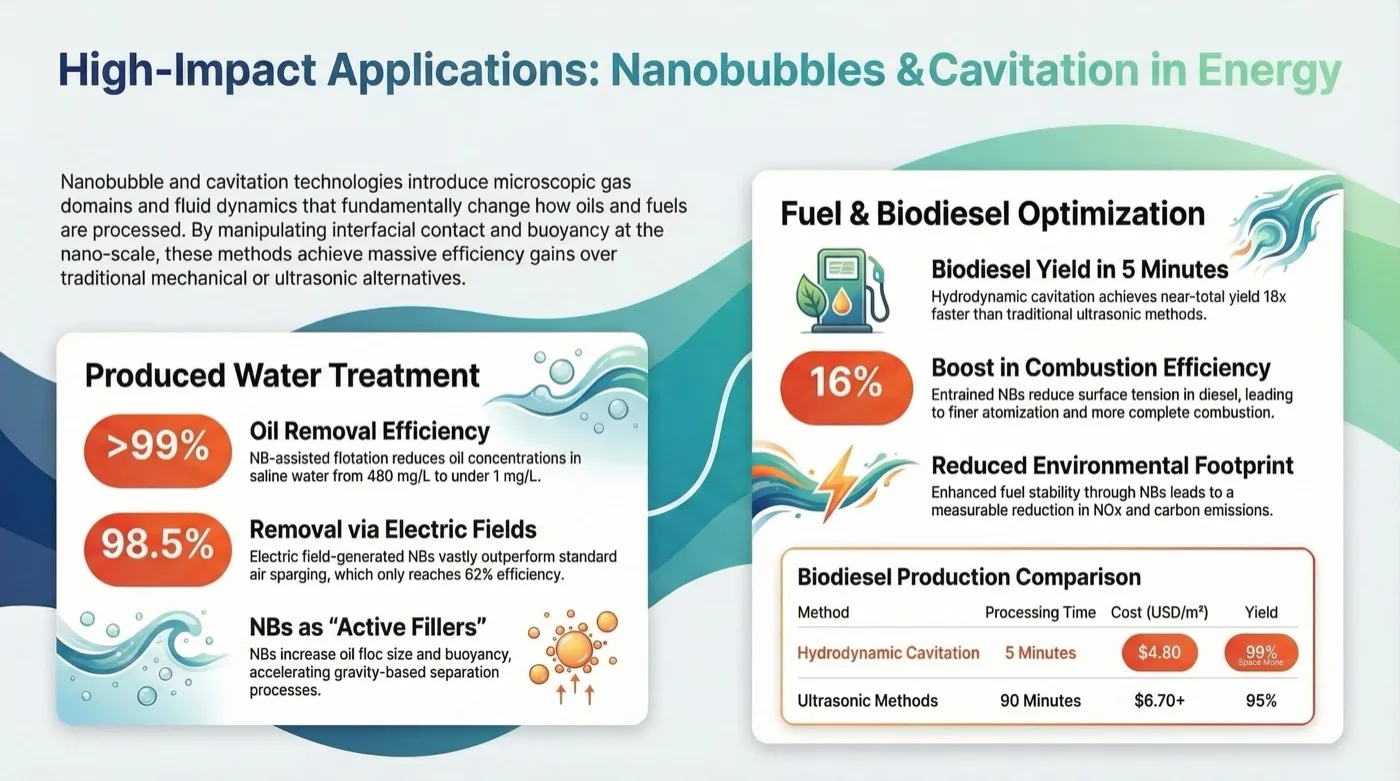
- Performance: Experimental data indicates that NB-assisted flotation can achieve oil removal efficiencies greater than 99%. In studies treating saline produced water, oil content was reduced from initial concentrations of 334–484 mg/L to less than 1 mg/L, meeting strict offshore discharge standards (<29 mg/L) Etchepare and Rubio, 2017.
- Mechanism: The high surface area and hydrophobic nature of NBs allow them to nucleate preferentially on oil droplet surfaces, enhancing the probability of collision and attachment compared to larger bubbles Shen et al., 2022.
Superiority over Dissolved Air Flotation (DAF) Standard Dissolved Air Flotation (DAF) typically generates microbubbles (30–100 µm). While effective for larger oil globules, DAF struggles with ultra-fine oil droplets (emulsions <20 µm) which follow water streamlines and evade bubble capture.
- The Nanobubble Advantage: NBs (<200 nm) possess a low buoyancy and long residence time, allowing them to remain suspended in the water column to interact with ultra-fine droplets that DAF misses. Oliveira and Rubio demonstrated that flocculation-column flotation using NBs generated by a multiphase pump significantly improved the separation of emulsified crude oil in saline water compared to conventional methods. The NBs act as "active fillers" within the oil flocs, increasing their apparent size and buoyancy, which drastically reduces the required hydraulic retention time Oliveira and Rubio, 2017.
- Chemical Savings: Recent trials utilizing electric field-generated air-NBs showed that oil removal efficiency increased to 98.5% with optimized polymer dosing (0.2 wt%), outperforming control air sparging (62% removal) and allowing for reduced chemical usage English, 2025.
2. Biodiesel Production Intensification
Hydrodynamic Cavitation (HC) Acceleration Traditional biodiesel production via mechanical stirring is limited by mass transfer resistance between the immiscible vegetable oil and alcohol phases. HC overcomes this by generating cavitation bubbles that collapse violently, creating localized "hot spots" (high temperature and pressure) and high-speed micro-jets. This turbulence emulsifies the immiscible liquids, increasing the interfacial contact area and reaction kinetics significantly Sun and Xuan, 2023.
Reaction Time and Yield Improvements
- Time Reduction: While ultrasonic cavitation is effective, HC offers superior scalability and energy efficiency. Cako et al. reported that HC reactors (specifically multi-hole orifice plates) achieved 99% biodiesel yield within just 5 minutes of processing time. In contrast, ultrasonic bath methods required 90 minutes to achieve 95% yield Cako et al., 2022.
- Economic Efficiency: The processing cost for HC was estimated at 4.80 USD/m³, which is notably lower than acoustic cavitation methods (e.g., 6.7–10.8 USD/m³) and mechanical stirring, due to reduced energy consumption and faster throughput Cako et al., 2022.
- Process Quality: The intense shear forces in HC allow for the use of lower catalyst concentrations and alcohol-to-oil ratios while still meeting ASTM D6751 and EN 14214 fuel quality standards Sun and Xuan, 2023.
3. Fuel Efficiency (Internal Combustion)
Combustion Efficiency and Stability The introduction of nanobubbles into liquid fuels (diesel or gasoline) enhances combustion performance through altered fluid properties and "micro-explosions" during atomization.
- Combustion Boost: English reported that electric field-generated air-NBs in diesel fuel boosted combustion efficiency by approximately 16%. This improvement is attributed to a reduction in surface tension (a ~7% drop for air-NBs), which facilitates finer droplet atomization in the fuel injector, leading to a more complete burn and improved thermodynamic cycle efficiency English, 2025.
- Emulsion Stability: Nanobubbles also enhance the stability of water-in-diesel emulsions (often used to reduce NOx emissions). The NBs act as a buffer, preventing the coalescence of water droplets and maintaining a stable dispersed phase, which supports the "secondary atomization" effect in the combustion chamber English, 2025; Sun and Xuan, 2023.