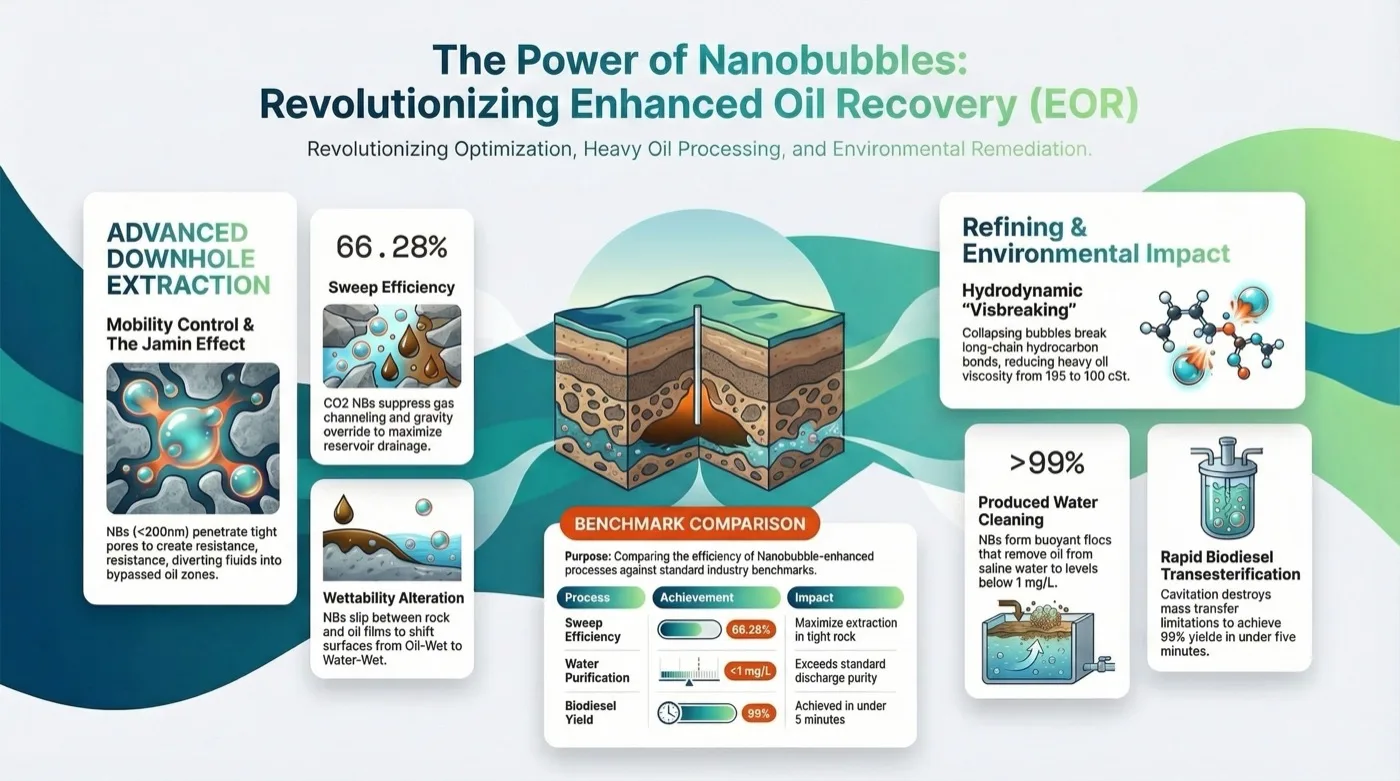
1. Mobility Control & Sweep Efficiency
Behavior in Porous Rock Formations Unlike macro-gas injection, which suffers from rapid gas segregation, gravity override, and channeling (fingering) through high-permeability zones, nanobubble dispersions exhibit unique stability and transport properties.
- Deep Penetration: Gas nanobubbles (typically <200 nm) are significantly smaller than the pore throats of tight reservoirs. This allows them to penetrate deep into the reservoir matrix where conventional water flooding or macro-bubbles cannot reach. For CO_2-EOR in extra-low-permeability reservoirs, CO_2 NBs effectively suppress gas channeling and gravity overlap, maintaining a stable dispersed phase within the liquid carrier Cai et al., 2024.
- N_2 Behavior: Nitrogen (N_2) NBs have demonstrated the ability to access isolated oil globules in micropores. In spontaneous imbibition tests, N_2 NBs outperformed distilled water by acting as a third, intermediate wetting phase that invades oil-filled pores more strongly than water alone Elnaggar et al., 2025.
The "Jamin Effect" and Sweep Efficiency The "Jamin effect" is a critical mechanism for improving sweep efficiency in heterogeneous reservoirs.
- Mechanism: When a liquid containing NBs flows through a porous medium, the bubbles can become trapped in pore throats, particularly in high-permeability channels. This creates additional resistance (increased apparent viscosity) due to the capillary pressure required to deform the bubble through the constriction (the Jamin effect). This resistance effectively blocks high-flow channels, forcing the subsequent injected fluid to divert into lower-permeability (tighter) zones that contain bypassed oil.
- Result: Research on CO_2 NB systems indicates that this blockage and subsequent flow diversion significantly expands the sweep efficiency. In core flooding experiments, this mechanism contributed to a recovery rate of 66.28%, which was 17.64% higher than conventional water flooding followed by CO_2 flooding Cai et al., 2024.
2. Viscosity Reduction of Heavy Oil
Hydrodynamic Cavitation and Cracking Hydrodynamic cavitation (HC) serves as a physical and chemical upgrading method for heavy crude and bitumen.
- Mechanism: The violent collapse of cavitation bubbles generates localized "hot spots" with extreme temperatures and pressures. These conditions provide the energy required to break the Carbon-Carbon (C-C) bonds of long-chain hydrocarbons (paraffins and asphaltenes) into shorter, lighter chains. This process is akin to visbreaking but occurs via mechanical-acoustic energy Askarian et al., 2017.
- Prevention of Re-polymerization: It is noted that cavitation alone can generate free radicals that may re-polymerize, potentially increasing viscosity. However, the presence of a hydrogen donor (e.g., small amounts of gasoline or tetrahydronaphthalene) inhibits this recombination, ensuring permanent viscosity reduction Askarian et al., 2017.
Upgrading Data (API Gravity)
- Viscosity Reduction: In experiments using a hydrodynamic cavitation setup with 2% gasoline as a hydrogen donor, the viscosity of heavy oil at 60°C was reduced significantly (e.g., from ~155 cSt to ~100 cSt).
- API Improvement: This process results in the partial upgrading of the crude, leading to a measurable increase in API gravity, making the oil lighter and easier to transport and refine Askarian et al., 2017. Additionally, CO_2 NBs dissolving into crude oil cause swelling, which also contributes to significant viscosity reduction in situ Cai et al., 2024.
3. Wettability Alteration
Releasing Trapped Oil Nanobubbles alter the rock-fluid interactions to favor oil detachment.
- Mechanism: In oil-wet (OW) reservoirs, oil adheres strongly to the rock surface. Nanobubbles, particularly CO_2 and N_2 NBs, can alter this wettability toward a more water-wet (WW) state. The NBs tend to accumulate at the solid-liquid interface or form a gas layer that reduces the contact area between the oil and the rock.
- Evidence: In spontaneous imbibition experiments on oil-wet carbonate rocks (Minnesota Northern Cream), N_2 NBs yielded significantly higher oil recovery compared to distilled water. The NBs induced a "slippage" effect and altered the capillary forces, allowing the aqueous phase to imbibe and displace the oil. The highest recovery enhancement was observed at 120 °C and 45 psi, nearing the recovery rates of water-wet rock Elnaggar et al., 2025. Similarly, modified nano-silica stabilized CO_2 NBs were confirmed to shift wettability from OW to WW, facilitating the peeling off of oil films Cai et al., 2024.
4. Energy: Produced Water & Biofuels
Oily Water Treatment (Produced Water)
- Process: Nanobubbles (NBs) and microbubbles (MBs) generated via multiphase pumps or depressurization are highly effective for cleaning produced water. NBs entrap and adhere within flocculated oil droplets, forming "aerated flocs" with high buoyancy.
- Efficiency: This "flotation" mechanism achieved oil removal efficiencies of >99%, reducing oil content from ~330–480 mg/L to <1 mg/L in treated saline water. The injection of NBs improved the adhesion between bubbles and oily flocs, significantly enhancing separation kinetics compared to traditional DAF (Dissolved Air Flotation) Etchepare et al., 2017; Oliveira et al., 2017.
- Reviews: Recent reviews confirm that micro-nanobubble flotation is a robust method for oily wastewater treatment, leveraging high surface area and stability to aggregate dispersed oil globules Shen et al., 2022.
Biodiesel Production Efficiency
- Process Intensification: Hydrodynamic cavitation (HC) is utilized to intensify the transesterification reaction for biodiesel production. The collapse of cavitation bubbles creates localized turbulence and high-energy conditions that overcome mass transfer limitations between immiscible oil and alcohol phases.
- Performance: HC reactors (such as multi-hole orifices) have achieved biodiesel yields of 99% within very short processing times (5 minutes) and at a lower processing cost (4.80 USD/m³) compared to acoustic cavitation or mechanical stirring methods. This establishes HC as a scalable and energy-efficient technology for biofuel synthesis Sun & Xuan, 2023.