1. Sediment Remediation (The "Internal Load")
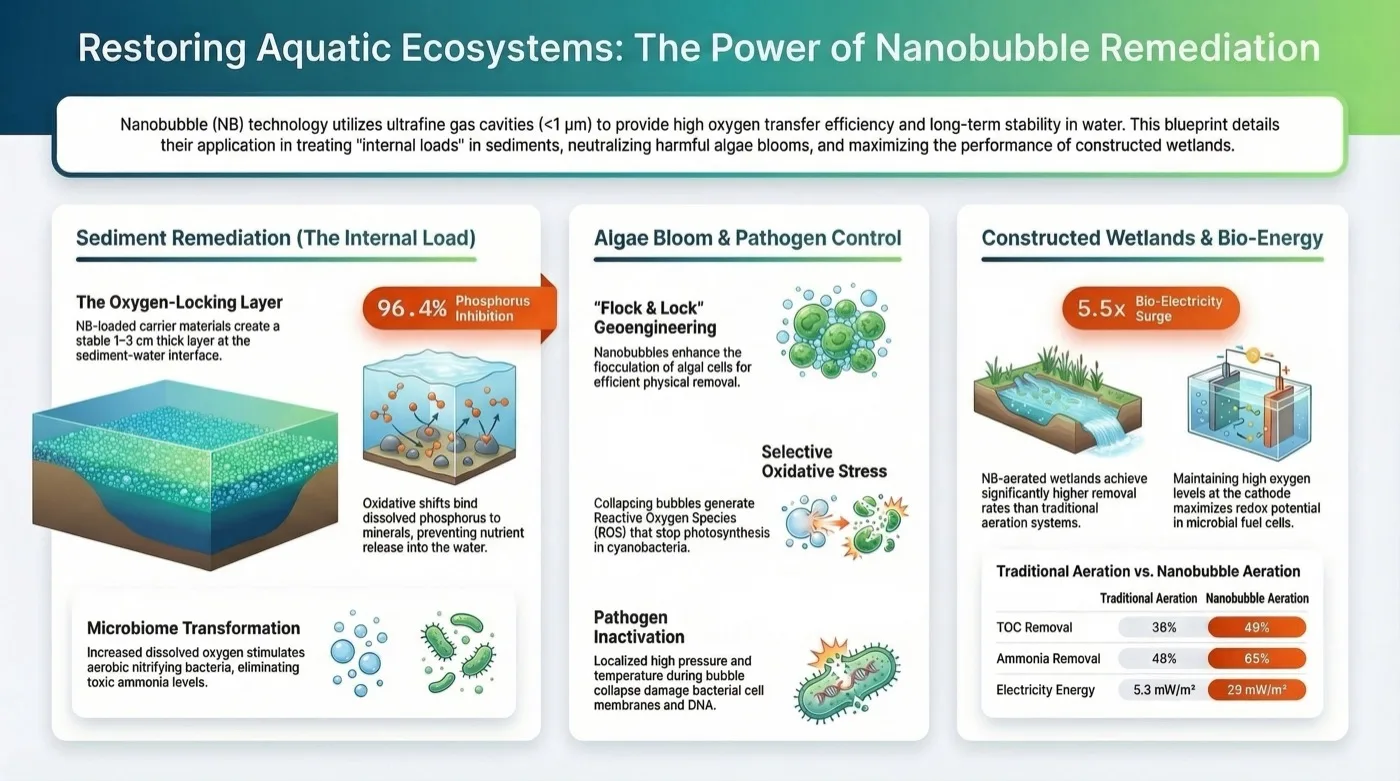
Penetration of the Sediment-Water Interface (SWI) A critical failure of traditional aeration is the inability to oxygenate the benthic layer where internal nutrient loading occurs. Nanobubble technology overcomes this by utilizing carrier materials (such as modified zeolites or local soils) loaded with ONBs.
- Mechanism: These ONB-loaded materials settle by gravity, penetrating the SWI to deliver oxygen directly to anoxic zones. This creates a stable "oxygen-locking layer" (approx. 1–3 cm thick) that persists for extended periods (weeks to months), effectively isolating the anoxic deep sediment from the water column Ali et al., 2023; Zhang et al., 2020.
- Control of Phosphorus (P): The introduction of ONBs shifts the redox potential (ORP) at the SWI from reducing to oxidizing. This oxidation converts soluble Ferrous iron (Fe^{2+}) into insoluble Ferric iron (Fe^{3+}), which strongly binds dissolved phosphorus to form iron-phosphate precipitates. This process significantly inhibits the "internal load" release of P from the mud back into the overlying water Zhang et al., 2018; Zhang et al., 2020.
Oxidation of Ammonia and Microbiome Activation The restoration of aerobic conditions modulates the benthic microbiome, shifting the metabolic pathways of nitrogen.
- Ammonia Oxidation: The high Oxygen Transfer Efficiency (OTE) of ONBs stimulates the activity of ammonia-oxidizing bacteria (AOB). This accelerates the nitrification process, converting toxic Ammonia (NH_4^+) into Nitrate (NO_3^-), thereby reducing nitrogen toxicity in the sediment Lyu et al., 2023.
- Microbiome Modulation: Research indicates that interfacial ONBs manipulate the microbial community responsible for pollutant transformation. For example, in arsenic-contaminated sediments, ONBs stimulated specific microbial oxidizers that converted toxic As(III) into less toxic As(V) and methylated species. The presence of ONBs also promotes the generation of hydroxyl radicals (^\• OH) via the oxygenation of reduced substances (like humic acids) in the sediment, further driving the oxidative detoxification of pollutants Tang et al., 2021; Ali et al., 2023.
2. Algae Bloom Control
Mitigation of Eutrophication and HABs Nanobubbles offer a dual-action strategy for controlling Harmful Algal Blooms (HABs): reducing the nutrient triggers (as detailed in section 1) and directly removing existing biomass.
- Physical Removal (Flotation/Flocculation): When integrated with "Flock & Lock" geoengineering approaches (using modified soils), nanobubbles enhance the flocculation of algal cells. While microbubbles are often used for flotation, nanobubbles can attach to hydrophobic cellular surfaces, increasing the efficacy of aggregation and subsequent sedimentation or separation, depending on the specific engineering setup Ali et al., 2023; Wang et al., 2023.
- Inhibition via Oxidative Stress: The collapse of nanobubbles generates Reactive Oxygen Species (ROS), such as hydroxyl radicals and superoxide anions. These ROS induce oxidative stress in cyanobacteria (e.g., Microcystis aeruginosa), damaging cell membranes and inhibiting photosynthesis. Studies have shown that while appropriate NB levels promote aquatic plant growth, excessive NB concentrations (e.g., >3.45 \\times 10^7 particles/mL for Iris pseudacorus) can inhibit growth, suggesting a threshold that can be manipulated to target algal blooms while protecting submerged macrophytes Wang et al., 2021; Zhang et al., 2021.
3. Microbial Fuel Cells (MFC) & Wetlands
Enhancement of Constructed Wetlands (CWs) A novel application of nanobubble technology is its integration into Constructed Wetlands coupled with Microbial Fuel Cells (CW-MFC), addressing the limitation of low oxygen availability in traditional subsurface flow wetlands.
- Pollutant Removal: Nanobubble aeration significantly enhances the removal efficiency of organics and nutrients. In livestock wastewater treatment trials, NB-aerated CWs achieved significantly higher removal of Total Organic Carbon (TOC) and Ammonium (NH_4^+-N) compared to traditional aeration. This is attributed to the high mass transfer of oxygen supporting vigorous aerobic biofilm growth on the substrate Lyu et al., 2023.
- Bio-Energy Generation: In CW-MFC systems, bacteria oxidize organic matter at the anode and transfer electrons to the cathode, where oxygen is required as the electron acceptor. Nanobubble aeration maintains high Dissolved Oxygen (DO) levels at the cathode, thereby maximizing the redox potential difference. This results in higher bio-electricity generation density and improved system stability compared to conventional aeration methods Lyu et al., 2023.