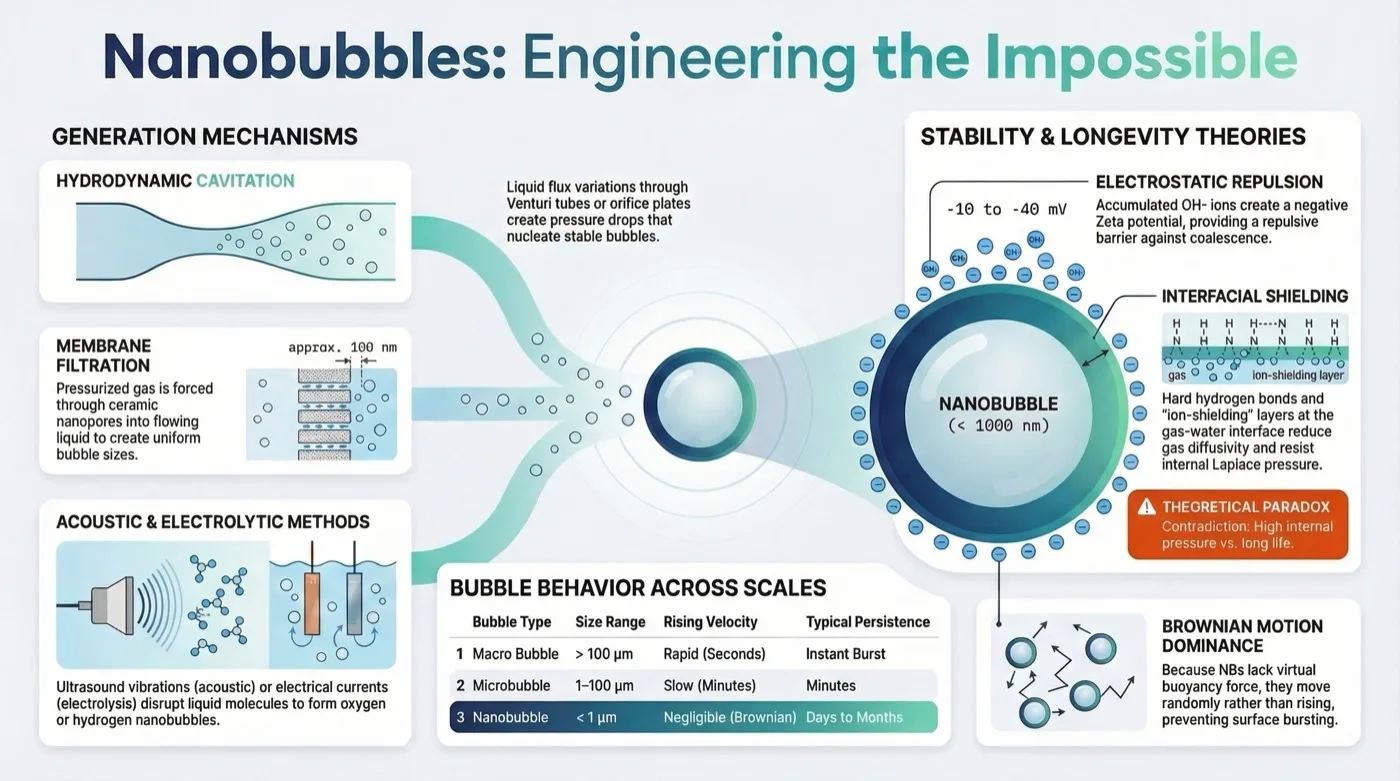
1. Generation Mechanisms
The generation of bulk nanobubbles (NBs) is primarily achieved through cavitation and membrane-based methods.
- Hydrodynamic Cavitation:
This is a widely adopted, energy-efficient method suitable for scaling up. It functions based on the Bernoulli principle: as liquid passes through a constriction, its velocity increases while static pressure decreases. If the local pressure drops below the saturated vapor pressure of the liquid, cavities (bubbles) form Ahmed et al., 2018; Akshit et al., 2020. - Venturi Tubes:
A common device for this method involves a conical convergent zone where liquid accelerates, creating a negative pressure zone that sucks in gas. The gas-liquid mixture is subjected to intense hydraulic shear, fragmenting gas into micro-nanobubbles Zheng & Shang, 2025; Li et al., 2021. - Swirling/Rotational Flow:
This technique creates a vortex-like cavity. High-speed rotation generates a low-pressure zone where NBs nucleate Li & Huang, 2023; Alam et al., 2021. During generation, the solution often turns "milky" due to microbubbles, which then rise and burst, leaving behind a transparent suspension of stable NBs Foudas et al., 2023. - Ceramic Membrane Method:
This method involves forcing pressurized gas through a porous ceramic membrane (e.g., with 100 nm pores) into a flowing liquid. - Mechanism:
The gas pressure must overcome the capillary pressure of the pores ("bubble point"). Shear force from the flowing liquid detaches the bubbles from the membrane surface Wang & Wang, 2023. - Control:
The size of the NBs is directly influenced by the membrane pore size, the hydrophobicity of the membrane surface, and the gas injection pressure. Higher injection pressures can yield smaller bubbles Ahmed et al., 2018; Phan et al., 2021.
2. Stability Theories
According to the Young-Laplace equation, NBs should dissolve in microseconds due to immense internal pressure. However, they persist for months. Several theories explain this paradox:
- Ion Shielding / Surface Charge (Bubston Model): NBs in pure water possess a negatively charged interface (due to OH^- adsorption). This charge attracts positive counterions, forming an Electric Double Layer (EDL). The electrostatic repulsion between ions on the bubble surface acts as an outward pressure that counteracts the inward surface tension (Laplace pressure), preventing collapse Nirmalkar et al., 2018; Bunkin et al., 2025.
- The "Skin" Model: This theory suggests that organic contaminants, surfactants, or solid particles adsorb to the gas-liquid interface, forming a rigid or semi-rigid "skin." This shell reduces surface tension and acts as a physical barrier to gas diffusion, thereby inhibiting dissolution Yasui et al., 2019; Jin & Gu, 2022.
- Supersaturation and Dynamic Equilibrium: This model proposes that the gas influx and outflux across the bubble interface reach a dynamic equilibrium. This is often supported by local gas supersaturation in the liquid surrounding the bubble, or hydrophobic surface interactions that trap gas, preventing net diffusion out of the bubble Akshit et al., 2024; Lasek et al., 2023.