1. Growth Rate Acceleration
Biomass and Weight Gain Statistics
Application of nanobubbles (NBs) has demonstrated statistically significant improvements in the final body weight and total biomass of cultured species, driven by the maintenance of optimal dissolved oxygen (DO) saturation.
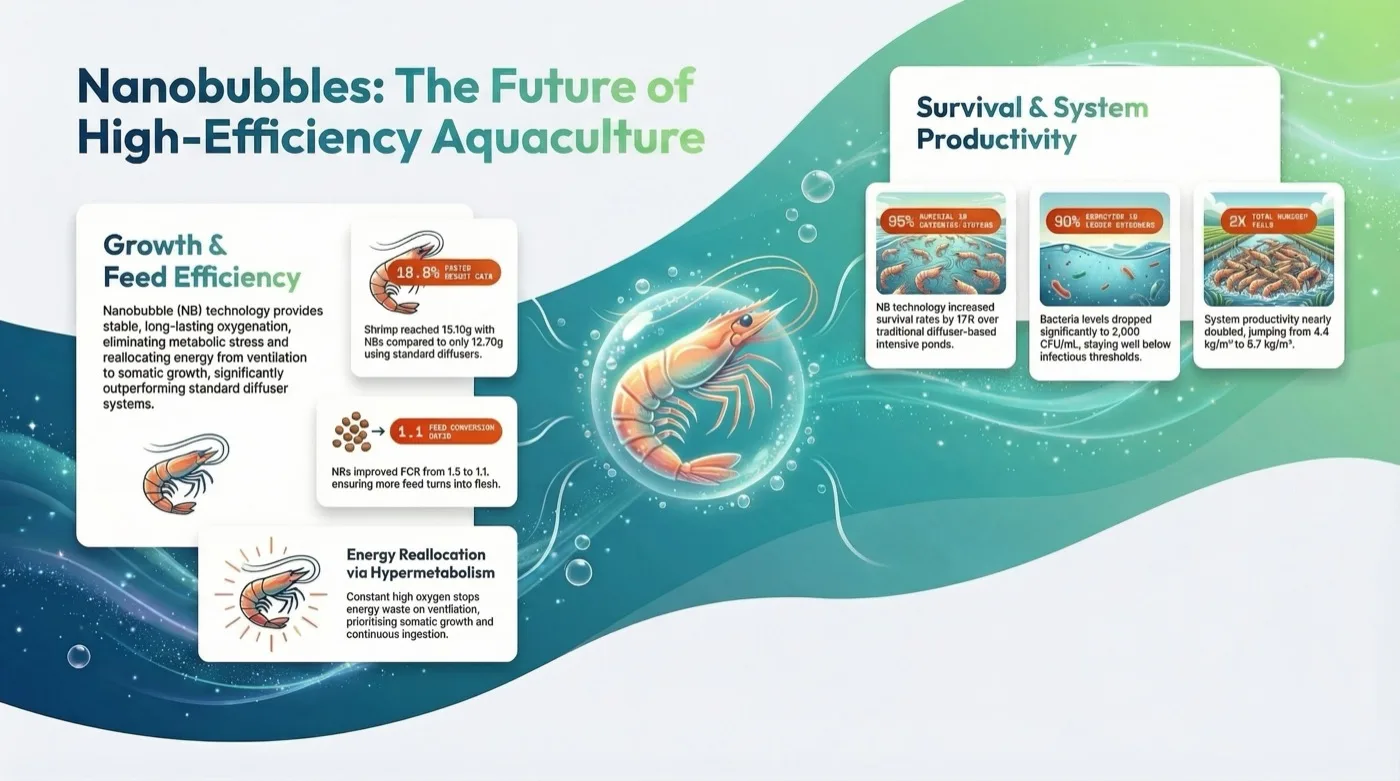
- Shrimp (Penaeus vannamei): In an 81-day indoor raceway trial, shrimp reared in nanobubble-treated ponds achieved a significantly higher average final weight of 15.10 g (±1.79) compared to 12.70 g (±1.83) in control ponds using standard diffuser aerators. This represents an approximate 18.9% increase in individual body mass. Additionally, the average length of the shrimp increased from 11.55 cm (control) to 13.10 cm (NB) Rahmawati et al., 2021.
- Finfish (Sweetfish and Rainbow Trout): In comparative trials, the total biomass of Sweetfish increased from an initial 3.0 kg to 10.2 kg in air-NB water, compared to only 6.4 kg in normal water (a 59% increase in final biomass). Similarly, Rainbow trout biomass increased from 50.0 kg to 148.0 kg in NB water versus 129.5 kg in normal water over 6 weeks Ebina et al., 2013.
Metabolic Mechanisms: Hypermetabolism and Energy Allocation
The mechanism driving this accelerated growth is rooted in bioenergetics and metabolic efficiency rather than a direct hormonal intervention (such as exogenous IGF-1 application), although IGF-1 pathways may be indirectly stimulated by improved physiological status.
- Metabolic Rate & Energy Budget: High oxygen availability via NBs allows aquatic animals to enter a "hypermetabolic state" where digestion and absorption rates are maximized. In hypoxic or normoxic conditions, a significant portion of an animal's energy budget is expended on respiration (ventilation). Under NB-induced hyperoxia/normoxia, the low demand for breathing allows a greater proportion of metabolized energy to be reallocated toward somatic growth Ebina et al., 2013.
- Digestion Physiology: For Penaeus vannamei, oxygen levels are a decisive factor in metabolism. If the energy cost associated with consuming and processing food cannot be met by available oxygen, the shrimp cease feeding to conserve energy. NBs ensure that oxygen is never a limiting factor, allowing for continuous and efficient processing of ingested nutrients Rahmawati et al., 2021.
2. Feed Conversion Ratio (FCR)
Evidence of Improved Efficiency
Nanobubble technology significantly lowers the Feed Conversion Ratio (FCR), indicating that less feed is required to produce a unit of biomass. This is a critical metric for the economic sustainability of intensive aquaculture.
- Data Point: In the Penaeus vannamei study, the FCR in NB-treated ponds was 1.1, whereas the control ponds using diffusers had an FCR of 1.5. This indicates a substantial improvement in nutrient utilization efficiency Rahmawati et al., 2021.
Physiological Explanation: Digestion Efficiency
The reduction in FCR is attributed to the enhanced oxidative capacity of the gut and the general metabolic environment.
- Digestion Efficiency: Aquatic species are unable to digest food effectively in low oxygen environments because digestion is an aerobically demanding process. By maintaining stable high DO levels, NBs prevent the metabolic suppression that occurs during oxygen dips (common after feeding), thereby ensuring that feed is converted to flesh rather than wasted or excreted Rahmawati et al., 2021.
- Feed Intake: The optimal oxygen environment promotes an increase in feed intake appetite while simultaneously ensuring the metabolic machinery is available to process it, preventing the "stop-eating" response observed in stressed animals Rahmawati et al., 2021.
3. Survival Rates
Comparative Statistics in Intensive Systems
Survival rates (SR) are a primary indicator of environmental stress and pathogen load. NBs drastically improve SR by mitigating both hypoxic stress and bacterial proliferation.
- Shrimp Survival: In intensive P. vannamei culture (stocking density 680 shrimp/m³), the survival rate in NB-treated ponds reached 95%, compared to only 78% in the control ponds aerated with diffusers Rahmawati et al., 2021.
- Total Harvest Impact: Consequently, the total harvest weight in the NB ponds was nearly double that of the control (436 kg vs. 222 kg), and productivity increased to 8.7 kg/m³ compared to 4.4 kg/m³ in the control Rahmawati et al., 2021.
Mechanisms of Survival Enhancement
- Pathogen Reduction: High oxygen levels and the presence of NBs induced bacterial autolysis and reduced sludge production. Specifically, Total Vibrio Bacteria (TVB) counts in NB ponds were significantly lower (2.0 × 10³ CFU/mL) compared to diffuser ponds (1.9 × 10⁴ CFU/mL), keeping pathogen loads below the infectious threshold Rahmawati et al., 2021.
- Immune Support: While not the primary focus of the Rahmawati paper, supporting literature suggests that consistent oxygen levels enhance immune parameters such as phagocytosis and phenoloxidase activity, providing higher resistance to pathogens Rahmawati et al., 2021; Ebina et al., 2013.