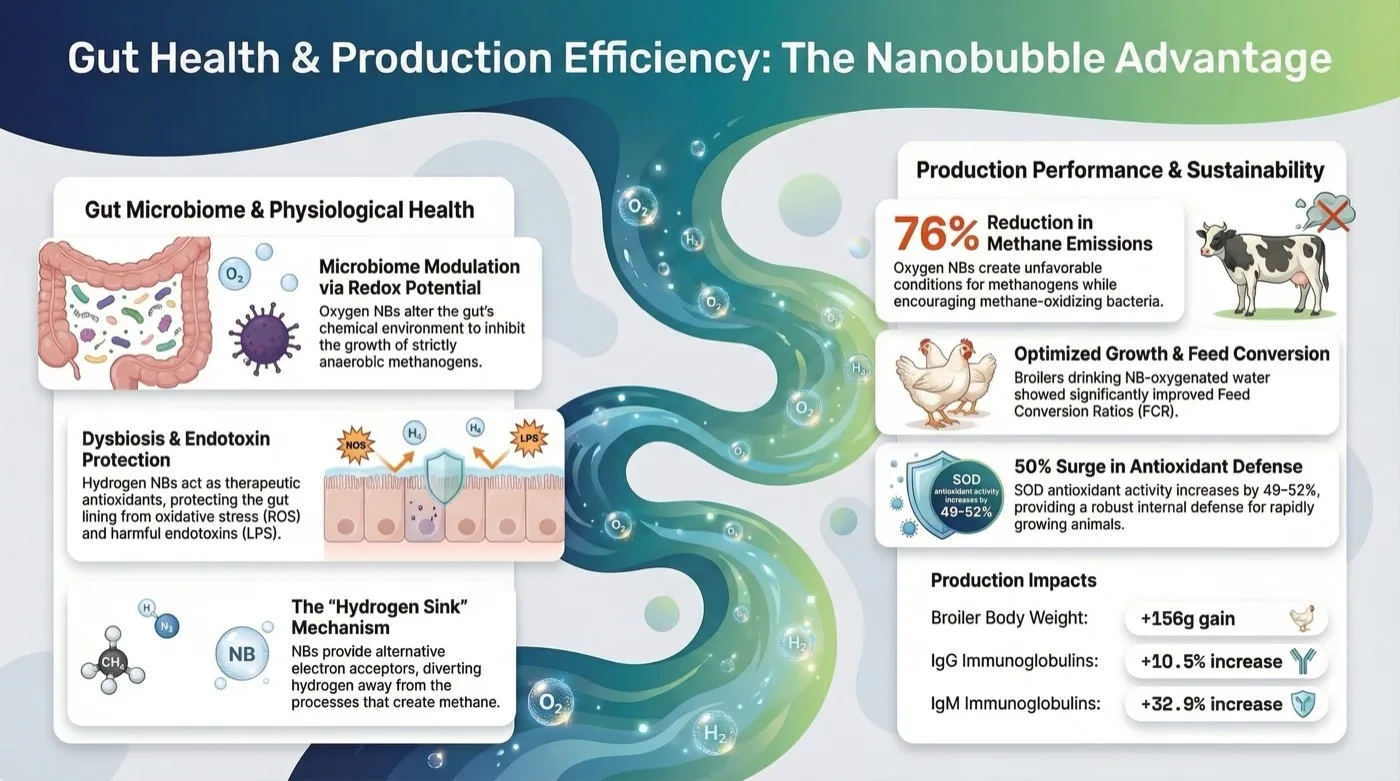
1. Rumen/Gut Microbiome Modulation
The introduction of oxygenated or hydrogen-rich water influences the fermentation environment by altering the redox potential, which is a critical determinant of microbial population dynamics.
- Mechanism: Rumen methanogens are strictly anaerobic archaea. The introduction of oxygen via nanobubbles can inhibit their activity. Research indicates that altering electron acceptors or introducing oxygen can shift the fermentation pathway. While not testing NBs directly, Patra & Yu establish that methanogens are extremely sensitive to oxygen and that interventions increasing redox potential can inhibit methanogenesis while shifting fermentation towards propionate, which is energetically more favorable for the host Patra & Yu, 2017.
- Balance of Bacteria: Dysbiosis (microbial imbalance) in the rumen, often caused by high-energy diets, leads to an increase in Gram-negative bacteria and the release of endotoxins (LPS), which triggers inflammation and reduces performance Khiaosa-ard & Zebeli, 2014. Hydrogen nanobubble water (HNW) has been shown to act as a therapeutic antioxidant, potentially neutralizing reactive oxygen species (ROS) generated during metabolic stress, thereby protecting the gut lining and maintaining a healthy microbial balance Shin & Shim, 2016.
2. Methane Emission Reduction
Mitigating enteric methane (CH_4) is critical for sustainability. The mechanism by which oxygen nanobubbles (ONBs) reduce methane involves the manipulation of the aerobic/anaerobic interface.
- Mechanism: Methanogens utilize H_2 and CO_2 to produce methane. By delivering oxygen via nanobubbles, the environment becomes less favorable for methanogens (which require strict anaerobiosis) and encourages the growth of methanotrophs (methane-oxidizing bacteria). Studies on sediment-water interfaces have shown that ONBs can significantly decrease methanogen abundance while increasing methanotroph abundance, thereby recycling carbon as CO_2 rather than the more potent GHG CH_4 Shi et al., 2018.
- Hydrogen Sink: Furthermore, anti-methanogenic strategies often rely on creating alternative hydrogen sinks. Oxygen provided by NBs can act as an electron acceptor, diverting hydrogen away from methanogenesis Patra & Yu, 2017.
3. Growth Performance and Immune Response
Empirical data from poultry studies confirms that water treated with oxygen or hydrogen nanobubbles significantly enhances production metrics.
- Growth and FCR: In broiler chickens, supplementation with Oxygenated Nanobubble Water (ONW) for five weeks resulted in a significant increase in final body weight (156 g higher than control) and improved the Feed Conversion Ratio (FCR). Specifically, birds in the ONW group showed improved feed efficiency and reduced abdominal fat accumulation compared to controls consuming tap water Shin & Shim, 2016.
- Immune Response: ONW supplementation significantly enhanced the generation of immunoglobulins IgG (up 10.58%) and IgM (up 32.97%) in broilers. This suggests that NB-treated water boosts the humoral immune system, potentially by stimulating B cells via altered redox status or interleukin-10 (IL-10) production Shin & Shim, 2016.
- Antioxidant Status: Both ONW and HNW significantly increased the activity of Superoxide Dismutase (SOD) in serum (by 49–52%) and breast muscle tissue. This indicates that NB water acts as an antioxidant therapy, reducing oxidative stress in rapidly growing animals Shin & Shim, 2016.