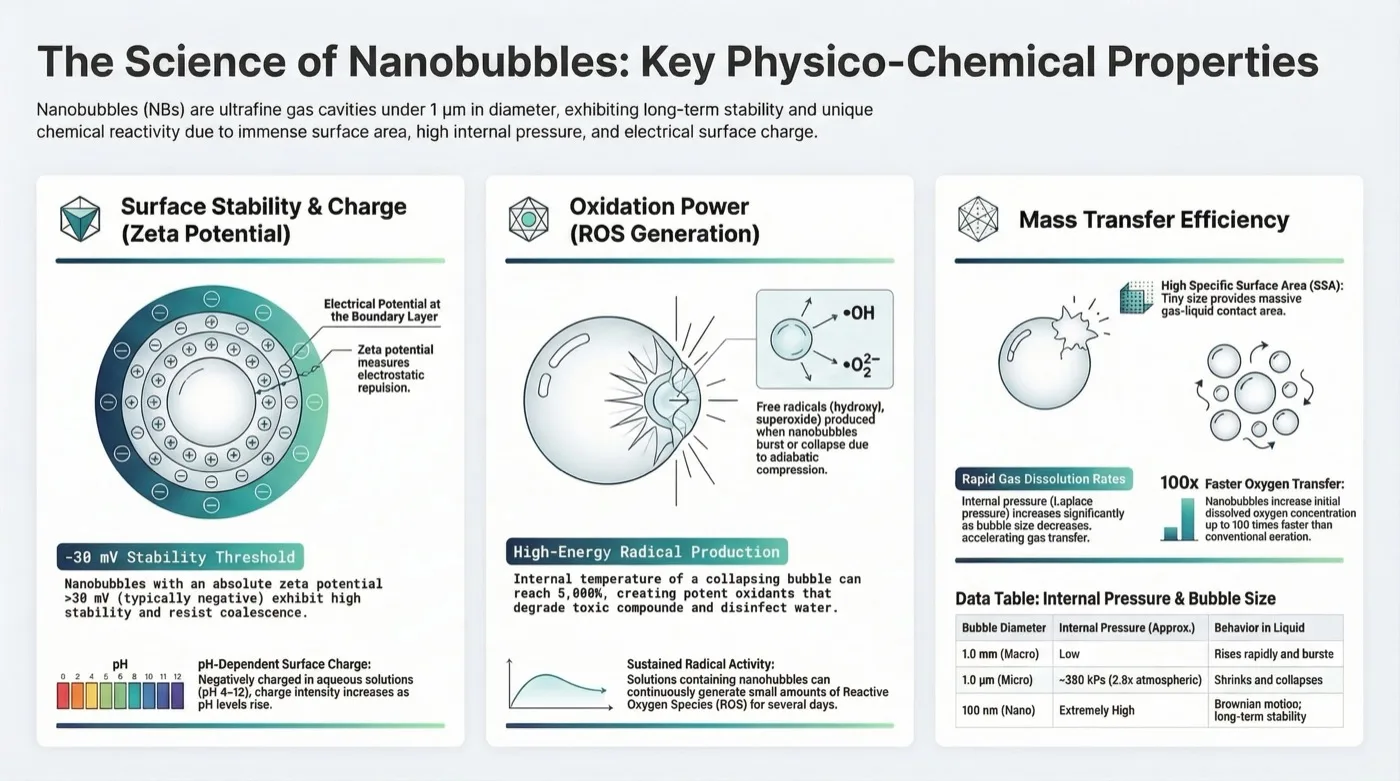
1. Zeta Potential (Surface Charge)
- Findings: NBs exhibit a high negative Zeta potential, typically ranging from −20 mV to −50 mV in neutral pH conditions. This charge arises largely from the preferential adsorption of hydroxide ions (OH^-) at the gas-liquid interface Hewage & Meegoda, 2021; Ushikubo et al., 2010.
- Significance: The Zeta potential is a critical indicator of stability. High absolute values (>30 mV) generate strong electrostatic repulsive forces between bubbles, preventing coalescence and aggregation, which allows them to remain dispersed for long periods Akshit et al., 2024; .
- Factors: The magnitude of the potential is influenced by pH (becoming less negative or positive in acidic conditions), gas type (Ozone NBs often have higher magnitude potentials), and ionic strength Ahmed et al., 2018; Takahashi et al., 2021.
2. Reactive Oxygen Species (ROS) Generation
- Radicals Generated: The primary radical generated is the hydroxyl radical (\\cdot OH), although superoxide anions (O_2^{\\cdot -}) and singlet oxygen (^1O_2) are also reported Liu et al., 2016; Takahashi et al., 2007.
- Conditions for Generation: ROS are produced during the collapse of bubbles.
- Mechanism 1 (Adiabatic Compression): Rapid shrinking of the bubble causes extreme localized heating (up to 5000 K) and pressure, causing the thermal decomposition of water vapor into radicals Agarwal et al., 2011; Akshit et al., 2024.
- Mechanism 2 (Ionic Accumulation): As a bubble shrinks, the charge density of ions (specifically H^+ and OH^-) at the interface increases drastically. When the bubble collapses, this accumulated electrical energy dissipates, triggering radical formation Takahashi et al., 2021; Farid et al., 2022.
3. Mass Transfer Efficiency
- High Efficiency: NBs exhibit significantly higher mass transfer rates compared to macrobubbles. This is driven by their exceptionally large Specific Surface Area (SSA) relative to their volume Akshit et al., 2024; Fan et al., 2010.
- Internal Pressure: The high internal pressure (Laplace pressure) of NBs increases the solubility of the gas in the surrounding liquid (Henry's Law), enabling the creation of supersaturated solutions without rapid off-gassing Ebina et al., 2013; Xue et al., 2022.