1. Enhanced Leaching (Bioleaching & Heap Leaching)
Accelerated Sulfide Oxidation via High Dissolved Oxygen (DO) The primary limitation in the bioleaching of metal sulfides (e.g., pyrite, chalcopyrite) is the low solubility of oxygen in aqueous solutions, which restricts the oxidation rate. Nanobubbles address this by providing a high mass transfer efficiency and sustaining elevated Dissolved Oxygen (DO) levels significantly longer than conventional aeration.
- Mechanism: In systems treating sulfide-rich concentrates, the oxygen demand is extreme. Conventional air sparging often fails to maintain adequate DO (>5 ppm) without excessive energy costs. Nanobubbles, particularly those enriched with oxygen (or ozone), overcome solubility limits (Henry's Law) by acting as a dense gas reservoir that continuously replenishes liquid-phase oxygen as it is consumed Guezennec et al., 2017.
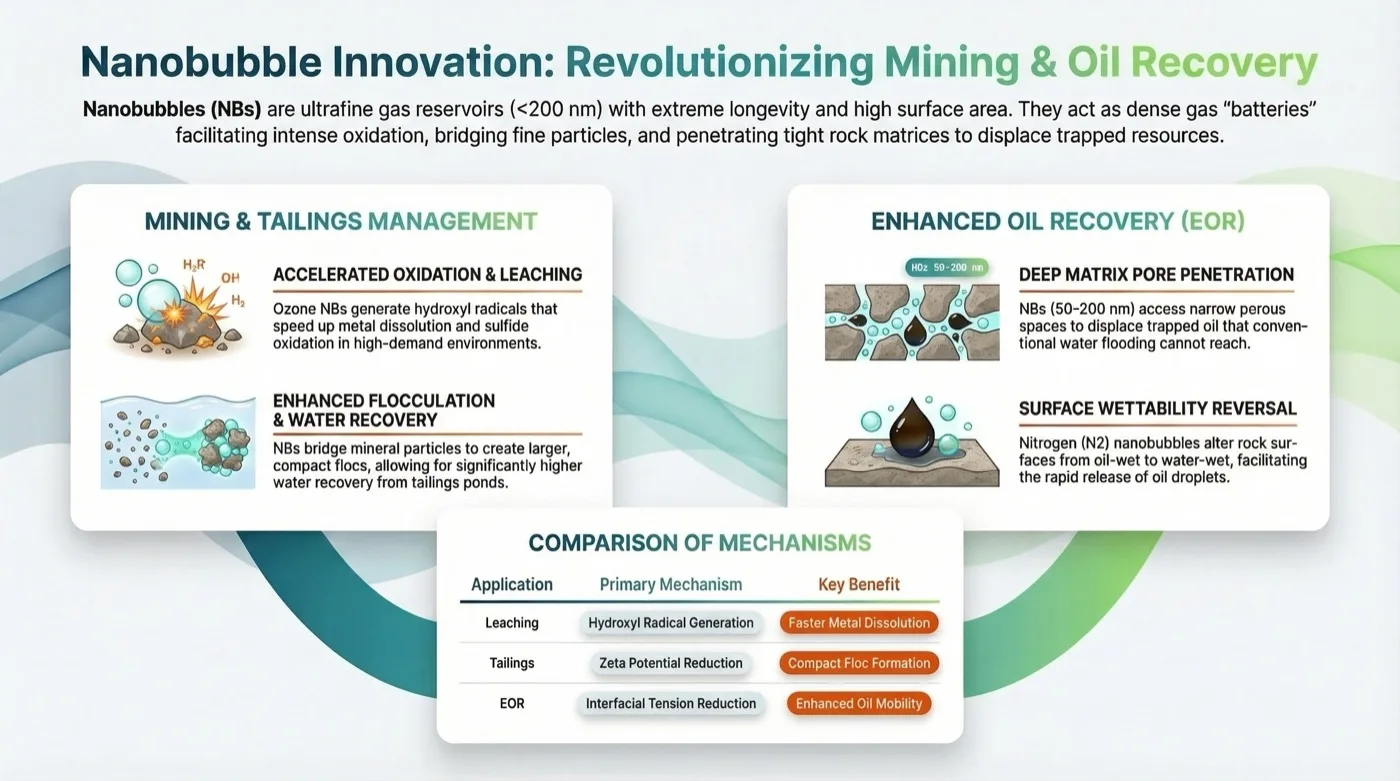
- Pyrite/Chalcopyrite Oxidation: For oxidative leaching, such as uranium recovery from sandstone or pyrite breakdown, Ozone Micro-Nanobubbles (OMNBs) have shown potent oxidizing capacity. OMNBs accelerate the dissolution of target metals and the oxidation of associated sulfides by generating hydroxyl radicals (^\• OH) and maintaining high oxidation-reduction potentials (ORP) Fang et al., 2025.
Supporting Bioleaching Microorganisms High DO levels are critical for the metabolic activity of chemolithotrophic bacteria (e.g., Acidithiobacillus spp.) which utilize oxygen as the final electron acceptor during the oxidation of ferrous iron (Fe^{2+}) and reduced sulfur compounds.
- Microbial Efficiency: Guezennec et al. demonstrated that maintaining DO concentrations between 4 and 18 ppm under an oxygen-enriched atmosphere significantly supports the bioleaching efficiency of mesophile and moderate thermophile consortia. Unlike conventional systems where oxygen depletion leads to microbial dormancy, NB-facilitated oxygenation ensures continuous microbial activity even under high solid loading conditions (e.g., 20% w/w solids), thereby maximizing sulfide dissolution yields Guezennec et al., 2017.
2. Tailings Dewatering & Flocculation
Nanobubble-Assisted Settling of Fines In tailings management, the slow settling of ultrafine particles (<20 µm) in ponds is a major bottleneck. Nanobubbles, when combined with flocculants, alter the hydrodynamic and surface properties of these fines to enhance solid-liquid separation.
- Bridging Mechanism: Nanobubbles can bridge particles to form larger, denser flocs. When used in conjunction with polymeric flocculants like Polyacrylamide (PAM), NBs adsorb onto the mineral surfaces, reducing the absolute value of the Zeta potential (reducing electrostatic repulsion) and acting as nucleation points for polymer attachment. This "ballasting" effect creates aggregates that settle faster than those formed by PAM alone, improving the clarity of the supernatant water Li and Bu, 2024; Azevedo et al., 2019.
- Water Recovery: The formation of compact, aerated flocs facilitates rapid drainage and consolidation of the sludge. This mechanism is particularly effective for clay-rich tailings (e.g., kaolin), allowing for significantly higher water recovery rates from tailings ponds, which can then be recycled back into the plant Li and Bu, 2024.
3. Energía: Recuperación Mejorada de Petróleo (EOR)
Revitalizing Mature Wells with Gas Nanobubbles Nanobubble technology offers a novel approach for Enhanced Oil Recovery (EOR) in mature and tight reservoirs where traditional water flooding is ineffective due to high capillary entry pressures.
- Mechanism of N2 and CO2 Injection:
- Pore Penetration: Unlike macrobubbles, gas nanobubbles (typically 50–200 nm) are smaller than the pore throats of low-permeability rocks (tight formations). This allows them to penetrate deep into the reservoir matrix, displacing trapped oil that water cannot reach Elnaggar et al., 2025.
- Wettability Alteration: Nitrogen (N_2) nanobubbles have been proven to alter the wettability of rock surfaces from oil-wet to water-wet. This change releases oil droplets adhered to the rock surface, significantly enhancing recovery rates via spontaneous imbibition Elnaggar et al., 2025.
- Viscosity Reduction: Carbon Dioxide (CO_2) nanobubbles dissolve into the crude oil, causing it to swell and reducing its viscosity. This improves the mobility ratio, allowing the oil to flow more easily toward the production well. Studies indicate that CO2 nanobubble systems are effective even in extra-low-permeability reservoirs Cai et al., 2024.
Performance Evidence
- Recovery Enhancement: Experimental core-flooding and imbibition tests on Berea sandstone and carbonates show that N_2 nanobubble solutions yield significantly higher oil recovery compared to distilled water flooding alone. The highest enhancement was observed in oil-wet carbonate samples under high-temperature conditions (120 °C), validating the technology's robustness for harsh reservoir environments Elnaggar et al., 2025.