1. Fine and Ultrafine Particle Recovery Mechanisms
1.1. The Collision & Attachment Probability
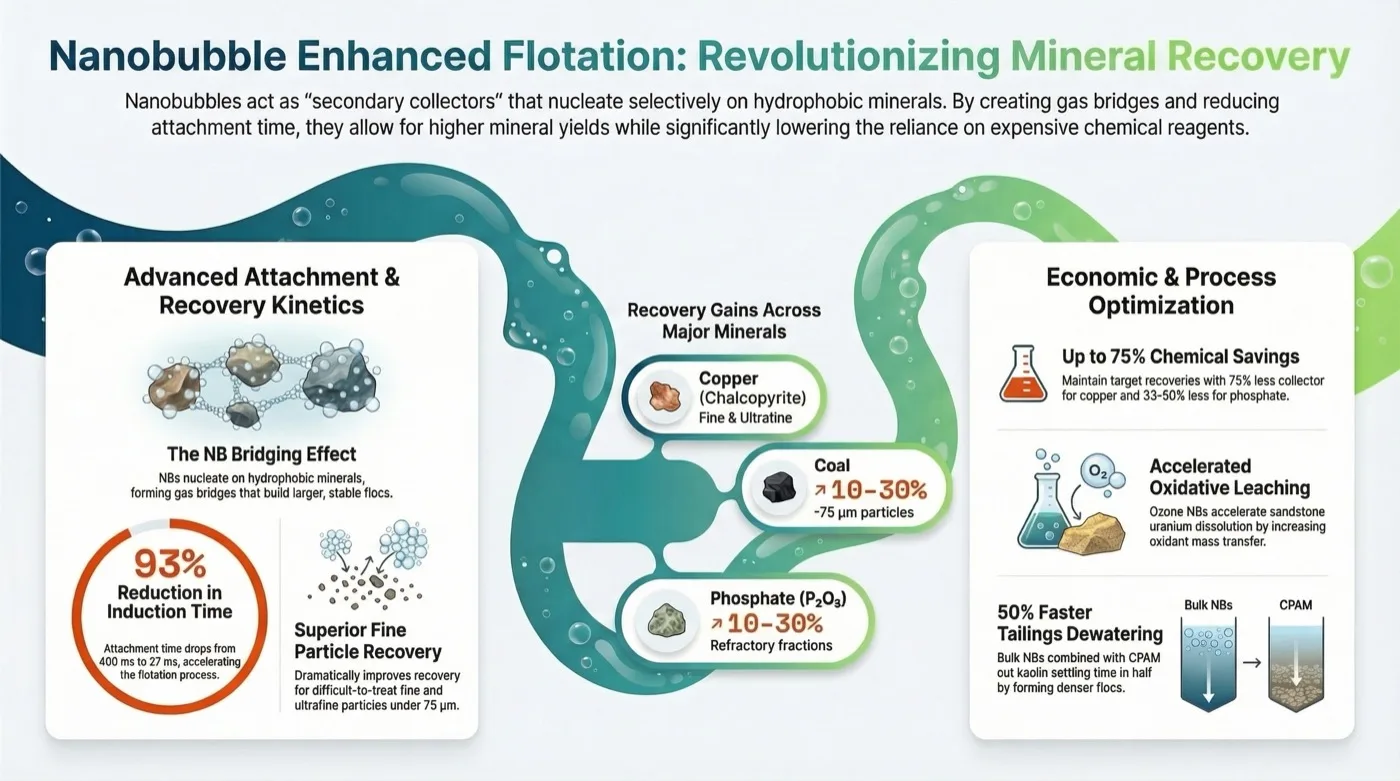
The Nanobubble Bridging Effect and Nucleation The recovery of fine particles (<20 µm) in conventional flotation is often limited by low collision probabilities and high detachment rates. Nanobubbles (NBs) overcome this by acting as a "secondary collector."
- Nucleation: NBs generated by hydrodynamic cavitation preferentially nucleate on hydrophobic mineral surfaces. This selective nucleation occurs because the work of adhesion between a solid particle and water is lower than the work of cohesion of water, particularly on hydrophobic surfaces Nazari et al., 2022.
- Bridging Mechanism: Once attached, NBs increase the apparent hydrophobicity of the particle. They act as a gas bridge (capillary bridge) between fine particles, promoting the formation of agglomerates (flocs) that are larger and easier to float. Furthermore, these surface NBs serve as nuclei or "seeds" for the attachment of larger conventional flotation bubbles (micro/macrobubbles). The attachment between an NB-coated particle and a macroscopic bubble is thermodynamically more favorable than the attachment of a bare particle to a bubble Rosa and Rubio, 2018; Azevedo et al., 2019.
Reduction in Induction Time The "induction time" defines the contact time required for a bubble to displace the water film and successfully adhere to a particle.
- Mechanism: The presence of NBs significantly reduces this induction time. When a macroscopic bubble approaches a particle surface "frosted" with NBs, the water film rupture is accelerated because the bubble is coalescing with an existing gas phase (the NB) rather than a solid–liquid interface.
- Data: In lignite flotation studies, the presence of interfacial NBs reduced the induction time from 400 ms to 27 ms and the attachment time from 208 ms to 128 ms, significantly enhancing the flotation rate Tao, 2022.
2. Recovery Rates (Case Studies)
Copper (Chalcopyrite/Molybdenite)
- Chalcopyrite: In laboratory-scale tests, the flotation recovery of fine (14–38 µm) and ultrafine (5–14 µm) chalcopyrite particles increased by approximately 16–21% in the presence of NBs compared to conventional flotation Azevedo et al., 2019.
- Real Ore Application (Chilean Porphyry): Recent studies on Chilean copper sulfide ores demonstrated that for low-clay ores (M1), NBs improved Copper recovery by up to 7.5% and Molybdenum recovery by 20%. However, in high-clay ores (M2), NBs negatively impacted recovery (decreasing ~5%) due to the intensification of non-selective slime coatings Ramírez-Madrid et al., 2025.
- Molybdenite Separation: Ozone NBs have been utilized to selectively separate molybdenite from chalcopyrite. The ozone NBs remove xanthate from the solution and generate hydrophilic species (CuO, Cu(OH)2) on the chalcopyrite surface, depressing it while allowing molybdenite to float Qiao et al., 2025.
Coal
- Recovery Improvement: The use of NBs in column flotation of fine coal increased combustible material recovery by 10–30% (up to 50% in some fine fractions) compared to conventional methods. Specifically, NBs allowed for the recovery of particles at the lower limit (minus 75 µm) which are typically lost Peng and Yu, 2015; Tao, 2022.
- Selectivity: NBs not only improved recovery but also maintained or improved the grade. For example, a combustible recovery of 85–90% was achieved with a clean coal ash content of 10–11% from a feed of 29.6% ash Peng and Yu, 2015.
Phosphate
- Coarse Particle Recovery: In the flotation of coarse phosphate (−1.18 + 0.425 mm), NBs increased P2O5 recovery by 10–30% for a given acid-insoluble rejection. This is critical as coarse phosphate is often lost in conventional circuits due to high detachment probabilities Fan et al., 2010.
- Tailings Reprocessing: When applied to apatite tailings, NBs (specifically with frother) improved mass recovery compared to conventional bubbles, suggesting a viable route for reprocessing waste streams without regrinding Chipakwe et al., 2021.
3. Reagent Reduction
Dosage Optimization via Nanobubbles There is substantial evidence that NBs allow for drastic reductions in chemical consumption while maintaining or improving metallurgical performance.
- Collector Reduction: In chalcopyrite flotation, NBs reduced collector consumption by up to 75% Azevedo et al., 2019. In phosphate flotation, collector dosage was reduced by 1/3 to 1/2 (e.g., from 0.7 kg/t to 0.4 kg/t) to achieve similar recovery targets Fan et al., 2010.
- Mechanism: NBs adsorbed on the particle surface act as a "secondary collector." By increasing the hydrophobicity of the mineral surface (increasing the contact angle), NBs reduce the reliance on chemical collectors to render the surface hydrophobic. Additionally, in fine particle flotation, NBs combined with reduced reagents (50% collector/60% frother reduction) still achieved recoveries >75% by extending the three-phase contact line and enhancing capillary attraction Dutta et al., 2025.
4. Mining: Leaching and Tailings Management
Leaching (Lixiviación)
- Uranium and Oxidative Leaching: The application of Ozone micro-nanobubbles (O3-MNBs) has been shown to enhance the oxidative leaching of sandstone uranium ores. O3-MNBs provide a high mass transfer of oxidant into the liquid phase, accelerating the dissolution of target metals and the oxidation of associated sulfides like pyrite. This is particularly relevant for heap leaching operations where oxygen availability is a limiting factor for reaction kinetics Fang et al., 2025.
- Mechanism: The high internal pressure and longevity of NBs allow for sustained high dissolved oxygen (or ozone) levels, facilitating the oxidation of refractory ores and potentially replacing more expensive oxidants Tao, 2022.
Tailings Management (Manejo de Relaves)
- Flocculation and Dewatering: Bulk nanobubbles significantly enhance the solid-liquid separation of fine tailings (e.g., kaolin suspensions). When combined with cationic polyacrylamide (CPAM), NBs reduced the settling time and supernatant zone height by over 50% compared to CPAM alone.
- Mechanism: NBs reduce the zeta potential of particles (e.g., shifting kaolin from −20 mV to −10 mV), reducing inter-particle repulsion. They also bridge particles together, forming denser flocs that settle faster. Furthermore, NBs lower the filter cake resistance, improving the dewatering rate and recovering more water from the sludge Li and Bu, 2024.