1. DO Levels in Nutrient Solutions
Stability and Supersaturation vs. Traditional Aeration
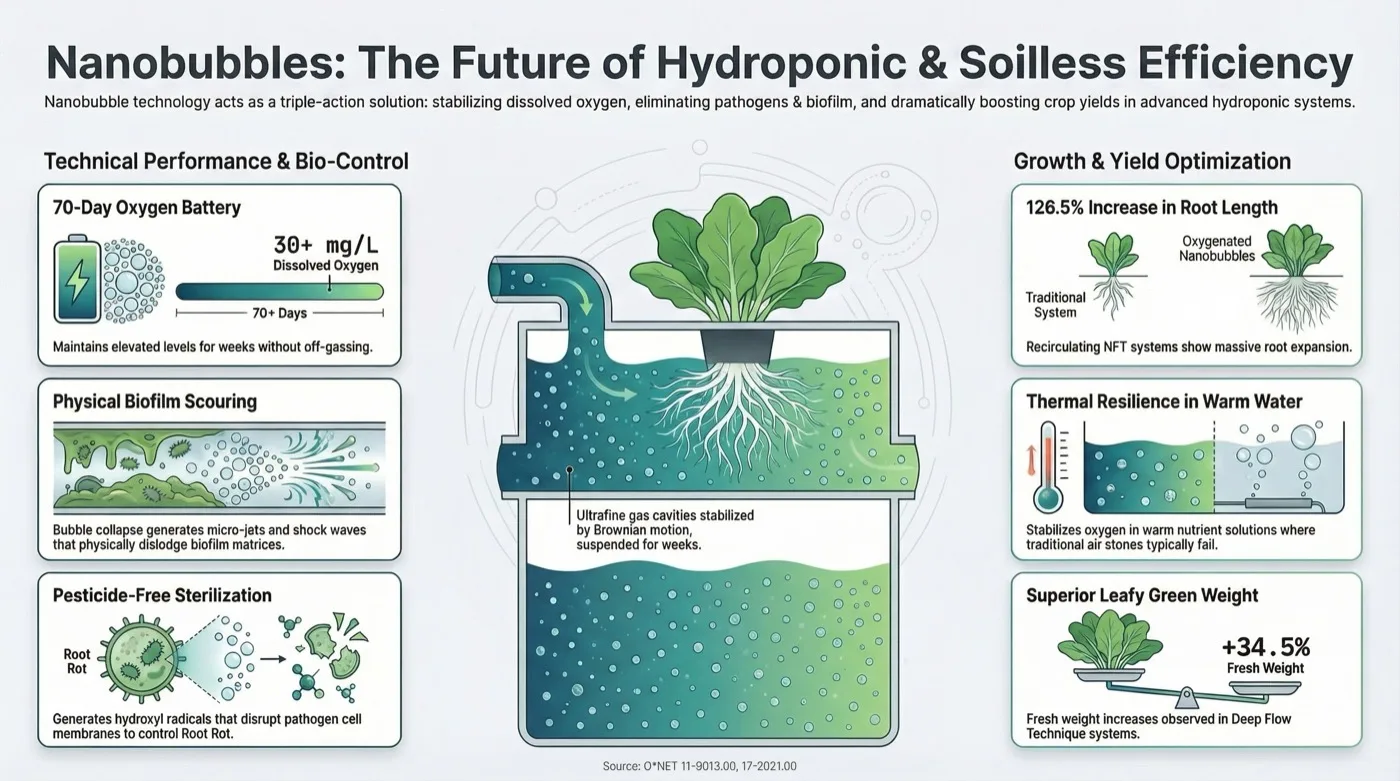
Conventional aeration using air stones generates macro- and microbubbles (1–100 µm) that rise rapidly to the surface and burst, resulting in poor gas transfer efficiency and short residence time. In contrast, nanobubbles (<200 nm) exhibit negligible buoyancy and follow Brownian motion, allowing them to remain suspended in the nutrient solution for weeks or even months without off-gassing Ebina et al., 2013.
- Operational Advantage: NBs can achieve oxygen supersaturation (e.g., increasing DO from ~8 mg/L to >30 mg/L) rapidly. Unlike macrobubbles, which lose oxygen to the atmosphere almost immediately, oxygen nanobubbles (ONBs) maintain elevated DO levels for extended periods (up to 70 days in some trials), acting as an "oxygen battery" within the reservoir Ebina et al., 2013.
Performance in Warm Nutrient Solutions
A critical challenge in hydroponics is the inverse relationship between water temperature and oxygen solubility (Henry’s Law). As nutrient solution temperatures rise (common in greenhouse environments), available DO for roots typically plummets, causing hypoxic stress.
- Thermal Stability: Nanobubbles demonstrate high stability even in varying thermal conditions. Research indicates that NBs are a promising method for retaining DO levels in outdoor hydroponics, specifically in high-temperature climates where traditional aeration fails to maintain adequate oxygenation Foudas et al., 2023.
2. Biofilm and Pathogen Control
Mechanism of Biofilm Removal
Biofilms in irrigation pipes and root surfaces harbor pathogens and clog emitters. NBs remove these films through a dual mechanism of physical abrasion and chemical oxidation.
- Physical Abrasion: NBs induce turbulence and shear forces at the liquid-solid interface. The vibrational motion and eventual collapse of NBs generate micro-jets and shock waves that physically dislodge extracellular polymeric substances (EPS) and detach biofilm matrices from pipe walls and root surfaces Babu & Amamcharla, 2023; Xiao et al., 2021.
- ROS Generation: The collapse of NBs generates mild amounts of Reactive Oxygen Species (ROS), specifically hydroxyl radicals (^\• OH). These radicals possess strong oxidative capabilities that degrade the organic components of the biofilm (proteins and polysaccharides) and disrupt bacterial cell membranes Shiroodi et al., 2021; Xiao et al., 2020.
Root Rot Control (Pythium and Phytophthora)
NBs offer a pesticide-free strategy for managing oomycete pathogens that thrive in hypoxic, stagnant zones.
- Pythium spp.: In hydroponic systems, oxygen treatment delivered via bubbling has been shown to significantly reduce Pythium colonization on tomato roots. NBs enhance this by maintaining high aerobic conditions that favor beneficial microbes over pathogenic anaerobes Mamun & Islam, 2025.
- Phytophthora spp.: High DO levels (6.6–7.4 mg/L) consistently lower plant susceptibility to Phytophthora infections compared to low oxygen conditions (<1 mg/L). By preventing hypoxia, NBs strengthen the plant's natural immune response and create an environment hostile to zoospores Mamun & Islam, 2025. Additionally, Ozone NBs can be used for sterilization of nutrient solutions to directly inactivate these pathogens without damaging plants if dosed correctly Tamaki et al., 2020.
3. Growth Results in Soilless Media
Yield Improvements in Hydroponic Lettuce
Application of NBs in deep flow technique (DFT) and nutrient film technique (NFT) systems has shown consistent yield improvements for leafy greens.
- Biomass Increase: In comparative trials, air-NB treated lettuce exhibited a 27% to 34.5% increase in aerial fresh weight compared to controls using standard aeration. Significant improvements were also recorded in plant height and leaf length Ebina et al., 2013.
- Root Development: In recirculating NFT systems, implementing ONBs resulted in a 126.5% enhancement in root length. This massive increase in root surface area improves nutrient uptake efficiency, leading to higher yields and better postharvest quality Mamun & Islam, 2025.
- Nutrient Solution Efficacy: Studies utilizing DFT culture systems confirmed that micro-nanobubbles promote lettuce growth by enhancing the uptake of dissolved ions (nutrients) from the solution, even under varying electrical conductivity (EC) rates Park & Kurata, 2009; Foudas et al., 2023.