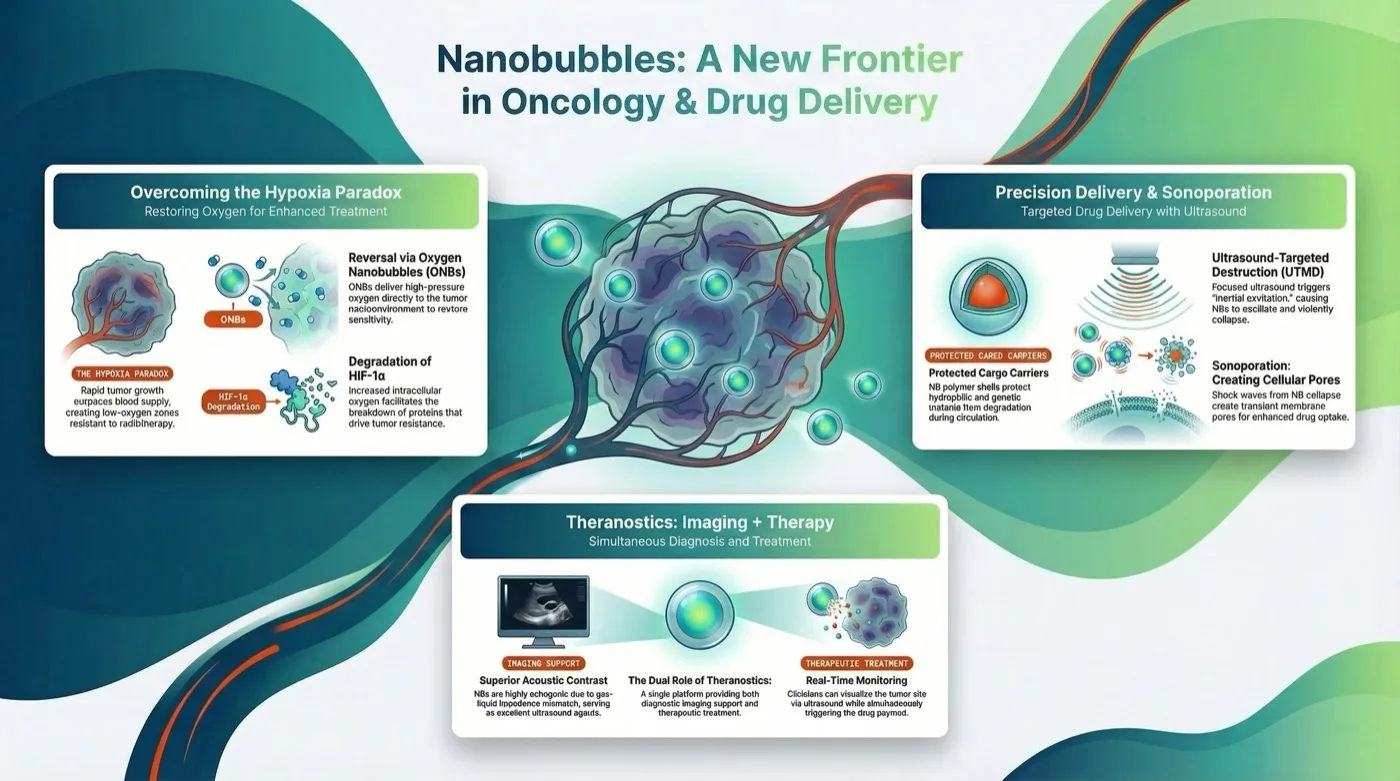
1. Reversal of Tumor Hypoxia
The "Hypoxia Paradox" in Cancer Treatment
A critical barrier in solid tumor therapy is the "Hypoxia Paradox." Rapidly proliferating tumors often outgrow their vascular supply, creating irregular and leaky vasculature that leads to regions of severe hypoxia (low oxygen). Paradoxically, this hypoxic environment renders tumors resistant to standard treatments. Radiotherapy requires oxygen to "fix" DNA damage caused by free radicals; without oxygen, the damage is reversible, and cancer cells survive. Similarly, hypoxia slows cell proliferation, reducing the efficacy of chemotherapies that target rapidly dividing cells, and selects for more aggressive, metastatic phenotypes Khan et al., 2018; Song et al., 2020.
Mechanism of HIF-1\\alpha Downregulation via ONBs
Oxygen Nanobubbles (ONBs) serve as a potent tool to reverse this resistance by delivering a high payload of oxygen directly to the tumor microenvironment.
- HIF-1\\alpha Stability: Under hypoxic conditions, the Hypoxia-Inducible Factor-1\\alpha (HIF-1\\alpha) protein stabilizes and translocates to the nucleus, activating genes that promote survival, angiogenesis, and metastasis.
- ONB Intervention: Khan & Choi demonstrated that lipid-shelled ONBs synthesized via sonication successfully reversed hypoxic conditions in MDA-MB-231 breast cancer cells. Upon the release of oxygen from the ONBs, intracellular oxygen levels increased, facilitating the hydroxylation and subsequent proteasomal degradation of HIF-1\\alpha. Experimental results showed a significant reduction in HIF-1\\alpha expression and a concurrent decrease in hypoxia-associated fluorescence markers (Image-iT), thereby sensitizing the cells to treatment Khan et al., 2018.
- In Vivo Validation: Furthermore, Song & Sun utilized lipid-coated biogenic gas vesicles (lipid-GVs) to deliver oxygen. They observed that tail-vein injection of these nanostructures significantly elevated oxy-hemoglobin levels in subcutaneous tumors within 15 minutes, effectively alleviating tumor hypoxia and downregulating HIF-1\\alpha downstream pathways Song et al., 2020.
2. Targeted Drug Delivery
Nanobubbles as Drug Carriers
Nanobubbles (NBs) function as versatile carriers for therapeutic agents, including hydrophilic drugs, lipophilic drugs, and genetic material (siRNA, DNA).
- Loading Capacity: Cavalli et al. developed chitosan-shelled nanobubbles with a perfluoropentane core. These "nanodroplets" could be loaded with corticosteroids (e.g., prednisolone phosphate) or coupled with MRI contrast agents (Gd-DOTP). The polymer shell protects the cargo from degradation while the nanometric size allows for extravasation through leaky tumor vasculature (the EPR effect) Cavalli et al., 2015.
- Gene Delivery: NBs are also effective for gene therapy. Because NBs can protect genetic material (like siRNA or plasmid DNA) from enzymatic degradation in the blood, they serve as non-viral vectors that can be targeted to specific tissues Jin et al., 2022; Wu et al., 2021.
Ultrasound-Targeted Microbubble Destruction (UTMD) and Sonoporation
The release of the drug payload is spatially controlled using Ultrasound-Targeted Microbubble Destruction (UTMD).
- Mechanism: When NBs accumulate at the tumor site, focused ultrasound is applied. The acoustic energy causes the bubbles to oscillate and collapse (inertial cavitation). This collapse generates micro-jets and shock waves that physically disrupt cell membranes, creating transient pores—a process known as sonoporation.
- Enhanced Permeability: This "on-demand" release mechanism significantly enhances the intracellular uptake of drugs such as doxorubicin or paclitaxel, which normally struggle to penetrate cell membranes or the blood-brain barrier. Cavalli et al. showed that ultrasound stimulation of chitosan NBs resulted in a marked increase in drug release kinetics compared to non-stimulated conditions, ensuring high local drug concentrations without systemic toxicity Cavalli et al., 2015; Chang et al., 2016.
3. Theranostics (Therapy + Diagnostics)
Dual Role in Imaging and Therapy
Nanobubbles are inherently echogenic due to the impedance mismatch between their gas core and the surrounding fluid, making them excellent ultrasound contrast agents. By loading them with therapeutic agents, they become "theranostic" platforms.
- Real-Time Monitoring: Song & Sun developed lipid-coated gas vesicles (lipid-GVs) that served a dual function. First, their acoustic properties allowed for high-contrast ultrasound imaging to locate the tumor and monitor perfusion. Second, they carried oxygen to the tumor site to enhance Photodynamic Therapy (PDT). The study showed that the presence of these oxygen-loaded GVs significantly improved the generation of Reactive Oxygen Species (ROS) upon laser irradiation, leading to greater tumor growth inhibition compared to PDT alone Song et al., 2020.
- Multimodal Imaging: Cavalli et al. demonstrated that chitosan NBs could be loaded with Gd-DOTP, a Gadolinium-based contrast agent. This allowed the NBs to be visualized via Magnetic Resonance Imaging (MRI) while simultaneously acting as ultrasound-responsive drug carriers, providing a multi-modal approach to patient monitoring Cavalli et al., 2015.
4. Wound Healing
Topical Oxygenation for Chronic Wounds
Chronic wounds (e.g., diabetic ulcers) are characterized by persistent hypoxia, which stalls the healing phases (inflammation, proliferation, remodeling). Topical oxygenation via MNBs offers a superior alternative to gaseous oxygen diffusion.
- Mechanism of Action: Sayadi & Widgerow highlight that MNBs (Micro/Nanobubbles) are small enough to penetrate the wound bed and biofilm layers that block conventional oxygen. By delivering oxygen directly to the hypoxic tissue, MNBs downregulate HIF-1\\alpha signaling (which prevents the switch-off of the hypoxic drive) and restore the balance between Matrix Metalloproteinases (MMPs) and Tissue Inhibitors of Metalloproteinases (TIMPs), which is crucial for collagen deposition and re-epithelialization Sayadi & Widgerow, 2018.
- Physiological Acceleration: High dissolved oxygen levels provided by NBs have been shown to act as a "safe accelerator of growth." Ebina et al. demonstrated that oxygen NB water promotes the physiological growth of biological systems (plants, fish, and mice) by maintaining a high-oxygen environment that supports increased metabolic activity and immune function, suggesting significant potential for accelerating tissue regeneration in clinical settings Ebina et al., 2013.