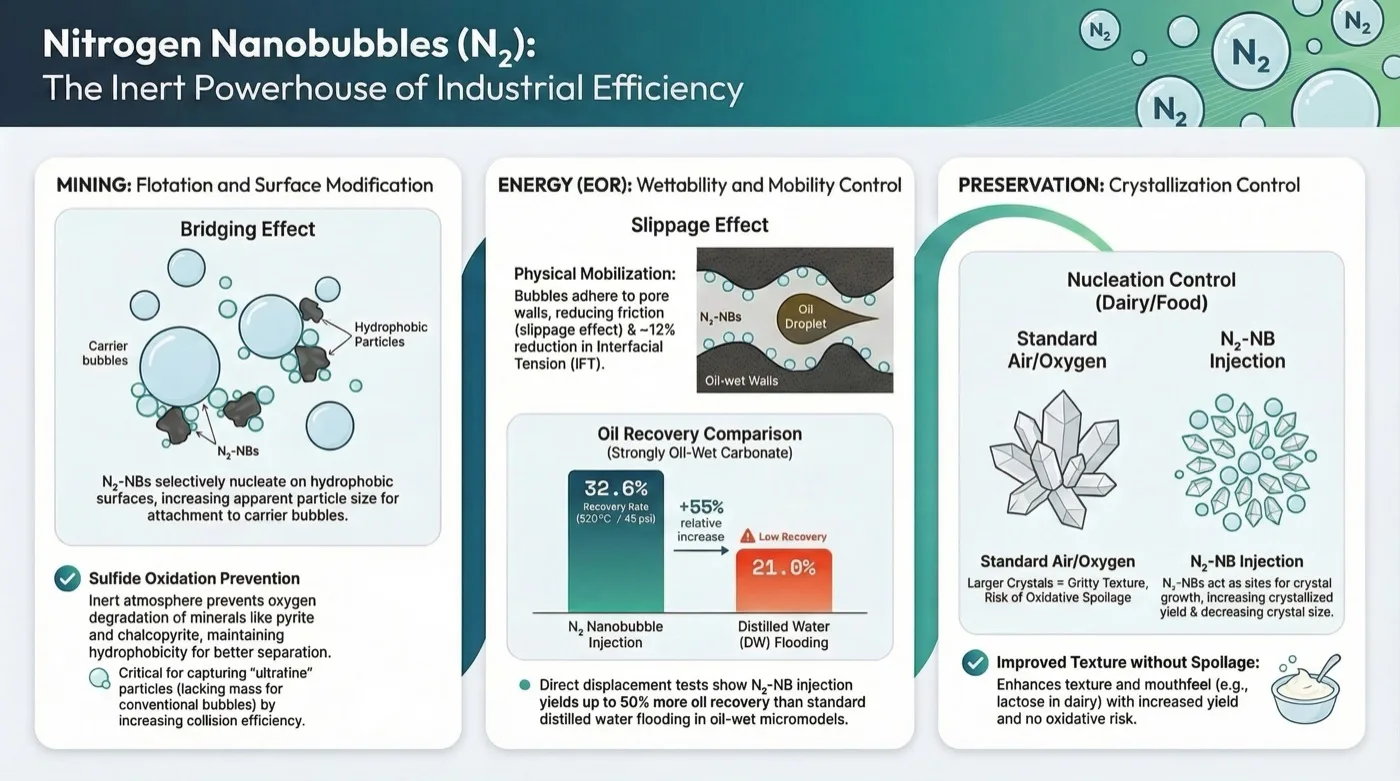
Nitrogen nanobubbles (N2-NBs) utilize the gas’s chemical inertness and hydrophobicity to modify surface interactions without inducing oxidative degradation, making them valuable in anaerobic environments and hydrocarbon extraction.
Mining: Flotation and Surface Modification
- Mechanism: In froth flotation, N2-NBs selectively nucleate on hydrophobic mineral surfaces, acting as a secondary collector. This "bridging" effect increases the apparent particle size and hydrophobicity, enhancing the attachment probability to larger carrier bubbles. This is particularly critical for fine and ultrafine particles that typically suffer from low recovery rates due to low collision efficiency Tao, 2022; Azevedo et al., 2019.
- Sulfide Oxidation Prevention: While air is commonly used, oxygen can detrimentally oxidize sulfide minerals (e.g., pyrite, chalcopyrite), reducing flotation selectivity. N2-NBs provide an inert atmosphere that prevents this surface oxidation, maintaining the natural hydrophobicity of sulfide minerals and improving separation efficiency in complex ores Kyzas et al., 2021.
Energy (EOR): Wettability and Mobility Control
- Wettability Alteration & Slippage: In high-pressure micromodel studies, N2-NBs demonstrated the ability to enhance oil recovery from oil-wet (OW) pores. Unlike CO2, which relies on chemical reactions, N2-NBs enhance recovery primarily through physical mechanisms: reducing Interfacial Tension (IFT) (by ~12%) and inducing a "slippage effect" where bubbles adhere to pore walls, reducing friction and facilitating oil mobilization Taman et al., 2025.
Recovery Rates vs. Water Flooding:
- Oil-Wet Reservoirs: N2-NBs significantly outperform distilled water (DW) flooding. In spontaneous imbibition tests on strongly oil-wet carbonate rocks at high temperature (120 °C) and moderate pressure (45 psi), N2-NBs achieved an ultimate oil recovery of 32.6%, compared to 21% for water alone. This performance nearly matched the recovery rates observed in water-wet rocks Elnaggar et al., 2025.
- Micromodel Efficiency: In direct displacement tests, N2-NB injection yielded up to 50% more oil recovery than conventional water flooding in oil-wet scenarios Taman et al., 2025.
Preservation: Crystallization Control
- Mechanism: In food processing, N2-NBs are utilized to control crystallization and prevent oxidative spoilage. For example, the addition of N2 nanobubbles has been shown to improve lactose crystal nucleation, increasing the crystallized yield while decreasing crystal size, which enhances the texture of dairy products without introducing reactive oxygen Babu & Amamcharla, 2023.