1. Pathogen Inactivation (Vibrio & Bacteria)
Efficacy Against Specific Pathogens
Ozone nanobubbles (O3-NBs) have demonstrated potent bactericidal effects against major aquaculture pathogens, significantly outperforming conventional aeration or macrobubble ozonation due to higher residual retention in the water column.
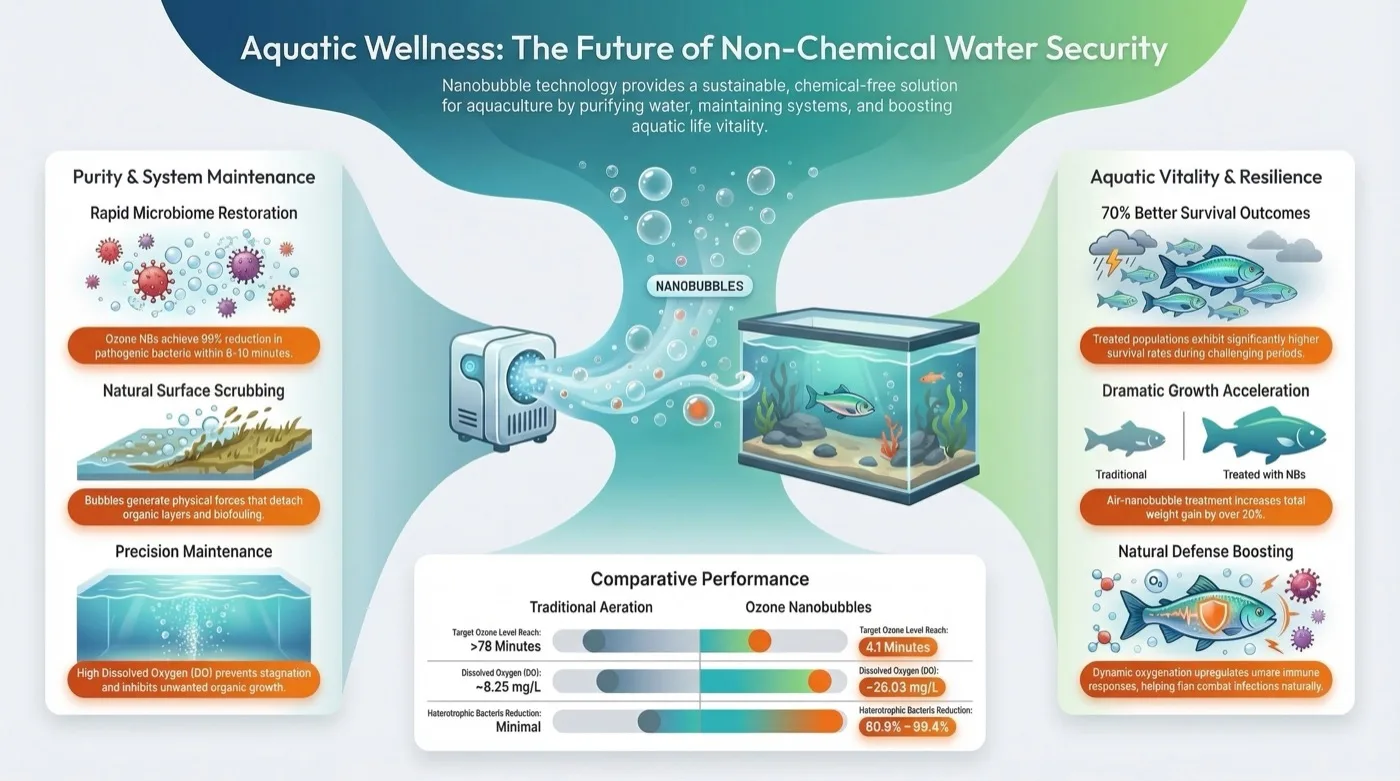
- Vibrio parahaemolyticus (EMS/AHPND): Laboratory trials indicate that O3-NBs are highly effective against V. parahaemolyticus, the causative agent of Acute Hepatopancreatic Necrosis Disease (AHPND). A study showed that O3-NB treatment reduced bacterial concentrations from \(10^6\) CFU/mL to undetectable levels within 6 minutes. In comparison, Oxygen NBs (O2-NBs) resulted in a 31% reduction over one week, highlighting the necessity of ozone for acute disinfection Nghia et al., 2022. Furthermore, O3-NBs achieved a sterilization rate of >99.99% against V. parahaemolyticus within 1 minute of exposure in seawater, effectively delaying mortality in infected shrimp Imaizumi et al., 2018.
- Aeromonas and Streptococcus: In freshwater systems, a 10-minute exposure to O3-NBs reduced the load of Streptococcus agalactiae by 96.11% and Aeromonas veronii by 97.92%. While the presence of organic matter (e.g., in culture water) reduced efficacy by approximately 1.6-fold, repeated treatments successfully suppressed bacterial populations without harming Nile tilapia Jhunkeaw et al., 2021.
- Microbial "Reset": O3-NBs (0.15 mg/L) have been proven to kill 90.9% to 99.4% of total heterotrophic bacteria in pond water, effectively "resetting" the microbial community. This allows for the potential re-introduction of beneficial probiotics before pathogenic species can re-establish dominance Huang et al., 2023.
Mechanism of Load Reduction: Oxidative Stress and Physical Disruption
The bactericidal action is driven by a dual mechanism:
- Oxidative Stress (ROS Generation): The collapse of nanobubbles generates Reactive Oxygen Species (ROS), specifically hydroxyl radicals (^\• OH). These radicals possess a high redox potential (2.80 V) and non-selectively attack bacterial cell walls, oxidizing polyunsaturated fatty acids in the cell membrane (lipid peroxidation) and damaging DNA strands. This leads to the leakage of cellular constituents and cell death Mukherjee et al., 2023; Huang et al., 2023.
- Physical Disruption: High-energy shock waves generated during the hydrodynamic collapse of NBs can physically rupture bacterial cell membranes. When combined with technologies like ultrasonication, Oxygen NBs can achieve a >6 log CFU/mL reduction of pathogens, suggesting a synergistic effect of physical cavitation and oxidative stress Rafeeq et al., 2020.
2. Biofilm Removal
Prevention and Removal Mechanisms
Biofilms on tank walls and pipes serve as reservoirs for pathogens. Nanobubbles mitigate this risk through physical abrasion and chemical degradation of the biofilm matrix.
- EPS Degradation: Biofilms are protected by Extracellular Polymeric Substances (EPS). NBs, particularly O3-NBs, penetrate the biofilm matrix and generate hydroxyl radicals that degrade the proteins and polysaccharides constituting the EPS. This disrupts the structural integrity of the biofilm, causing it to detach Shiroodi et al., 2021.
- Surface Tension and Shear Force: NBs reduce the contact angle of water on surfaces (increasing wettability) and alter surface tension. The Brownian motion and eventual collapse of NBs generate localized shear forces (micro-jets) that physically scour and detach biofilm layers from pipe walls and tank surfaces. This mechanism has been effective in removing E. coli and Listeria biofilms from plastic and stainless steel Shiroodi et al., 2021; Xiao et al., 2021.
- Inhibition of Formation: By maintaining high dissolved oxygen (DO) and generating ROS, NBs create an environment unfavorable for the development of anaerobic biofilms often associated with pathogenic proliferation in stagnant zones Xiao et al., 2020.
3. Immune System Stimulation
Modulation of Innate Immunity
Beyond direct pathogen control, nanobubble-treated water actively modulates the host immune system, enhancing resistance to infection.
- Gene Expression (Cytokines): Exposure to O3-NBs triggers the upregulation of key pro-inflammatory cytokine genes. In Nile tilapia, significant upregulation of TNF-\\alpha (Tumor Necrosis Factor-alpha), IL-1\\beta, and IL-2\\beta was observed in the gills, head kidney, and spleen within 15 minutes of exposure. This suggests that O3-NBs act as a mild stressor that "primes" the fish's innate immune system, preparing it to fight potential infections Linh et al., 2021.
- Antioxidant Enzymes (SOD/CAT): Fish treated with O3-NBs exhibit a transient increase in Superoxide Dismutase (SOD) activity (e.g., rising to 8.0 units vs. 4.5 in controls) one day post-treatment. This enzymatic response helps the fish manage oxidative stress and maintains homeostasis. Importantly, these levels return to baseline within 48 hours, indicating no long-term physiological damage Huang et al., 2023. Similarly, hydrogen NBs have been shown to reduce ROS accumulation and down-regulate inflammatory factors in zebrafish infected with viruses, significantly improving survival rates Li et al., 2022.
- Survival Enhancement: The modulation of these immune pathways directly translates to survival. Tilapia pre-treated with O3-NBs showed a relative percent survival of 60–70% when challenged with Streptococcus agalactiae, compared to untreated controls Linh et al., 2021. Additionally, high DO levels from Oxygen NBs support a "hypermetabolic state" that enhances general physiological resilience and immune competence Ebina et al., 2013.