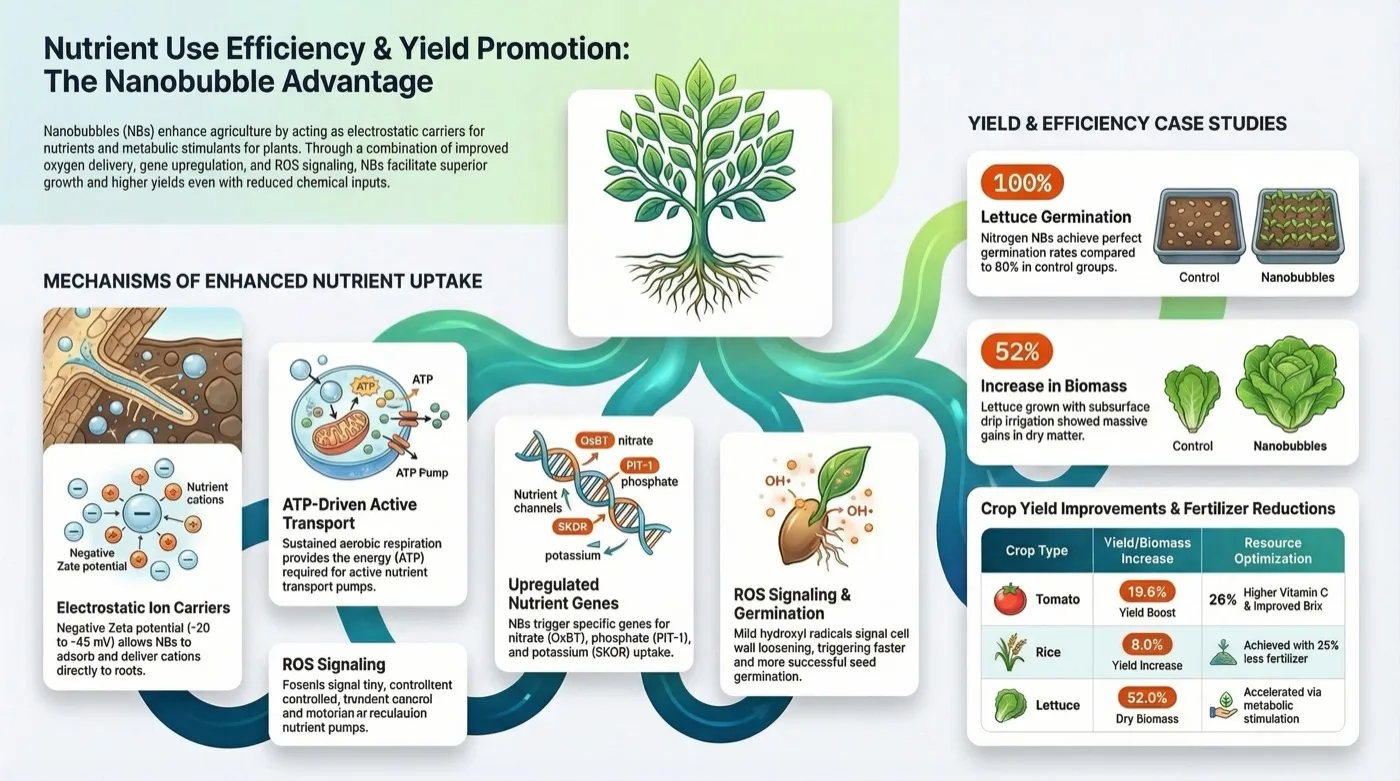
1. Nutrient Uptake Mechanisms
Electrostatic Adhesion and Zeta Potential
The fundamental mechanism enhancing NUE is the high surface area and electrical charge of the nanobubbles. NBs suspended in water typically exhibit a negative Zeta potential, ranging from −20 to −45 mV depending on the gas type and pH.
Mechanism:*
The negatively charged gas–liquid interface of NBs creates an electrostatic attraction to positively charged nutrient ions (cations) such as Ammonium (NH_4^+), Potassium (K^+), Calcium (Ca^{2+}), and Magnesium (Mg^{2+}). This effectively turns NBs into nutrient "carriers," delivering these ions directly to the root surface, thereby increasing their bioavailability Arablousabet & Povilaitis, 2024; Wang et al., 2021.
Gas Influence: Research by Ahmed et al.* indicates that Nitrogen NBs (NNBs) exhibit a higher magnitude of negative Zeta potential compared to Air NBs (ANBs) due to differences in ionization energy. This higher charge enhances the ability of NNBs to adsorb positively charged nutrient ions, potentially explaining why NNBs often outperform other gases in vegetative growth promotion Ahmed et al., 2018.
Active Transport and ATP Availability
NBs facilitate the active transport of macronutrients by preventing root hypoxia (oxygen deficiency). Active uptake of nutrients like N, P, and K requires energy in the form of Adenosine Triphosphate (ATP).
Root Respiration:*
In heavy or waterlogged soils, hypoxia inhibits aerobic respiration, forcing roots into anaerobic metabolism (glycolysis), which yields significantly less ATP. By maintaining high Dissolved Oxygen (DO) levels, Oxygen NBs (ONBs) sustain the aerobic respiration (TCA cycle) required to generate sufficient ATP to power ion pumps and transport proteins Zheng & Shang, 2025; Ahmed et al., 2018.
Gene Expression:
Laboratory studies on rice seedlings have shown that NB treatment upregulates specific genes responsible for nutrient absorption, including OsBT (nitrate uptake), PiT-1 (phosphate transport), and SKOR (potassium transport), confirming a genetic basis for the observed increase in NUE Wang et al., 2021.
2. Seed Germination Rates
Gas Type Influence on Germination
The efficacy of NBs in breaking seed dormancy and accelerating germination varies significantly by gas type.
Nitrogen vs. Oxygen vs. Air:
In a comparative study on lettuce, carrot, and fava bean, Nitrogen NBs (NNBs) showed the most consistent promotion. For lettuce, NNBs achieved a 100% germination rate, compared to 85% for ONBs, 82% for ANBs, and 80% for tap water. This suggests that while oxygen is vital, the enhanced nutrient delivery (via Zeta potential) provided by Nitrogen NBs may be more critical for early-stage development in some species Ahmed et al., 2018.
Electric Field Air NBs: Recent techniques using electric fields to generate Air NBs have shown dramatic results, increasing lettuce germination rates from ~20% (control) to 96% within just two days Jannesari et al., 2024.
The ROS Signaling Theory
The mechanism for this acceleration is linked to the "oxidative window" concept.
- Mechanism: Liu et al. identified that NBs produce mild levels of exogenous Reactive Oxygen Species (ROS), specifically hydroxyl radicals (^\• OH) and superoxide anions (O_2^{\•-}). Within a specific "window," these ROS act as signal molecules that trigger cell wall loosening and cell elongation, essential for germination Liu et al., 2016.
- Toxicity Threshold: However, excess ROS can be inhibitory. For example, ONBs (pure oxygen) generated the highest concentration of ROS, which exceeded the toxic threshold for sensitive seeds like carrots, resulting in no significant promotion. Conversely, NNBs and Air NBs produced moderate ROS levels that fell within the optimal window for stimulating germination Ahmed et al., 2018; Liu et al., 2016.
3. Yield Case Studies
Lettuce (Leafy Greens)
- Yield Increase: In subsurface drip irrigation trials using treated wastewater, Oxygen NB (ONB) aeration increased lettuce aboveground dry biomass by 52% compared to control subsurface irrigation Baram et al., 2021. Another study using Air-NBs showed a 34.5% increase in aerial fresh weight (Brassica campestris) Ebina et al., 2013.
- Root Development: NBs have been observed to increase total root length density in lettuce crops significantly, improving water and nutrient uptake capacity del Moral Torres et al., 2024.
Tomato (Fruit Vegetables)
- Yield Increase: In greenhouse trials, Micro-Nano Bubble Water Oxygation (MNBWO) increased tomato yield by 16.9% to 19.66% compared to non-aerated controls Liu et al., 2019; Chen et al., 2023.
- Quality Improvements: The quality of the fruit was significantly enhanced. Studies recorded a 17.7% to 26.5% increase in Vitamin C content and a 20.7% to 39.2% increase in soluble sugar content (Brix), indicating that NBs improve metabolite accumulation Liu et al., 2019; Chen et al., 2023.
Barley & Rice (Cereals)
- Yield & Fertilizer Savings: Field experiments with rice showed that NB irrigation increased yield by approximately 8%. Crucially, NB treatment allowed for a 25% reduction in fertilizer application while maintaining the same yield as the fully fertilized control, demonstrating significant NUE improvement Wang et al., 2021.
- Germination Speed: Barley seeds submerged in NB water exhibited a germination rate of 58% after 17 hours, which was double the rate of seeds in distilled water (28%), attributed to the ROS signaling effect Liu et al., 2016.