1. Nanobubble Flotation vs. Dissolved Air Flotation (DAF)
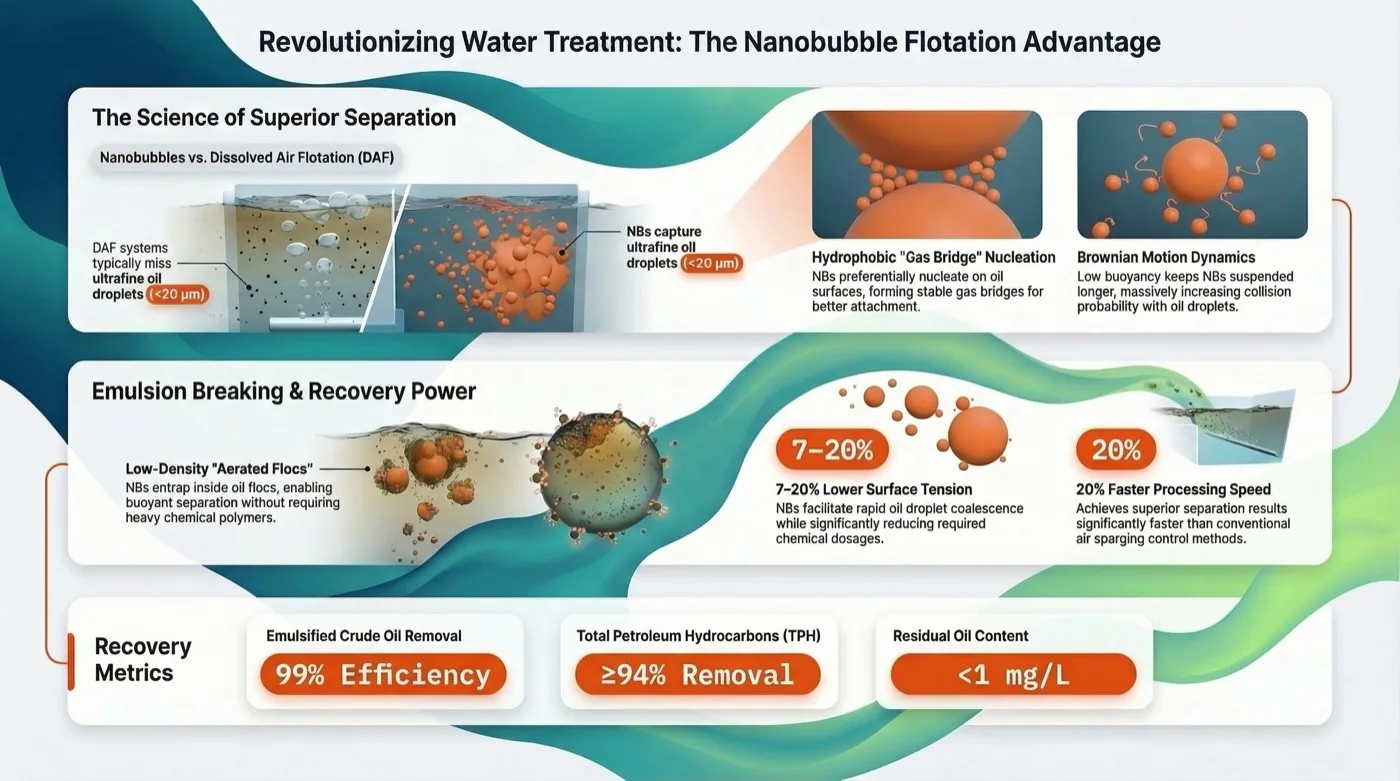
Operational Comparison Traditional Dissolved Air Flotation (DAF) relies on the generation of microbubbles (MBs), typically ranging from 30 to 100 µm. While effective for separating free oil and larger suspended solids, DAF systems often struggle with emulsified oil droplets smaller than 20 µm. These ultrafine droplets tend to follow the water streamlines around the rising microbubbles, resulting in low collision efficiencies.
Nanobubble (NB) flotation utilizes bubbles <1 µm (typically 150–350 nm). Unlike MBs, NBs possess low buoyancy and are dominated by Brownian motion rather than buoyancy, allowing them to remain suspended in the water column for extended periods. This characteristic significantly increases the probability of collision with ultrafine oil droplets that standard DAF systems miss Shen et al., 2022.
Attachment Mechanism: Contact Angle and Hydrophobicity The superiority of NBs in attaching to emulsified oil is governed by surface thermodynamics:
- Hydrophobic Attraction: Nanobubbles preferentially nucleate on hydrophobic surfaces (such as oil droplets) due to the lower energy barrier. Once attached, they form a "gas bridge" or act as a secondary collector.
- Contact Angle Modification: NBs increase the apparent contact angle of the oil droplets (or solid particles). By expanding the three-phase contact line (gas/liquid/solid), NBs enhance the hydrophobicity of the aggregate. This prepares the surface for the attachment of larger carrier bubbles (microbubbles), facilitating a more stable rise to the surface. This "seeding" effect allows NBs to convert hydrophilic or weakly hydrophobic impurities into separable aggregates Oliveira et al., 2017; Shen et al., 2022.
2. Emulsion Breaking
Destabilization Without Heavy Chemicals Breaking stable oil-in-water emulsions usually requires high doses of chemical demulsifiers to overcome the electrostatic repulsion (Zeta potential) between droplets. Nanobubbles offer a physical alternative to heavy chemical dosing:
- Entrapment and "Aerated Flocs": Research indicates that NBs can become entrapped inside flocculated oil structures. Unlike conventional air bubbles that attach to the outside, NBs penetrate the aggregate, significantly lowering the density of the floc without requiring excessive polymer bridging. This creates "aerated flocs" that are highly buoyant and resistant to shear forces during the rise phase Etchepare et al., 2017.
- Reduction of Interfacial Tension: The presence of NBs has been observed to lower the surface tension of the aqueous phase (e.g., a ~7–20% reduction depending on gas type). This reduction facilitates the coalescence of oil droplets and enhances the adsorption of surfactants/polymers, thereby requiring lower chemical dosages to achieve phase separation English, 2025.
- Zeta Potential Modulation: While bubbles are generally negatively charged, their high specific surface area and interaction with ions in saline water can modulate the Zeta potential of the system, reducing the repulsive forces between oil droplets and facilitating aggregation Shen et al., 2022.
3. Recovery Metrics
Removal Efficiency Data The integration of nanobubbles into flotation circuits has yielded superior separation metrics compared to conventional methods, particularly in challenging saline or produced water environments.
- Emulsified Crude Oil: In tests treating saline water with emulsified crude oil (initial concentrations 334–484 mg/L), the combination of microbubbles and nanobubbles achieved removal efficiencies >99%, reducing residual oil content to <1 mg/L. Even at lower saturation pressures (3.5 bar), the effluent met strict offshore discharge standards (<29 mg/L) Etchepare et al., 2017.
- Total Petroleum Hydrocarbons (TPH): In the remediation of oil-contaminated sands and fluids, positively charged NBs demonstrated a TPH removal efficiency of ≥94% using intermittent injection regimes, outperforming batch injections Bui et al., 2022.
- System Efficiency vs. Control: When comparing air-NB enhanced flotation against standard air sparging (control), oil removal efficiency increased from 62% (control) to 98.5% (NB-enhanced) using optimized polymer dosing (0.2 wt%). Furthermore, the NB process achieved these results roughly 20% faster than the control English, 2025.
- Oil and Grease: In municipal secondary effluent treatment, oxygen nanobubbles reduced oil and grease content by 33% (from 9 mg/L to 6 mg/L), whereas conventional air bubbles showed no significant effect on oil reduction in the same timeframe Ahmed et al., 2023.