1. Dissolved Oxygen (DO) Stability
Supersaturation Capability vs. Conventional Aeration
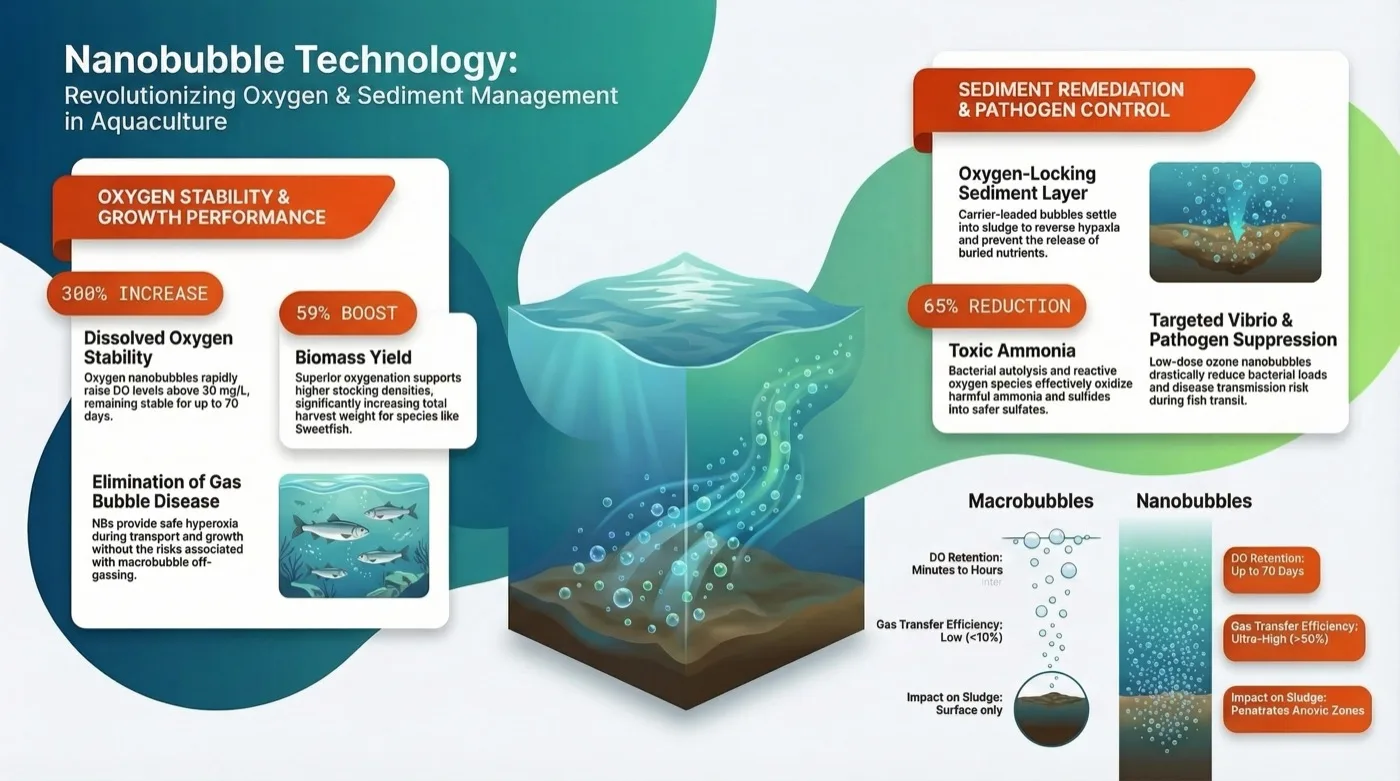
Traditional aeration methods, such as paddlewheels or air stones, generate macrobubbles (>1 mm) that rise rapidly to the surface and burst, resulting in low gas transfer efficiency. In contrast, nanobubbles (<200 nm) exhibit negligible buoyancy and remain suspended in the water column, allowing for the "supersaturation" of liquids.
- Mechanism: Research indicates that oxygen nanobubbles (ONBs) can rapidly increase dissolved oxygen (DO) from standard levels (e.g., 7.7 mg/L) to supersaturated levels (e.g., 31.7 mg/L) within minutes of generation. Unlike macrobubbles, which off-gas quickly, ONBs act as a gas reservoir within the liquid Ebina et al., 2013.
- Comparison: Ng & St-Hilaire confirmed that DO levels in tanks treated with ozone nanobubbles were considerably higher and more stable than those treated with ozone macrobubbles delivered via air stones, demonstrating superior mass transfer efficiency Ng & St-Hilaire, 2023.
Residence Time and Stability
A critical operational advantage of NBs is their longevity in the water column.
- Data: Experimental data shows that while the initial supersaturated spike (e.g., ~31 mg/L) may settle, ONBs maintain elevated DO levels (e.g., ~8.7 mg/L) for extended periods. Ebina et al. reported that the size and concentration of nanobubbles in distilled water remained relatively stable for up to 70 days when stored at 4°C, preventing the rapid hypoxia often seen when mechanical aerators fail Ebina et al., 2013.
Benefit for High-Density Stocking
The ability to maintain stable, high DO levels directly correlates to biomass capacity.
- Yield Increase: In comparative trials, Rainbow trout reared in air-NB water showed a total weight increase from 50.0 kg to 148.0 kg over 6 weeks, compared to 129.5 kg in normal water. Similarly, Sweetfish biomass increased to 10.2 kg in NB water versus 6.4 kg in control water. This suggests that NBs can support significantly higher stocking densities and metabolic rates without inducing hypoxic stress Ebina et al., 2013.
2. Sediment Remediation (Sludge Control)
Penetration of Anoxic Zones
Conventional surface aeration fails to oxygenate the benthic layer (pond bottom) where sludge accumulates. NBs, due to their neutral buoyancy and Brownian motion, can remain suspended and permeate the water column down to the sediment-water interface.
- Mechanism: Specialized approaches load NBs onto carrier materials (like zeolite) or utilize their low buoyancy to settle into the sludge layer. Once in the sediment, they reverse anoxia/hypoxia by slowly releasing oxygen, creating an "oxygen-locking" layer that prevents the release of toxic substances Shi et al., 2018; Ali et al., 2023.
Oxidation of Toxic Compounds (Ammonia and Hydrogen Sulfide)
The accumulation of uneaten feed and feces creates sludge that releases toxic Ammonia (NH_3) and Hydrogen Sulfide (H_2S) under anaerobic conditions.
- Mechanism: High dissolved oxygen levels provided by NBs induce bacterial autolysis and increase biological lysis reactions, which reduces total sludge production. Furthermore, the presence of Reactive Oxygen Species (ROS) and high oxygen availability facilitates the nitrification of Ammonia into less toxic Nitrate, and the oxidation of Sulfides into Sulfates Rahmawati et al., 2021; Ahmed et al., 2023.
- Effectiveness: In wastewater and sludge treatment trials, nanobubble injection has been shown to reduce Ammonia levels by up to 65% compared to traditional aeration methods Lyu et al., 2023.
3. Transport Applications
Stress and Mortality Reduction
Transporting live fish is a high-stress event defined by rapid oxygen depletion and ammonia accumulation in small water volumes. NBs offer a solution by pre-saturating transport water with oxygen.
- Findings: Although Ebina et al. focused on rearing, the results imply that keeping fish in NB water (which mimics transport conditions of high density and limited water exchange) leads to better physiological outcomes. The study noted that NB water acts as a "safe accelerator of growth" and immune system support, maintaining high survival rates even under intensive conditions Ebina et al., 2013.
- Safety: The absence of "gas bubble disease" (embolism) in fish exposed to NB supersaturation (up to 31.7 mg/L) indicates that NBs are physiologically safe for transport applications, unlike macrobubble supersaturation which can be lethal Ebina et al., 2013.
- Bacterial Control during Transit: The use of Ozone NBs (at safe low doses) can also be utilized prior to or during transport to reduce bacterial loads (e.g., Vibrio parahaemolyticus), further reducing stress and disease transmission risk during transit Ng & St-Hilaire, 2023; Nghia et al., 2022.