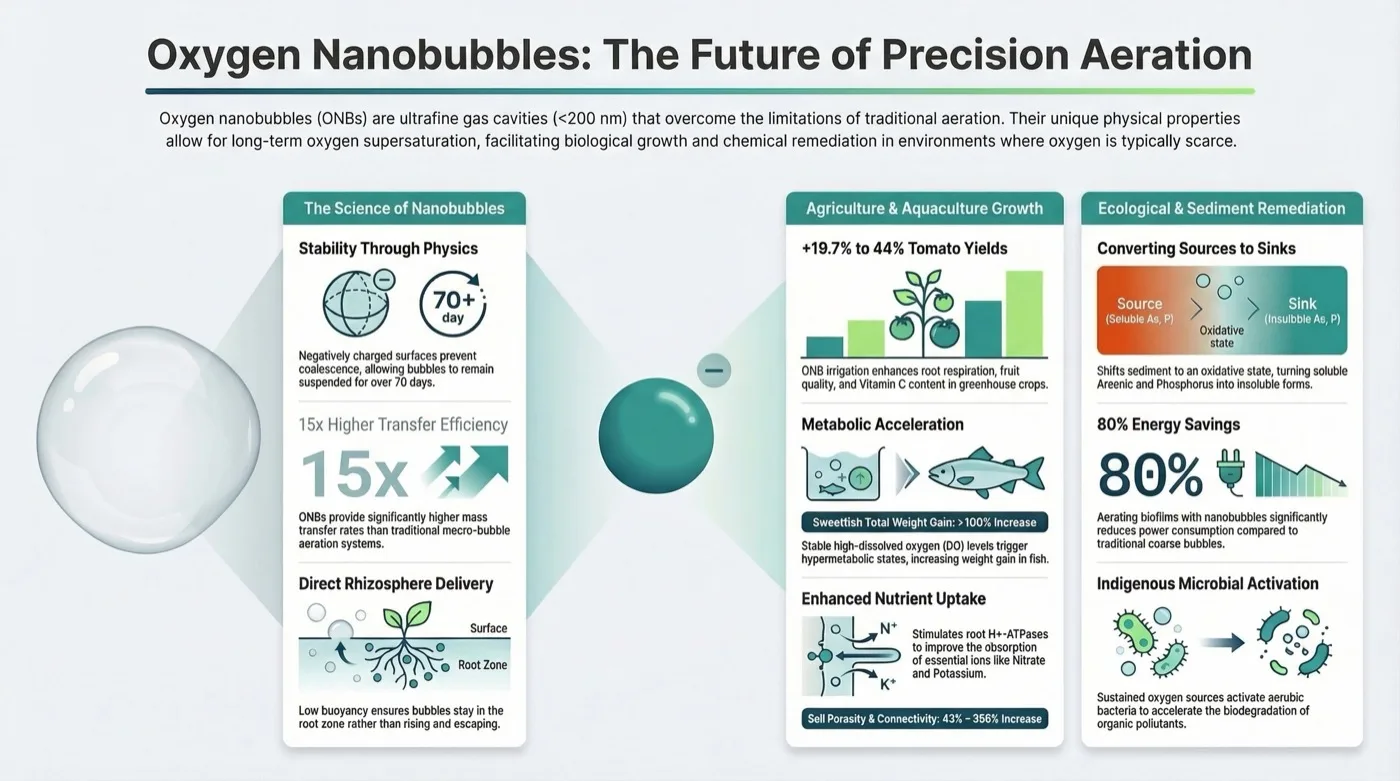
Oxygen nanobubbles (ONBs) are primarily utilized to overcome mass transfer limitations in liquid phases, maintaining supersaturated Dissolved Oxygen (DO) levels for extended periods to support aerobic biological processes.
Agriculture: Root Respiration & Yield Enhancement
- Mechanism (Hypoxia Reversal): In heavy, saline, or flooded soils, root respiration is often inhibited by hypoxia. ONBs, due to their low buoyancy and high internal pressure, remain suspended in the soil solution, delivering oxygen directly to the root zone (rhizosphere). This alleviates hypoxic stress, enhances root activity, and promotes nutrient uptake efficiency (NUE) by upregulating specific genes involved in nutrient transport Wang et al., 2021; Baram et al., 2022. Furthermore, ONBs can modify the soil microbial community, fostering beneficial bacteria that support plant health Chen et al., 2023.
Yield Increases:
- Tomato: Application of ONBs in irrigation water has been shown to increase tomato yields by approximately 19.7% compared to conventional irrigation, while also improving fruit quality parameters like Vitamin C and soluble sugar content Lei et al., 2023; Liu et al., 2019.
- Lettuce: Hydroponic cultivation with ONBs significantly promotes the growth of lettuce, increasing leaf area and fresh weight by alleviating dissolved oxygen limitations common in static solution cultures Kobayashi & Yamaji, 2022; Ebina et al., 2013.
Aquaculture: Metabolic Acceleration & Survival
- Physiological Impact: The high DO stability provided by ONBs accelerates metabolism and growth rates in aquatic species. Studies on sweetfish and rainbow trout demonstrated that ONB treatment promoted total weight gain compared to normal aeration Ebina et al., 2013.
- Survival in High Density: In intensive shrimp farming (Penaeus vannamei), ONB aeration enhanced the nitrification process, maintaining lower ammonia levels and supporting higher stocking densities without compromising survival rates .
- Sediment Remediation: Interfacial ONBs can effectively control the internal load of pollutants. By shifting the redox potential at the sediment-water interface to an oxidative state, ONBs convert soluble Arsenic (As) and Phosphorus (P) into insoluble forms, significantly reducing their release into the water column Tang et al., 2021; Sha et al., 2020.
Ecological: Microbial Activation
- Mechanism: ONBs provide a sustained oxygen source that activates indigenous aerobic microorganisms in eutrophic water bodies. This enhanced microbial activity accelerates the biodegradation of organic matter and reduces the production of anaerobic metabolites like methane Shi et al., 2018. The technology has been successfully applied to combat hypoxia and anoxia at sediment-water interfaces, promoting ecosystem restoration Zhang et al., 2018.