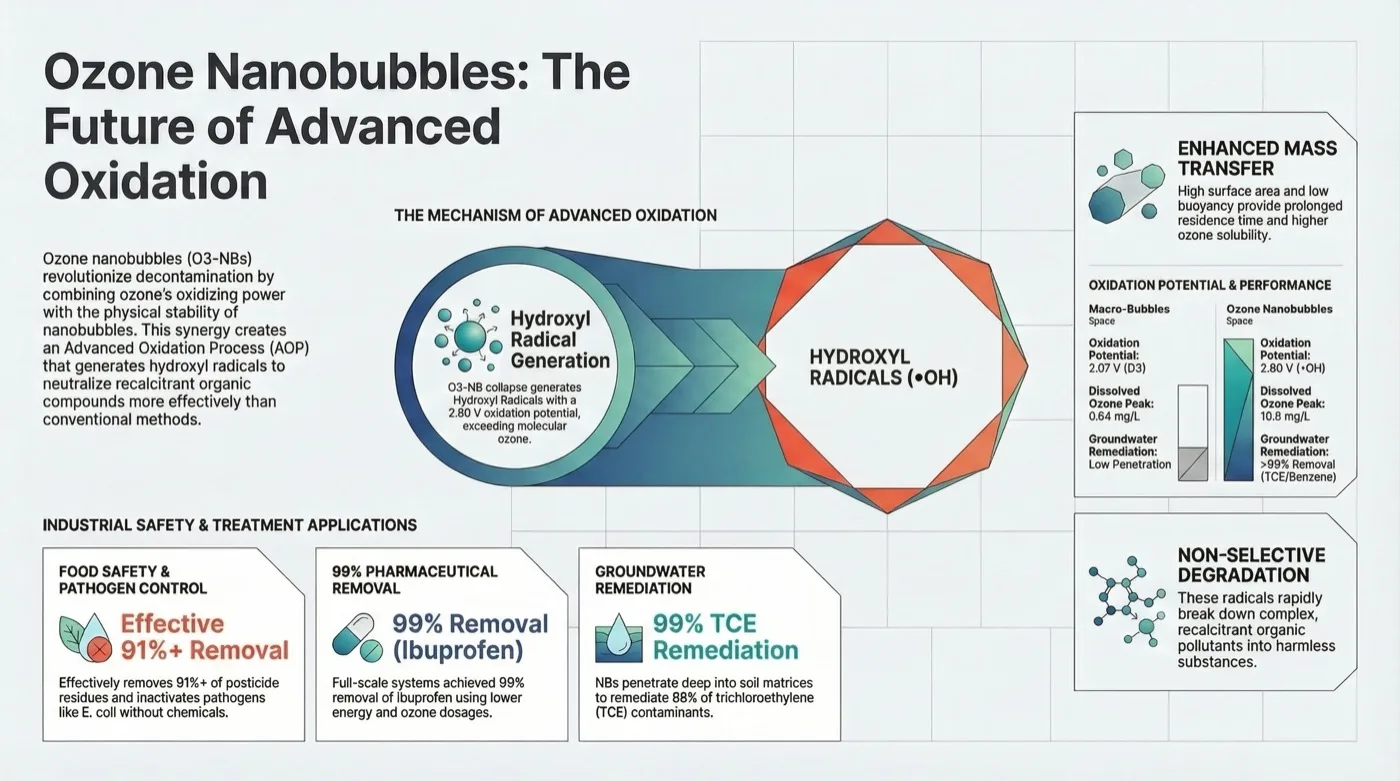
Ozone nanobubbles (O3-NBs) combine the strong oxidizing power of ozone with the physical stability of nanobubbles, creating a potent Advanced Oxidation Process (AOP) agent.
Mechanism: Hydroxyl Radical Generation
- Radical Formation: The collapse of O3-NBs, stimulated by stimuli or self-decomposition, generates diverse Reactive Oxygen Species (ROS), predominantly Hydroxyl Radicals (^\• OH). These radicals possess a higher oxidation potential (2.80 V) than molecular ozone (2.07 V), allowing for the non-selective degradation of recalcitrant organic compounds Takahashi et al., 2007; Hu & Xia, 2018.
- Mass Transfer: Unlike macro-bubbles that rise and burst rapidly, O3-NBs have a high specific surface area and low buoyancy, leading to prolonged residence time and significantly higher mass transfer efficiency of ozone into the aqueous phase Fan et al., 2020; Khuntia et al., 2012.
Food Safety: Pesticide & Pathogen Control
- Pesticide Removal: O3-NBs have demonstrated high efficacy in degrading residual pesticides on fresh produce. For instance, the treatment effectively removed residues of fenitrothion, chlorpyrifos, and chlorothalonil from vegetables such as spinach and baby cabbage, significantly outperforming conventional washing methods Ikeura et al., 2011; .
- Pathogen Inactivation: The strong oxidative stress induced by O3-NBs disrupts microbial cell membranes. This technology has proven effective against foodborne and aquaculture pathogens, including Escherichia coli and Vibrio parahaemolyticus, offering a chemical-free disinfection method that preserves food quality Ahmed et al., 2023; Jhunkeaw et al., 2021.
Water Treatment: Degradation of Recalcitrants
- Pollutant Degradation: O3-NBs are employed to degrade complex organic pollutants in wastewater.
- Pharmaceuticals: In full-scale wastewater treatment plant (WWTP) applications, O3-MNB systems achieved high removal efficiencies for pharmaceuticals such as ibuprofen (99%), utilizing lower ozone dosages and energy costs compared to conventional ozonation Ponce-Robles et al., 2023.
- Antibiotics & Dyes: The technology enhances the photodegradation of antibiotics like oxytetracycline and azo dyes (e.g., Methyl Orange), attributing the enhanced removal to the synergistic effect of high ozone solubility and radical generation Wang et al., 2020; Xia & Hu, 2018.
- Groundwater Remediation: Field applications have shown that O3-NBs can effectively remediate groundwater contaminated with Trichloroethylene (TCE) and benzene, achieving removal rates >99% due to the deep penetration capability of NBs in soil matrices Hu & Xia, 2018; Cao & Hu, 2023.