1. Pesticide Residue Removal
Mechanism of Action: Oxidative Cleavage and Enhanced Mass Transfer The removal of hydrophobic pesticide residues (e.g., organophosphates) from fruit and vegetable surfaces is significantly enhanced by Ozone Micro-Nanobubbles (OMNBs) compared to conventional washing. The mechanism is twofold:
- Enhanced Mass Transfer: Unlike macrobubbles which burst at the surface, nanobubbles remain stable in the aqueous phase, maintaining high levels of dissolved ozone (supersaturation) and increasing the contact time with contaminants Pal et al., 2025.
- Radical Generation: Upon collapse, OMNBs generate hydroxyl radicals (^\• OH), which are non-selective and highly reactive. These radicals attack the functional groups of pesticides—such as amino, methoxy, dichlorovinyl, and nitro groups—via oxidative cleavage, hydrolysis, and photolysis. This breaks down complex pesticide molecules into harmless byproducts like water, carbon dioxide, and inorganic salts Pal et al., 2025.
Removal Efficiency Data
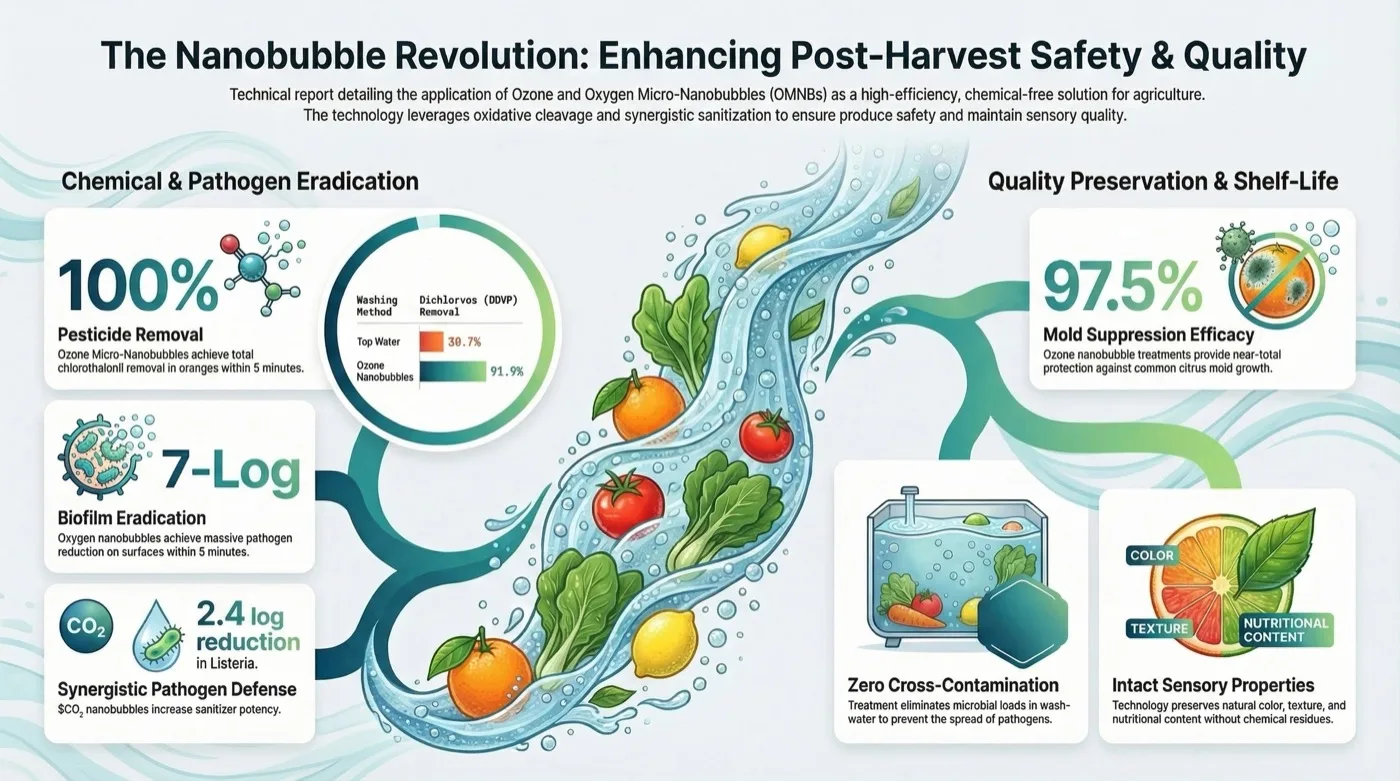
- Chlorothalonil: A 5-minute ozonation treatment facilitated by micro-nano bubbles was reported to completely eliminate (100% removal) chlorothalonil residues from orange matrices Pal et al., 2025.
- Fenitrothion: OMNBs generated by decompression methods showed superior removal efficiency for fenitrothion on lettuce, cherry tomatoes, and strawberries compared to macrobubbles, attributed to the ability of NBs to penetrate micropores and waxy cuticles Pal et al., 2025.
- Dichlorvos (DDVP): In tomatoes, ozonated water treatment achieved a 91.9% removal efficiency of DDVP, significantly outperforming tap water washing (30.7%) Pal et al., 2025.
2. Pathogen Control & Food Safety
Efficacy Against E. coli, Salmonella, and Listeria Nanobubbles have demonstrated a unique ability to enhance the potency of common antimicrobials (Chlorine and Peracetic Acid) and, in some cases, remove biofilms independently.
- Synergistic Potency: Unger et al. demonstrated that incorporating CO2 nanobubbles into antimicrobial solutions significantly increased log reductions of pathogens on apples. CO2 NBs combined with sanitizers resulted in a 2.1 log CFU/apple reduction of E. coli O157:H7 and a 2.4 log CFU/apple reduction of Listeria monocytogenes, compared to 1.4 and 1.9 log reductions, respectively, in solutions without NBs Unger et al., 2022.
- Biofilm Removal: Shiroodi et al. found that oxygen NBs alone completely removed Vibrio parahaemolyticus biofilms (7 log reduction) from stainless steel and plastic within 5 minutes. While L. innocua and E. coli biofilms were more resistant, NBs alone still achieved a 1 to 3 log CFU/cm² reduction, and complete inactivation was achieved when NBs were combined with Neutral Electrolyzed Water (NEW) Shiroodi et al., 2021.
Mechanism: Physical Scrubbing and Oxidative Stress The destruction of bacterial membranes is achieved through a "physio-chemical" attack:
- Physical Scrubbing & Anti-Adhesion: NBs reduce the surface tension of water and the contact angle on produce surfaces (e.g., reducing contact angle on stainless steel from 70.1° to 67.3°). This increases wettability, allowing the solution to penetrate biofilm matrices. NBs physically scour the surface, detaching Extracellular Polymeric Substances (EPS) Shiroodi et al., 2021.
- EPS Disruption via ROS: Raman spectroscopy analysis revealed that NB treatment reduces the intensity of spectral bands associated with proteins, carbohydrates, and DNA within the biofilm matrix. This indicates that the Reactive Oxygen Species (ROS), specifically hydroxyl radicals generated during NB collapse, chemically degrade the protective EPS layer and oxidize cell membrane components Shiroodi et al., 2021; Unger et al., 2022.
3. Shelf-Life Extension
Reduction of Microbial Load and Spoilage Washing produce with OMNBs effectively lowers the initial microbial load, which is the primary determinant of shelf-life.
- Microbial Reduction: The application of OMNBs has been shown to reduce heterotrophic bacteria by 90.9% to 99.4% in aquatic environments, suggesting a similar potential for wash-water disinfection to prevent cross-contamination during produce processing Huang et al., 2023; Pal et al., 2025.
- Mold Suppression: Ozone treatments, particularly in the aqueous phase enhanced by NBs, have demonstrated efficacy rates as high as 97.5% in reducing mold growth on citrus fruits, directly translating to extended storage life Pal et al., 2025.
Maintenance of Fruit Quality Crucially, OMNB treatment degrades contaminants without compromising the physiological quality of the fruit.
- Quality Metrics: Research indicates that ozonated water treatments maintain the green color of peppers (h values) and do not negatively impact texture or visual appearance. In apple processing, OMNB treatment showed significantly higher pesticide removal rates (98–100%) without altering the fruit's sensory properties compared to tap water Pal et al., 2025.
- Storage Viability: By achieving high bacterial log reductions (up to 2.4 log CFU/apple) without using harsh thermal treatments, NB technology preserves the fresh status of the produce while ensuring safety compliance Unger et al., 2022.