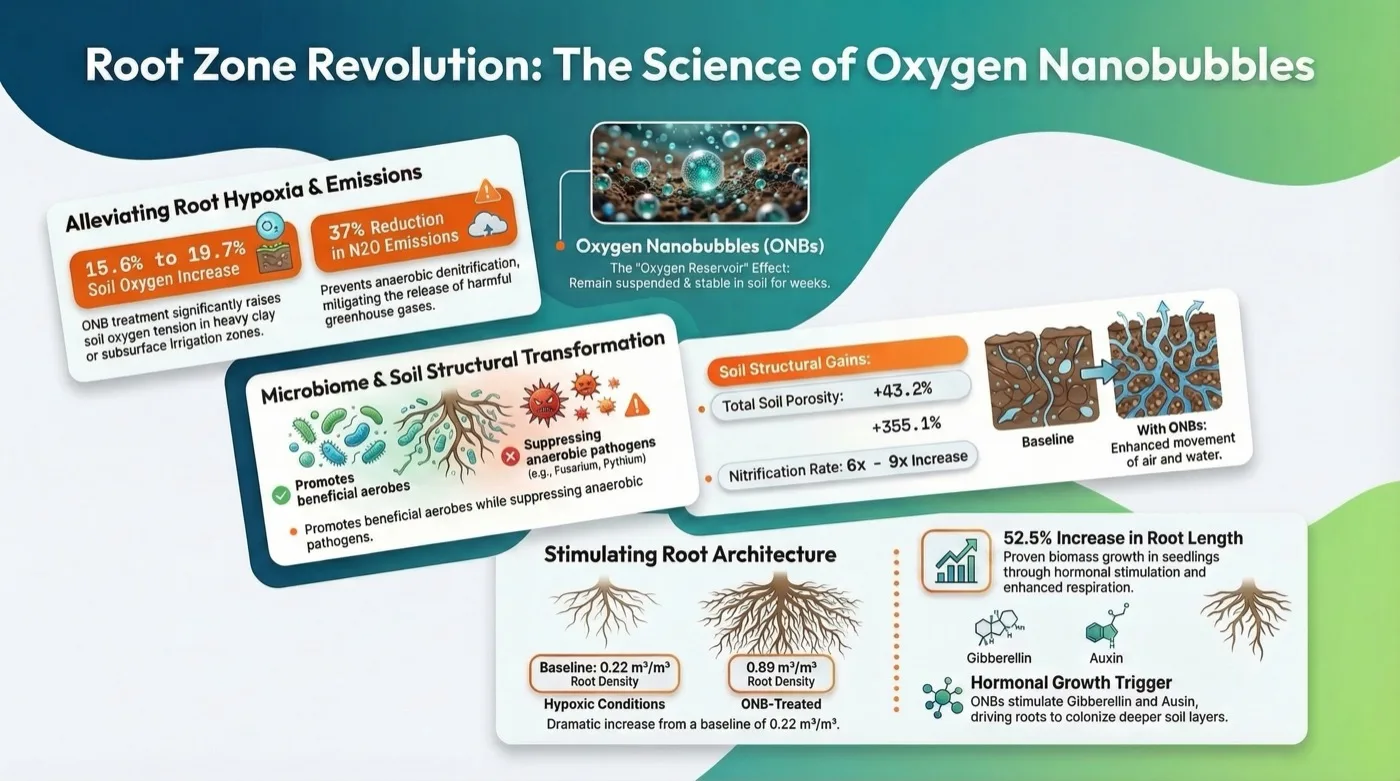
1. Alleviation of Root Hypoxia
The Physicochemical Mechanism in Heavy Soils
In intensive agricultural systems, particularly those utilizing subsurface drip irrigation (SDI) or situated on heavy clay soils, rhizosphere hypoxia (oxygen deficiency) is a critical limiting factor. Conventional irrigation generates a saturated wetting front that expels soil air from pore spaces, drastically reducing the oxygen diffusion rate (ODR) required for root respiration Baram et al., 2021. Unlike macro-bubbles which rise rapidly and burst, oxygen nanobubbles (ONBs) possess negligible buoyancy and high internal pressure, allowing them to remain suspended in the soil solution for prolonged periods (days to weeks) and act as an "oxygen reservoir" that diffuses oxygen slowly into the rhizosphere Wang et al., 2021; Zheng et al., 2025.
This capability is particularly vital in clayey soils where high tortuosity and small pore sizes restrict gas exchange. ONBs delivered via drip lines do not merely transport dissolved oxygen (DO); they prevent the formation of anaerobic pockets by maintaining elevated soil oxygen tension even during irrigation events Baram et al., 2022.
Evidence from Baram et al.: Aeration and Emission Reduction
Empirical evidence provided by Baram et al. (2021) demonstrates the efficacy of ONBs in reversing hypoxic conditions in clayey soils degraded by treated wastewater. Their lysimeter study revealed critical findings regarding soil aeration and greenhouse gas mitigation:
- Soil Aeration: In surface drip irrigation systems, ONB treatment significantly increased soil oxygen concentrations from 15.6% to 19.7% (p < 0.0001). In subsurface systems, oxygen levels rose from 18.2% to 19.2% Baram et al., 2021.
- Reduction of Nitrous Oxide (N_2O): Crucially, the study established a link between NB-induced aeration and the suppression of anaerobic microbial pathways. By maintaining aerobic conditions, ONBs prevented denitrification—a primary source of potent greenhouse gases. The application of ONBs reduced cumulative N_2O emissions by 37% in surface irrigation systems and 14% in subsurface systems compared to controls Baram et al., 2021.
2. Impact on Soil Microbiome
Oxygen-Driven Community Shifts
The introduction of ONBs creates a specific niche that alters the soil microbial landscape. High DO levels serve as a selection pressure that reshapes the bacterial community structure, generally reducing alpha diversity (species richness) while increasing the abundance of specific functional groups involved in nutrient cycling Zhou et al., 2022. This shift is characterized by a transition from anaerobic/facultative populations to obligate aerobes.
Evidence from Zhou et al.: Promoting Beneficial Aerobes
Research by Zhou et al. (2022) highlights how oxygen gradients established by nanobubbles regulate microbial functions:
- Selection for Aerobes: There is a distinct increase in the relative abundance of Proteobacteria and Nitrospirae in NB-treated soils. Specifically, Nitrospirae, which plays a critical role in nitrification (converting nitrite to nitrate), showed a positive correlation with increased total oxygen concentrations Zhou et al., 2022.
- Functional Enhancement: The study utilized FAPROTAX analysis to show that functional groups related to aerobic chemo-heterotrophy and nitrification were enriched in NB-treated soils, while functions related to anaerobic respiration (e.g., nitrate reduction and fermentation) were suppressed Zhou et al., 2022.
- Suppression of Pathogens: Higher DO levels mediate the suppression of anaerobic pathogens. By maintaining aerobic conditions, ONBs inhibit the proliferation of harmful anaerobes such as Fusarium and Pythium, which thrive in stagnant, hypoxic root zones, thereby indirectly boosting plant health Mamun and Islam, 2025; Zheng et al., 2025.
3. Root Architecture Changes
Morphological Adaptations
Plants treated with nanobubbles exhibit significant plasticity in root architecture. The presence of NBs stimulates the synthesis of growth-promoting hormones, specifically Gibberellin (GA) and Indole-3-acetic acid (IAA), which drive cell division and elongation in root tissues Wang et al., 2020; Wang et al., 2021.
Observed Physical Changes
- Root Length Density and Distribution: In greenhouse tomato crops, del Moral Torres et al. (2024) observed that nanobubble treatment significantly increased total root length density (0.89 m^3 m^{-3}) compared to controls (0.22 m^3 m^{-3}). Furthermore, NB treatment modified the spatial distribution of roots, allowing them to colonize deeper soil horizons (15–30 cm depth) and areas closer to irrigation emitters, zones typically avoided due to localized hypoxia del Moral Torres et al., 2024.
- Total Root Biomass: The enhanced aerobic respiration and metabolic activity facilitated by NBs lead to greater biomass accumulation. For instance, in rice seedlings, high-frequency NB treatment resulted in a 52.5% increase in root length and significant increases in total root biomass compared to non-treated controls Wang et al., 2021.
- Lateral Root Formation: The stimulation of auxin (IAA) production by NBs promotes the initiation of lateral roots and adventitious roots, increasing the total absorptive surface area. This results in a denser, more vigorous root system capable of higher water and nutrient uptake efficiency Wang et al., 2021; Zheng et al., 2025.