1. Synergistic Effects: Hydrodynamic Cavitation (HC) + Reactive Gases
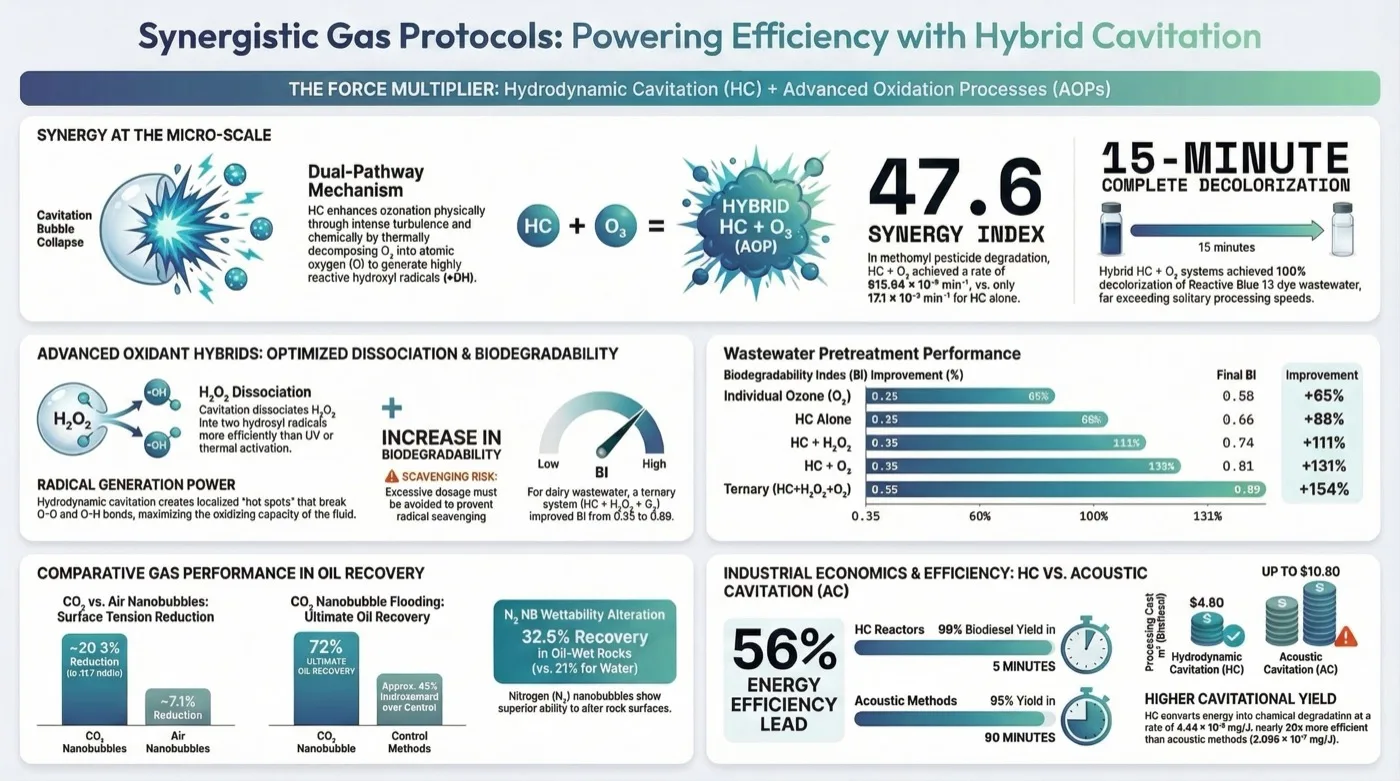
The combination of HC with reactive gases (Ozone) or liquid oxidants (H2O2) creates "hybrid AOPs" that significantly outperform individual unit operations. The mechanism relies on cavitation bubbles acting as micro-reactors that break down oxidants into non-selective radicals.
HC + Ozone (O3): The "Synergy Index"
- Mechanism: HC enhances ozonation through two pathways: (1) Physical: Intense turbulence and micro-circulation eliminate mass transfer resistance, breaking ozone gas into micro-nano bubbles that dissolve rapidly; (2) Chemical: The extreme conditions of cavity collapse (hot spots) thermally decompose ozone (O3) into atomic oxygen (O) and oxygen molecules (O2). The atomic oxygen reacts with water to generate hydroxyl radicals (\• OH), which are far more reactive than molecular ozone Wang & Cui, 2022.
- Performance Metrics: The "Synergy Index" (SI) quantifies this benefit. In the degradation of the pesticide methomyl, the combined HC + O3 process achieved a specific degradation rate of 915.94 \\times 10^{-3} \\text{ min}^{-1}, which was vastly superior to individual ozonation (2.1 \\times 10^{-3} \\text{ min}^{-1}) or HC alone (17.1 \\times 10^{-3} \\text{ min}^{-1}), yielding a synergy coefficient as high as 47.6 Mohod et al., 2023; Wang & Cui, 2022.
- Industrial Application: In the treatment of dye wastewater (Reactive Blue 13), the HC + O3 hybrid system achieved complete decolorization in 15 minutes and a 72% reduction in Total Organic Carbon (TOC) in 120 minutes, significantly faster than solitary processes Wang & Cui, 2022.
HC + Hydrogen Peroxide (H2O2)
- Radical Generation: Cavitation facilitates the dissociation of H2O2 into two hydroxyl radicals (2\• OH) much more efficiently than thermal or UV activation alone. However, an optimum dosage exists; excessive H2O2 can scavenge radicals, forming weaker hydroperoxyl radicals (HO2\•), which reduces efficiency Mohod et al., 2023.
- Ternary Systems (HC + H2O2 + O3): The combination of all three elements yields the highest degradation rates. For dairy wastewater, the Biodegradability Index (BI) improved from 0.35 to 0.89 using the ternary combination, compared to 0.66 for HC alone, demonstrating a strong synergistic effect for biological pretreatment Patil et al., 2025.
2. Side-by-Side Gas Comparisons: Efficacy vs. Fluid Properties
Recent studies have conducted direct comparisons of different nanobubble gases to determine their specific impacts on fluid mechanics and recovery rates.
Carbon Dioxide (CO2) vs. Air Nanobubbles
- Surface Tension Reduction: In "nanofluid" engineering for oil recovery, CO2 nanobubbles (NBs) are chemically more active than Air NBs. CO2-NBs reduced the surface tension of a surfactant-polymer solution by ~20.3% (down to 31.7 mN/m), whereas Air-NBs only achieved a ~7.1% reduction (to 59.7 mN/m) under identical conditions English, 2025.
- Recovery Yields: In core-flood tests, water flooding enhanced with CO2-NBs improved the ultimate oil recovery to 71–72% (a ~45% improvement over control), significantly outperforming standard gas flooding techniques due to mechanisms like oil swelling and viscosity reduction English, 2025.
Nitrogen (N2) vs. Water Flooding
- Wettability Impact: While CO2 is often used for miscibility, Nitrogen (N2) NBs are preferred for stability. In spontaneous imbibition tests on oil-wet carbonate rocks, N2 NB solutions achieved an ultimate oil recovery of 32.6%, compared to only 21% for distilled water. This indicates that N2 NBs can alter wettability or induce slippage mechanisms that water alone cannot Elnaggar et al., 2025.
3. Economic and Energy Analysis: HC vs. Acoustic Cavitation
A critical barrier to industrial adoption is energy cost. The literature provides definitive data favoring Hydrodynamic Cavitation (HC) over Acoustic Cavitation (AC) for bulk processing.
Biodiesel Production Costs
- Process Efficiency: HC reactors (specifically multi-hole orifice plates) achieved 99% biodiesel yield in just 5 minutes. In direct comparison, ultrasonic (acoustic) bath methods required 90 minutes to achieve 95% yield Cako et al., 2022.
- Cost Metrics: The processing cost for HC was estimated at 4.80 USD/m³. This is notably lower than acoustic cavitation methods, which ranged from 6.7 to 10.8 USD/m³, making HC the economically superior choice for scale-up Cako et al., 2022.
Wastewater Treatment Energy Yield
- Cavitational Yield: HC converts energy into chemical degradation more efficiently. For the degradation of methyl parathion, the cavitational yield for HC was reported at 4.44 \\times 10^{-6} mg/J, substantially higher than the 2.098 \\times 10^{-7} mg/J achieved by acoustic cavitation Mohod et al., 2023.
- Desulfurization Costs: For fuel desulfurization, vortex diode HC systems achieved costs as low as 36 USD/m³ (100% efficiency), whereas comparable acoustic methods were estimated at significantly higher operational costs due to the low energy efficiency of electrical-to-acoustic conversion Cako et al., 2022.
Net Present Value (NPV) in Aeration
- Nanobubble Aeration: In wastewater aeration, replacing conventional blowers with electric-field NB generation results in a linear-scaling cost profile. NPV analysis suggests that for high-cleanliness requirements, NB approaches effectively decouple energy costs from treatment levels, avoiding the exponential cost curve of conventional aeration English, 2022.