Turf & golf — Courses and sports fields

Greens that drink. Roots that go deeper.

Salts in the root zone, water that sits on top instead of soaking in, localized dry spots, shallow roots in summer stress, and aeration cycles and water budgets that keep growing. Oxygen injected into the irrigation main at the pump house reaches the root zone with every cycle, feeding the roots and the soil biology that keeps the profile open.

Yorba Linda Country Club, three months: one treated green against two control greens, +24.7% water penetration, with dissolved oxygen raised in the irrigation water at the pump house.

+24.7%
Water penetration
(Treated Green #9 vs controls · KST field data)
3 months
Pilot length
(Yorba Linda Country Club · 2023)
2 controls
Untreated greens on the same source water
(Greens #7 and #8)
The problem

Water on top isn't water in the root zone

Foot traffic, mowing and salty irrigation water work on a green every day. Salts build where water stops moving. As the surface tightens, water ponds in one spot and skips the next, and dry spots show up where it skips. Roots stay near the surface, where the oxygen is, and when summer stress arrives a shallow root system has little in reserve. The usual answers are more water, more hand-watering and another aeration pass.

How it works

Oxygen at the pump house. Delivered with every cycle.

We inject oxygen into the irrigation main at the pump house as ultrafine bubbles. They persist far longer in the water than coarse bubbles, so the oxygen travels with the water through the heads and into the profile. Each irrigation cycle carries oxygen to the root zone. Roots respire and keep growing down into it, and the aerobic soil biology that builds and holds pore structure picks up. As the pores open, water and the salts dissolved in it move down through the profile instead of sitting on top.

Root health first, then water and salts

Roots that keep growing down

A root grows into soil it can respire in. Oxygen arriving with each cycle supports root growth below the surface layer, and that depth is the reserve a green draws on when summer stress arrives.

Water that soaks in

The aerobic microbes that bind particles into stable aggregates need oxygen to do it. As pore structure opens, irrigation moves into the profile instead of ponding on top. At Yorba Linda, less water pooled on the treated green.

Salts that move down

Salt concentrates where water stops. With water moving through the profile, the salts dissolved in it move below the root zone rather than building up in it. Flushing still does the leaching; oxygen helps the profile take the water.

Oxygen supports aeration, topdressing and flushing. It does not replace them, and it is not a sanitizer: keep your cultural and turf-health program, and judge the change in your own readings.

The pilot that fits a course

One treated green. Controls beside it. Three months.

A course pilot treats the water to one green and keeps control greens on the untreated supply, on the same irrigation schedule and the same cultural program, for three months.

  • Before anything ships: we capture your baseline and agree the success criteria in writing.
  • Through the pilot: soil moisture (VWC), soil conductivity (EC) and dissolved oxygen are logged, and soil cores are taken at intervals for rooting and compaction. You see each reading as it is logged, not in a report at the end.
  • Your layout: how the trial green is isolated depends on your irrigation system; the proposal names it.
  • Credit: pilot fees can credit toward the full system, up to the full pilot fee on structured trials.

What Yorba Linda measured

Yorba Linda Country Club ran it this way in 2023: Green #9 treated, Greens #7 and #8 as controls on the same source water. Over three months the treated green showed +24.7% water penetration against the controls. Dissolved oxygen in the treated irrigation water rose 300% against the untreated supply; that is the input, not a result.

The paired soil cores show deeper rooting on the treated plot, a visual observation rather than a measured figure. The club also recorded fewer aeration cycles and chemical treatments on the treated green, without keeping a figure. The skid injected oxygen and ozone together, so the result belongs to that combined treatment, at one club, on its water and soil.
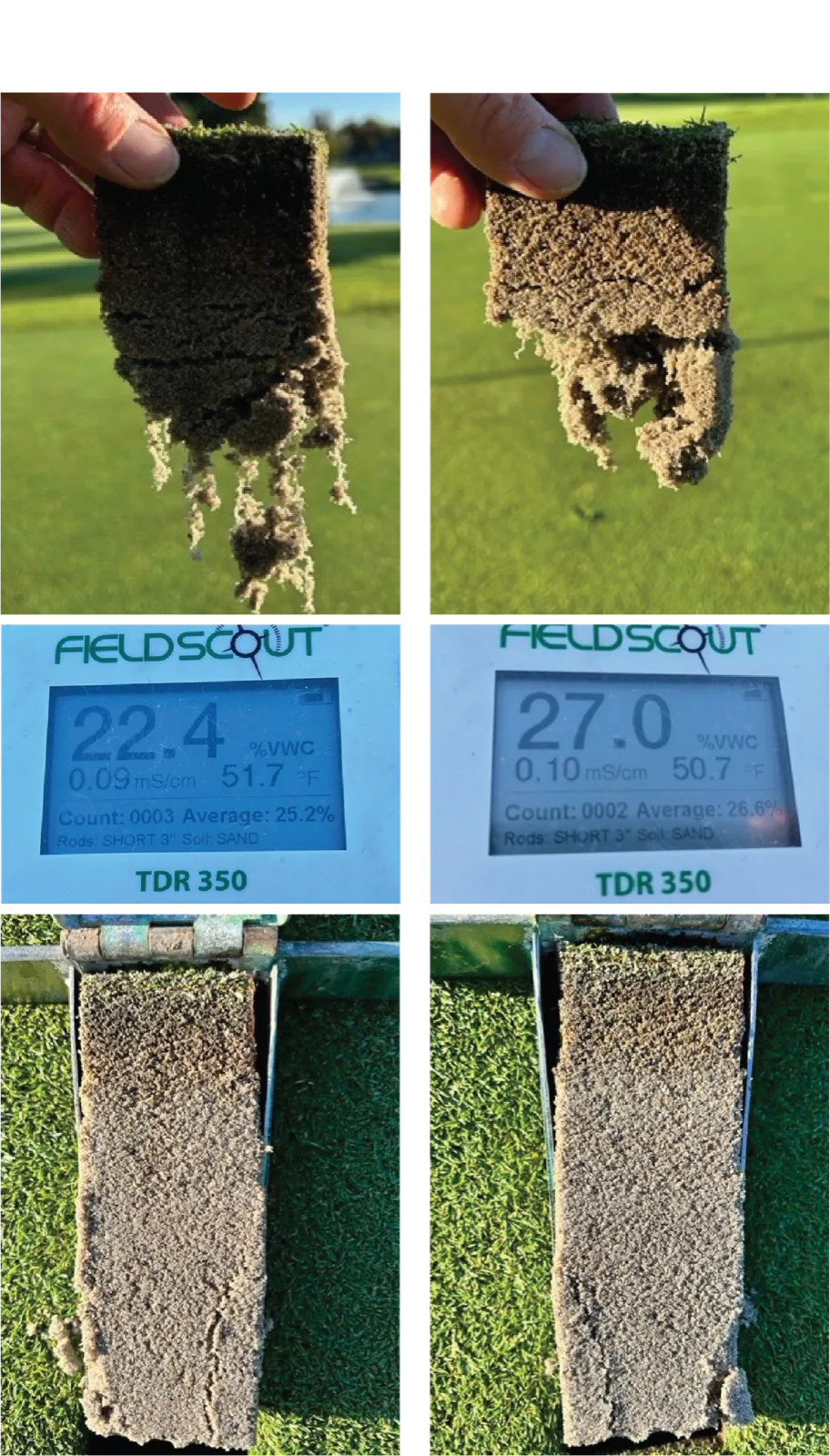
Paired photos from the Yorba Linda pilot: soil cores, FieldScout TDR 350 moisture and conductivity readings, and profile samples, with treated Green #9 on the left and untreated control Green #8 on the right
Left: Green #9, treated. Right: Green #8, untreated control. Soil cores, FieldScout TDR 350 readings and profile samples from the pilot.
What you're buying

One system in the pump house, sized to your main

We size it from your pump flow, main diameter and water source, and the proposal names the injection point and the power it needs.

  • HardwareA titanium-core inline injector sized to your irrigation main, a PSA oxygen concentrator matched to it, and an optical dissolved-oxygen meter to read the result.
  • Where it goesIn the pump house, inline on the irrigation main, so every zone that main feeds gets treated water.
  • InstallTies into existing piping in 1–3 days, with hours of interruption on the treated line, not days, scheduled around your irrigation windows.
  • Lead time4–6 weeks from down payment to hardware on site.
  • PowerA dedicated GFCI-protected circuit, commonly about 220 V / 30 A. The exact spec is in your proposal.
  • Warranty3 years on non-moving parts (piping, injectors, cavitators); 1 year on moving parts (pump, oxygen generator).
  • MaintenanceInjectors have no moving parts. Pumps and oxygen generators are serviced every six months.
  • Ways to buyDirect from Kairospace, through your irrigation dealer, or lease-to-own: 3–4 month terms, with lease fees credited toward the purchase.
Get a quote for my course WhatsApp an engineer An engineer replies within 48 hours.
Buyer questions

What superintendents ask before a pilot

Will it change my fertigation or wetting-agent program?

It adds dissolved oxygen to the water, not a product, so your fertigation and wetting-agent program stays yours. We ask what you inject into the main and where, and place the oxygen injection relative to it. During a pilot, treated and control greens stay on the same program, so the difference you measure is the water. Any rate change afterward is your call, made on your own readings.

What goes in the pump house?

A titanium-core injector inline on the irrigation main, a PSA oxygen concentrator beside it, and an optical dissolved-oxygen meter. You provide access to the main at the injection point and floor space for the equipment; we handle delivery, installation, commissioning and training for your crew. The tie-in takes 1–3 days, with hours of interruption on the treated line, scheduled around your irrigation windows.

What power does it need?

A dedicated GFCI-protected circuit, commonly about 220 V / 30 A. Your proposal gives the exact voltage and amperage for the system sized to your main, so your electrician can quote the circuit before anything ships.

How do you measure the result?

At the main, an optical meter reads dissolved oxygen in the irrigation water. On the greens, soil moisture (VWC) and soil conductivity (EC) are logged with a probe on treated and control greens (Yorba Linda used a FieldScout TDR 350), and soil cores are pulled at intervals to look at rooting and compaction. The success criteria are agreed in writing before the pilot starts.

What does a pilot need from my crew?

A trial green and control greens that are as alike as you can pick them: similar construction, age, exposure and traffic. Keep the same irrigation schedule and cultural program on all of them, and log when you aerate, topdress or flush so it sits next to the readings. We bring the instruments and set the reading schedule with you.

How do I buy it?

Three ways: direct from Kairospace, through your irrigation dealer, or lease-to-own, with 3–4 month terms and lease fees credited toward the purchase. You can start with a one-green pilot; pilot fees can credit toward the full system, up to the full pilot fee on structured trials. Hardware is on site 4–6 weeks after the down payment.

Next step

Measure it on your own greens

Tell us your pump flow, main size, water source and the greens that give you the most trouble. An engineer replies within 48 hours, with a proposal or with the questions we need to write one.