Advanced oxidation processes (AOPs)
How do hydrodynamic cavitation and ozone, alone and combined, break down persistent pollutants in wastewater?
On this page
How cavitation forms hydroxyl radicals
Hydrodynamic cavitation () turns a pressure drop into oxidizing chemistry. When liquid passes a constriction such as a venturi or an orifice plate, local pressure falls below the vapor pressure; vapor-filled cavities form and grow, then collapse violently when the pressure recovers.
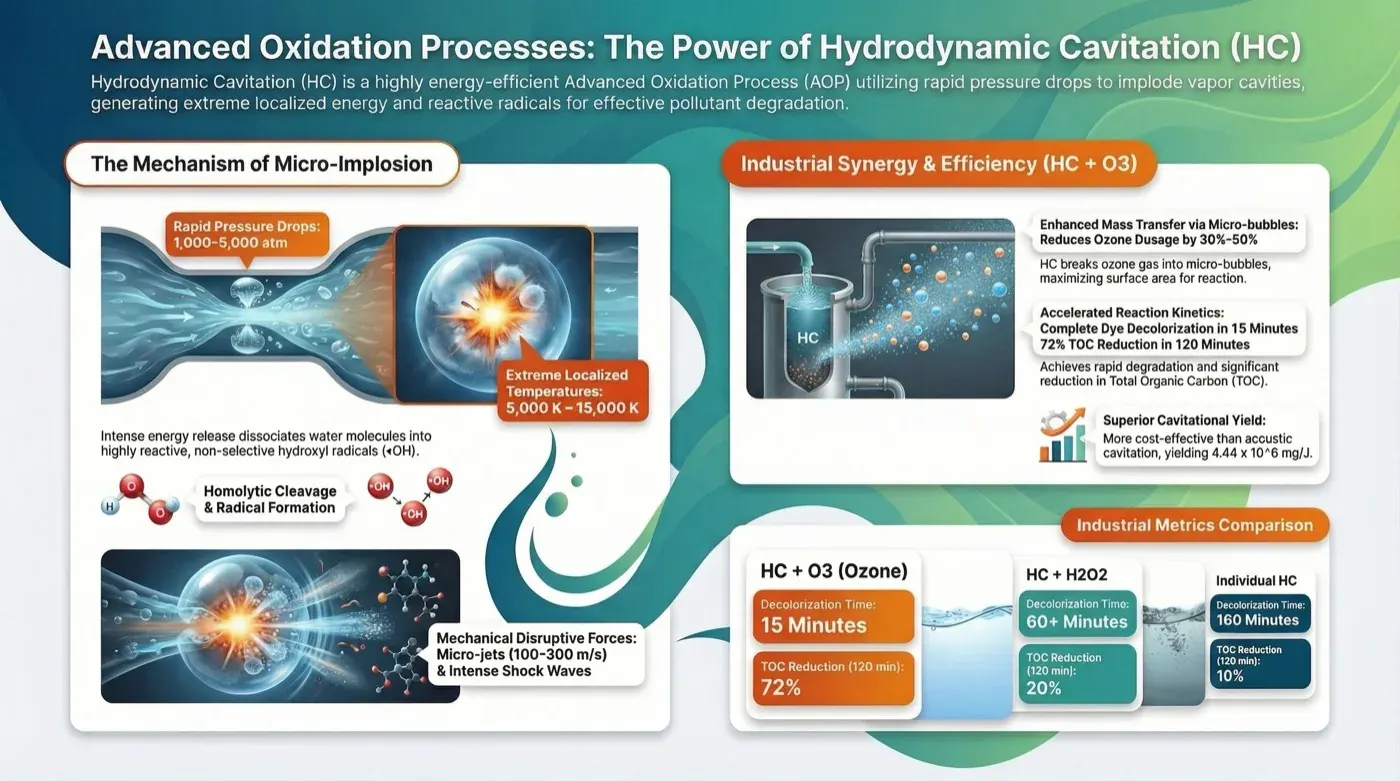
An advanced oxidation process () is any treatment that generates hydroxyl radicals to break down pollutants, and HC is one route to them. The collapse of each cavity is nearly adiabatic, so energy concentrates in a tiny volume for an instant. Reviews estimate local temperatures of 5,000–15,000 K and pressures of 1,000–5,000 atm (about 100–500 MPa) inside the collapsing cavities Wang et al., 2022; Warade et al., 2023.
Under those conditions, water vapor trapped in the cavity dissociates by heat (pyrolysis) into hydrogen atoms and hydroxyl radicals: H₂O → •H + •OH Mohod et al., 2023; Wang et al., 2022. The hydroxyl radical belongs to the reactive oxygen species () and is a non-selective oxidant.
How pollutants break down
Complex molecules such as textile dyes (for example Rhodamine B) and pharmaceutical residues degraded through two pathways in the reviewed work. Which pathway applies depends on whether the pollutant is volatile enough to enter the cavity.
- Pyrolysis inside the cavity. Volatile pollutants that enter the cavitation bubble are decomposed by the heat of collapse, which breaks strong covalent bonds in their structure Wang et al., 2022.
- Radical attack and shear outside it. Non-volatile pollutants gather at the gas–liquid interface or stay in the bulk liquid, where the •OH radicals released on collapse attack them. The collapse also produces shock waves and micro-jets whose turbulence and shear break down large molecules and reduce mass-transfer resistance, leaving pollutants more exposed to oxidation Yeneneh et al., 2024; Wang et al., 2022.
Combining cavitation with ozone
HC combined with ozone (O₃) outperformed either process alone in the studies reviewed by Wang et al., 2022. The synergy index, which compares the combined process with the individual ones, typically ranged from 1 to 4 and exceeded 10 in some cases, depending on the pollutant and operating conditions.
Two mechanisms explain the gain.
- Mass transfer. Ozone dissolves poorly in water, and its from gas to liquid meets high resistance. The turbulence and micro-circulation of cavitation broke the ozone gas into microbubbles, increasing interfacial area and dissolution; the required ozone dose fell by about one-third to one-half Wang et al., 2022.
- Radical generation. Inside cavitation bubbles, ozone decomposes at lower temperatures than water does, forming atomic oxygen and molecular oxygen (O₂). The atomic oxygen reacts with water to form hydroxyl radicals: O(³P) + H₂O → 2•OH Wang et al., 2022.
This continuous conversion of ozone kept •OH available for persistent pollutants such as the pesticide triazophos and dyes, with degradation rates higher than ozonation alone Mohod et al., 2023.
Reported reaction rates
The combined process was faster than single processes in the comparisons the reviews collected.
- Dye wastewater. For Reactive Blue 13, HC plus ozone reached complete decolorization in 15 minutes and a 72% reduction in TOC in 120 minutes; the individual processes needed considerably longer to reach comparable results Wang et al., 2022.
- Degradation rate. A degradation rate as high as 915.94 × 10⁻³ min⁻¹ was reported for combined ozone and HC, well above the rates of the single unit operations Mohod et al., 2023.
Color and carbon moved at different speeds. The dye lost its color within 15 minutes, while TOC, a measure of the organic carbon still in the water, had fallen by 72% after 120 minutes. Loss of color is therefore not the same as removal of the organic carbon.
Energy yield and cost
HC used energy more efficiently than acoustic cavitation in the comparison reported by Mohod et al., 2023. Cavitational yield expresses the mass of pollutant degraded per joule delivered. For methyl parathion, HC reached 4.44 × 10⁻⁶ mg/J, against 2.098 × 10⁻⁷ mg/J for acoustic cavitation.
The reviews also describe combined HC and ozone as more cost-effective than the individual processes: stronger oxidation lowers the oxidant dose, and with it the treatment cost and energy demand. They present the combination as a candidate for large-scale industrial effluent treatment Yeneneh et al., 2024; Wang et al., 2022. The sources summarized here give no cost per cubic meter, so the comparison remains qualitative.
What this means in practice
The findings apply to wastewater carrying persistent organic pollutants, such as dyes, pesticides or pharmaceutical residues, treated by HC with or without ozone. Because the synergy index varied with the pollutant and the operating conditions, a site would test its own effluent at bench scale before scaling up.
A useful test runs three arms on the same water: HC alone, ozone alone and the two combined. For each arm, record the target pollutant concentration over time (to compare degradation rates in min⁻¹), color, and TOC before and after treatment, so that decolorization is not mistaken for removal of organic carbon. Log the ozone dose applied and the electrical energy delivered to the cavitation device, so that yield can be expressed in mg/J and any ozone saving compared with the one-third to one-half reported in reviews Wang et al., 2022.
Limits and open questions
- Most figures here come from review articles, which pool studies with different reactors, pollutants and operating conditions. Reactor volumes, flow rates and treatment scale are not given for individual results.
- The temperature and pressure figures are estimates for the inside of a collapsing cavity, not measurements of the bulk liquid.
- The synergy index ranged from about 1 to over 10, so a result for one dye or pesticide does not predict the result for another effluent.
- The energy comparison covers one pesticide, methyl parathion, and the cost advantage is described only qualitatively.
- The summarized results do not report transformation products or residual ozone, and they concern cavitation and ozone microbubbles; they do not isolate an effect of nanobubbles.
Questions
What makes an oxidation process "advanced"?
An advanced oxidation process generates hydroxyl radicals, highly reactive and non-selective oxidants, to break down pollutants. In hydrodynamic cavitation, collapsing vapor cavities split water into hydroxyl radicals and hydrogen atoms; reviews estimate local temperatures of 5,000–15,000 K inside the cavities at the moment of collapse Wang et al., 2022.
Why combine hydrodynamic cavitation with ozone?
Cavitation breaks ozone gas into microbubbles and adds turbulence, which improves ozone transfer into water, and it decomposes ozone into atomic oxygen that forms more hydroxyl radicals. Reviewed studies reported synergy indices of 1 to 4, sometimes above 10, and ozone doses lowered by about one-third to one-half Wang et al., 2022.
Is hydrodynamic cavitation more energy-efficient than ultrasound?
In the comparison reported by Mohod and colleagues, it was. For methyl parathion, hydrodynamic cavitation degraded 4.44 × 10⁻⁶ mg of pollutant per joule, against 2.098 × 10⁻⁷ mg/J for acoustic cavitation Mohod et al., 2023. That comparison covers a single pesticide, so a site would measure yield on its own effluent.
References
- Wang, B., Liu, Y., Zhang, H., et al. (2022). Hydrodynamic cavitation and its application in water treatment combined with ozonation: A review. Journal of Industrial and Engineering Chemistry, 114, 33-51. https://doi.org/10.1016/j.jiec.2022.07.031 ↩
- Mohod, A. V., Teixeira, A. C. S. C., Bagal, M. V., et al. (2023). Degradation of organic pollutants from wastewater using hydrodynamic cavitation: A review. Journal of Environmental Chemical Engineering, 11, 109773. https://doi.org/10.1016/j.jece.2023.109773 ↩
- Warade, A., Shinde, G., Gaikwad, R., et al. (2023). Intensification of pharmaceutical wastewater treatment using hydrodynamic cavitation process. Materials Today: Proceedings, 77, 692-697. https://doi.org/10.1016/j.matpr.2022.11.355 ↩
- Yeneneh, A. M., Al Balushi, K., Jafary, T., et al. (2024). Hydrodynamic Cavitation and Advanced Oxidation for Enhanced Degradation of Persistent Organic Pollutants: A Review. Sustainability, 16, 4601. https://doi.org/10.3390/su16114601 ↩