Enhanced oil recovery (EOR)
What have core-flood and laboratory studies shown about nanobubbles and cavitation in enhanced oil recovery?
On this page
Mobility control and sweep efficiency
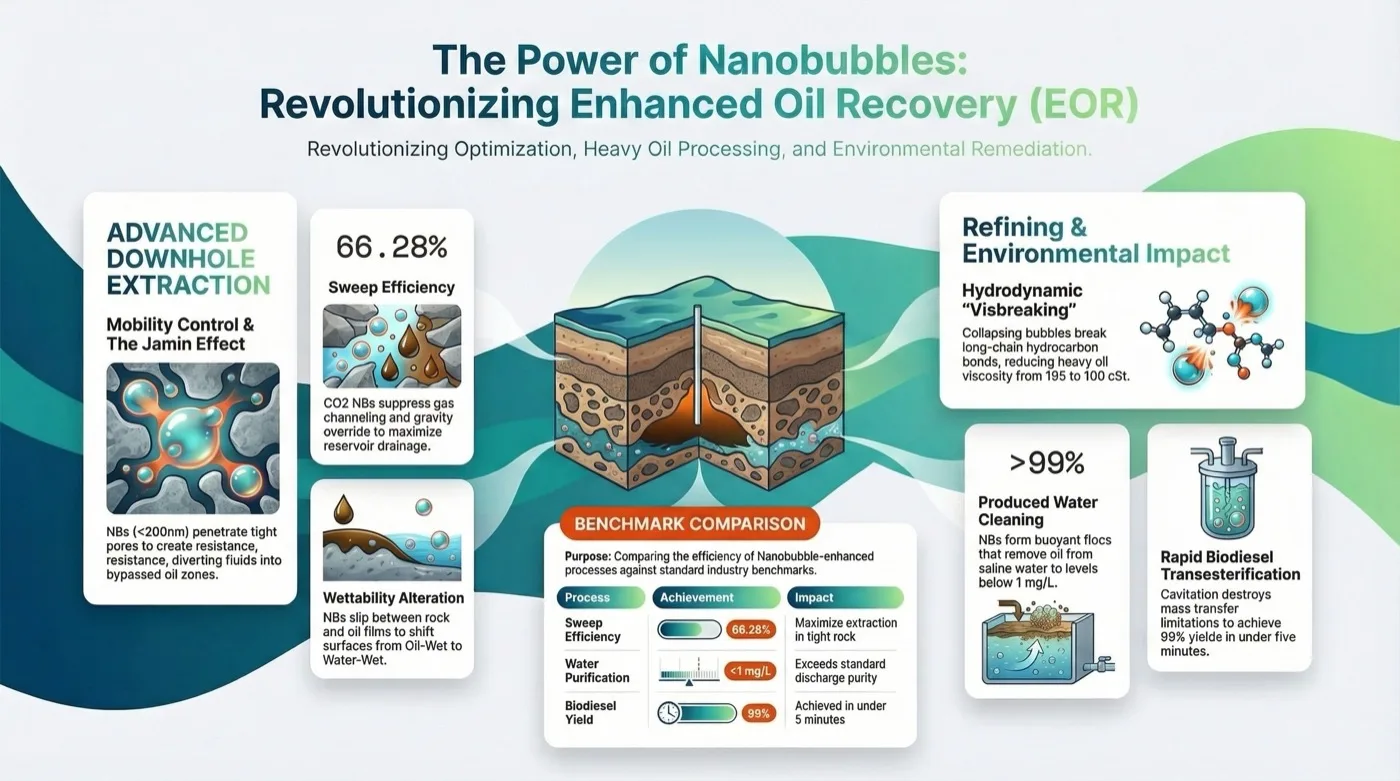
In core-flooding experiments, CO₂ nanobubbles improved sweep by resisting flow in high-permeability channels and diverting the injected fluid into tighter rock Cai et al., 2024. Sweep efficiency is the share of the reservoir that injected fluid actually contacts, and it is where conventional gas injection in (enhanced oil recovery) tends to fall short.
Gas injected as large bubbles or as a continuous phase separates from the water, rises over it (gravity override) and fingers through the most permeable zones, leaving oil behind in the rest of the rock. Nanobubbles, typically below 200 nm, are smaller than the pore throats of tight reservoirs, so they can travel with the carrier liquid into the rock matrix. In extra-low-permeability CO₂-EOR, Cai et al. reported that CO₂ nanobubbles suppressed gas channeling and gravity override while remaining a dispersed phase in the liquid Cai et al., 2024.
The Jamin effect
The mechanism behind the diversion is the Jamin effect. When a bubble reaches a pore throat narrower than itself, it has to deform to pass, and the capillary pressure needed to squeeze it through adds resistance to flow. The liquid behaves as if it had a higher apparent viscosity.
Bubbles held in this way accumulate in the high-permeability channels that carry most of the flow. The added resistance there pushes the fluid that follows into lower-permeability zones that still hold bypassed oil. In Cai et al.'s core floods, this blocking and diversion contributed to a recovery rate of 66.28%, reported as 17.64% higher than conventional water flooding followed by CO₂ flooding Cai et al., 2024.
Wettability alteration
In laboratory tests, N₂ and CO₂ nanobubbles shifted oil-wet rock toward water-wet behavior, which let water enter the pores and displace oil Elnaggar et al., 2025. Wettability describes which fluid prefers to coat the rock. In oil-wet reservoirs, oil clings to the pore walls and water flooding leaves much of it in place.
The proposed mechanism is that nanobubbles gather at the solid–liquid interface or form a thin gas layer that reduces the contact area between oil and rock. Elnaggar et al. described N₂ nanobubbles acting as a third, intermediate-wetting phase that reached isolated oil globules in micropores and invaded oil-filled pores more strongly than water alone.
The evidence comes from spontaneous-imbibition experiments on oil-wet carbonate rock (Minnesota Northern Cream). N₂ nanobubbles gave higher oil recovery than distilled water, and the authors attributed this to a slippage effect and altered capillary forces that let the aqueous phase imbibe and displace the oil. The largest gain appeared at 120 °C and 45 psi, where recovery approached that of water-wet rock Elnaggar et al., 2025.
A second study reached a similar conclusion with a different system: CO₂ nanobubbles stabilized with modified nano-silica shifted wettability from oil-wet toward water-wet and helped peel oil films from the surface Cai et al., 2024. That system combined the bubbles with a chemical stabilizer, so the result belongs to the pair, not to the bubbles alone.
Heavy-oil viscosity reduction
Hydrodynamic cavitation lowered heavy-oil viscosity in laboratory experiments when a hydrogen donor was present Askarian et al., 2017. Heavy oil and bitumen are hard to produce and transport because they flow poorly, so a lower viscosity matters from the wellhead to the refinery.
Cavitation bubbles form when a liquid's pressure drops below its vapor pressure and collapse when it recovers. The collapse creates local hot spots of high temperature and pressure. Askarian et al. described this energy as enough to break carbon–carbon bonds in long-chain hydrocarbons, such as paraffins and asphaltenes, into shorter and lighter chains: a process similar to visbreaking, driven by mechanical and acoustic energy rather than furnace heat.
Cavitation on its own also forms free radicals that can recombine (re-polymerize) and raise viscosity again. The authors reported that a hydrogen donor, such as a small amount of gasoline or tetrahydronaphthalene, inhibited this recombination so that the viscosity reduction held. With 2% gasoline as the donor, viscosity at 60 °C fell from about 155 cSt to about 100 cSt (cSt: centistokes), and API gravity, the American Petroleum Institute scale of how light an oil is, rose measurably. The oil was partially upgraded: lighter and easier to transport and refine Askarian et al., 2017.
A separate route works in the reservoir itself. When CO₂ from nanobubbles dissolves into crude oil, the oil swells and its viscosity drops, which the core-flood study counted among the reasons for higher recovery Cai et al., 2024.
What this means in practice
These findings describe laboratory cores, oils and conditions. A field would first repeat them with its own cores and fluids before any injection trial, because permeability, temperature, pressure, salinity and oil composition all change the result.
The measurements that matter are the ones the studies reported. For mobility control, measure incremental recovery over a water-flood baseline in core floods, together with pressure drop across the core to see whether flow resistance actually rises. For wettability, compare spontaneous-imbibition recovery against a distilled-water or brine control at reservoir temperature and pressure. For cavitation upgrading, record viscosity in cSt at a stated temperature and API gravity before and after treatment, with and without the hydrogen donor.
Characterize the injected dispersion as well: bubble size and concentration, with gas-free controls, and whether the bubbles survive the pumps, lines and injection conditions. If a stabilizer such as nano-silica is used, test it alone too, so the effect of the bubbles can be separated from the effect of the chemistry.
Limits and open questions
All of the evidence here is from the laboratory: core floods, imbibition cells and a cavitation setup. No field pilot, reservoir simulation at field scale or economic analysis is cited.
Each finding rests on a single study, and the lesson does not give sample sizes or the number of repeat runs. The 66.28% recovery came from a nano-silica-stabilized CO₂ system, so the separate contributions of bubbles and silica are not shown. The imbibition result was for one oil-wet carbonate, with the largest gain at 120 °C and 45 psi; other rock types and conditions may behave differently.
The cavitation result depended on the hydrogen donor. Without it, the radicals cavitation forms can recombine and raise viscosity instead of lowering it. Whether nanobubbles remain stable over the distances and residence times of a real reservoir, at its temperature, pressure and salinity, is not established by the studies cited.
Questions
How do nanobubbles improve sweep efficiency?
In core floods, CO₂ nanobubbles lodged in the pore throats of high-permeability channels, and the capillary pressure needed to squeeze them through (the Jamin effect) added flow resistance. Injected fluid then moved into tighter zones holding bypassed oil. Cai et al. reported 66.28% recovery, 17.64% higher than water flooding followed by CO₂ flooding Cai et al., 2024.
Can nanobubbles change rock wettability?
Laboratory studies report a shift toward water-wet behavior. In spontaneous-imbibition tests on oil-wet carbonate, N₂ nanobubbles recovered more oil than distilled water, most at 120 °C and 45 psi Elnaggar et al., 2025. CO₂ nanobubbles stabilized with modified nano-silica also moved surfaces from oil-wet toward water-wet Cai et al., 2024.
Does hydrodynamic cavitation lower heavy-oil viscosity?
In laboratory experiments with 2% gasoline as a hydrogen donor, cavitation lowered heavy-oil viscosity at 60 °C from about 155 cSt to about 100 cSt and raised API gravity. The donor mattered: without it, radicals formed during cavitation can recombine and raise viscosity again Askarian et al., 2017.
References
- Cai, L., Wu, J., Zhang, M., et al. (2024). Investigating the Potential of CO2 Nanobubble Systems for Enhanced Oil Recovery in Extra-Low-Permeability Reservoirs. Nanomaterials, 14, 1280. https://doi.org/10.3390/nano14151280 ↩
- Elnaggar, H., Taman, A., Ali, R., et al. (2025). Oil Recovery Enhancement by N 2 Nanobubbles. Energy & Fuels, 39, 2482-2499. https://doi.org/10.1021/acs.energyfuels.4c05180 ↩
- Askarian, M., Vatani, A., Edalat, M. (2017). Heavy oil upgrading via hydrodynamic cavitation in the presence of an appropriate hydrogen donor. Journal of Petroleum Science and Engineering, 151, 55-61. https://doi.org/10.1016/j.petrol.2017.01.037 ↩