Animal production and the gut
What has research reported about nanobubble drinking water, poultry production, rumen fermentation and methane, and how much of it was measured in animals?
On this page
Broiler growth and feed conversion
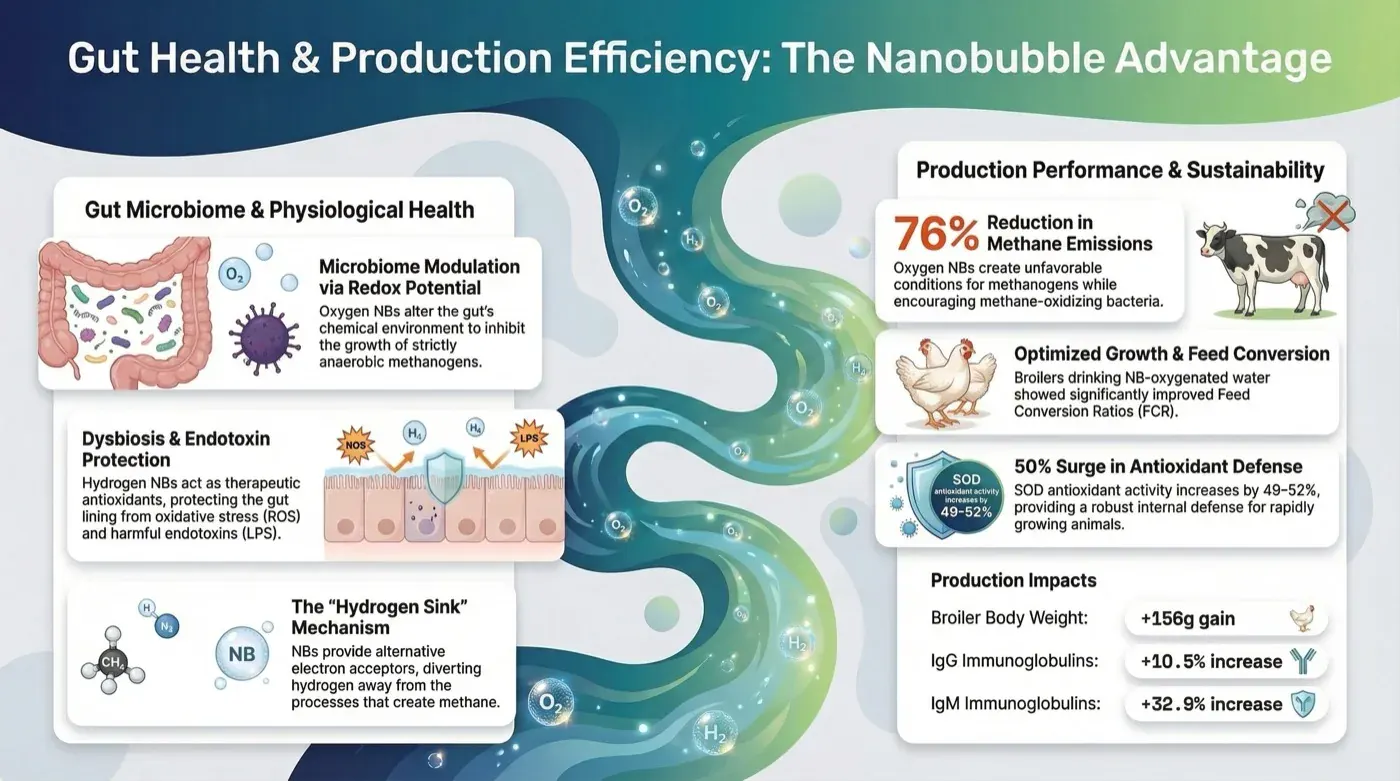
Broilers drinking oxygenated nanobubble water grew heavier than birds on tap water. After five weeks of supplementation, final body weight was 156 g higher than in the control group, and the feed conversion ratio () improved Shin et al., 2016.
Researchers also reported less abdominal fat in the birds given oxygenated nanobubble water than in controls drinking tap water Shin et al., 2016.
Broiler immune and antioxidant markers
The same study measured blood and tissue markers. These are research measurements in one poultry trial, reported here as findings, not as health outcomes.
Researchers reported that oxygenated nanobubble water raised immunoglobulin levels in broilers: IgG by 10.58% and IgM by 32.97% Shin et al., 2016. Immunoglobulins are antibodies measured in blood; a higher level is a marker, and this lesson does not link it to disease outcomes.
Both oxygenated and hydrogen nanobubble water raised the activity of superoxide dismutase (SOD), an antioxidant enzyme, by 49–52% in serum, and increased it in breast muscle tissue as well Shin et al., 2016. A higher SOD level is consistent with, but does not by itself show, lower oxidative stress in fast-growing birds.
Rumen fermentation: what the reviews say
No study in this lesson delivered nanobubbles to a rumen. What exists is a line of reasoning built from reviews of rumen biology.
Fermentation in the rumen depends on redox potential, which shapes which microbes thrive. Rumen methanogens are strictly anaerobic archaea. A review of rumen methanogens, which did not test nanobubbles, describes methanogens as extremely sensitive to oxygen, and reports that interventions raising redox potential can suppress methanogenesis and shift fermentation toward propionate, which is energetically more favorable for the host animal Patra et al., 2017.
A second review describes how high-energy diets can unbalance rumen microbes (dysbiosis), raising Gram-negative bacteria and the release of endotoxins (lipopolysaccharides, LPS), which is associated with inflammation and lower performance Khiaosa-ard & Zebeli, 2014. Whether nanobubble water changes any of this in cattle has not been studied in the work cited here.
Methane: evidence from sediment, not the rumen
The methane evidence for oxygen nanobubbles comes from sediment, and it describes a shift in microbes rather than a measured cut in livestock emissions.
Methanogens produce methane (CH₄) from hydrogen (H₂) and carbon dioxide (CO₂), and they need strictly anaerobic conditions. At sediment–water interfaces, oxygen nanobubbles () decreased methanogen abundance and increased the abundance of methanotrophs, the bacteria that oxidize methane, so more carbon left as CO₂ rather than as CH₄, the more potent greenhouse gas Shi et al., 2018.
The proposed link to the rumen is the hydrogen sink. Strategies against methanogenesis often rely on an alternative sink for hydrogen, and a review of those strategies describes such sinks Patra et al., 2017. The hypothesis is that oxygen delivered by nanobubbles could act as an electron acceptor and divert hydrogen away from methane formation. That hypothesis has not been tested in animals in the cited work.
What this means in practice
The measured findings here apply to broilers drinking oxygenated or hydrogen nanobubble water over five weeks. The rumen and methane material is a hypothesis to test, not a result to rely on. Any trial with animals would be designed with a veterinarian and follow the rules for animal studies and feed or water additives where the farm operates.
A drinking-water comparison would keep feed, housing and flock or herd management the same across groups and record:
- Water: dissolved oxygen () in mg/L at the drinker, not only at the source, and daily water intake per group.
- Production: body weight at fixed intervals, feed delivered, FCR, and carcass traits such as abdominal fat at slaughter.
- Markers, if in scope: blood samples analyzed by an accredited laboratory for the same markers the study used.
- Methane: only direct measurement with a recognized method can support a methane figure; nothing in this lesson provides one for livestock.
Limits and open questions
- The animal data come from one broiler study over five weeks; this lesson does not report its sample size or replicates.
- The source's title describes oxygenated or hydrogenated water; this lesson does not record how the nanobubbles were generated or characterized, so the effect of the bubbles cannot be separated from the effect of the dissolved gas.
- Immunoglobulin and SOD levels are markers measured in blood and tissue, not disease outcomes.
- No cited study gave nanobubble water to cattle or other ruminants. The rumen mechanism rests on reviews that did not test nanobubbles.
- The methanogen and methanotroph shifts were measured at sediment–water interfaces. They provide no methane reduction figure for livestock.
Questions
Do nanobubbles reduce methane from cattle?
No study cited here gave nanobubble water to cattle or measured enteric methane. Oxygen nanobubbles lowered methanogens and raised methanotrophs at sediment–water interfaces, and a review describes rumen methanogens as highly sensitive to oxygen. The rumen effect is a hypothesis that would need direct measurement in animals.
What did the broiler study find?
Broilers given oxygenated nanobubble water for five weeks were 156 g heavier than controls on tap water, with improved feed conversion and less abdominal fat. Researchers also reported higher IgG and IgM levels and 49–52% higher serum superoxide dismutase activity. This is one study in one species.
Do higher antioxidant and antibody levels mean healthier animals?
Not on their own. Superoxide dismutase and immunoglobulins are markers measured in blood and tissue, and this lesson reports no disease outcomes from the broiler study. They show that the birds' physiology changed under the trial conditions, which makes them a starting point for further research.
References
- Shin, D., Cho, E., Bang, H. T., et al. (2016). Effects of oxygenated or hydrogenated water on growth performance, blood parameters, and antioxidant enzyme activity of broiler chickens. Poultry Science, 95, 2679-2684. https://doi.org/10.3382/ps/pew237 ↩
- Shi, W., Pan, G., Chen, Q., et al. (2018). Hypoxia Remediation and Methane Emission Manipulation Using Surface Oxygen Nanobubbles. Environmental Science & Technology, 52, 8712-8717. https://doi.org/10.1021/acs.est.8b02320 ↩
- Patra, A., Park, T., Kim, M., et al. (2017). Rumen methanogens and mitigation of methane emission by anti-methanogenic compounds and substances. Journal of Animal Science and Biotechnology, 8, 13. https://doi.org/10.1186/s40104-017-0145-9 ↩
- Khiaosa-ard, R., Zebeli, Q. (2014). Cattle's variation in rumen ecology and metabolism and its contributions to feed efficiency. Livestock Science, 162, 66-75. https://doi.org/10.1016/j.livsci.2014.01.005 ↩