Growth performance and feed efficiency
What did published trials measure on growth, feed conversion and survival when shrimp and fish were reared in nanobubble water?
On this page
Growth in shrimp and finfish
Shrimp and fish grew heavier in nanobubble water than in the comparison water in both studies. The effect was reported as higher final weight and biomass, measured against a conventional control.
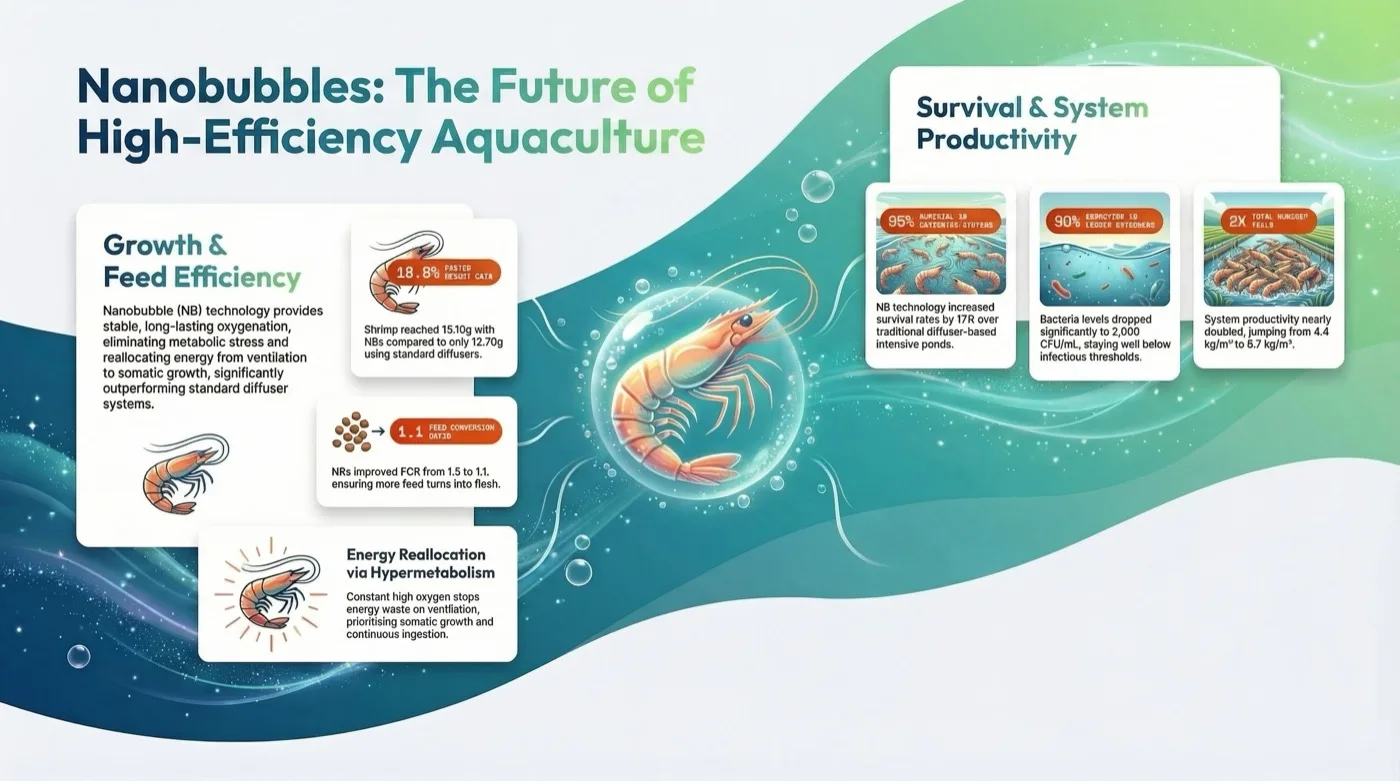
In the shrimp trial, Penaeus vannamei reared for 81 days in nanobubble-treated indoor raceway ponds reached an average final weight of 15.10 g (± 1.79), compared with 12.70 g (± 1.83) in control ponds using standard diffuser aerators. That is about 18.9% more individual body mass. Average length rose from 11.55 cm in the control to 13.10 cm with nanobubbles Rahmawati et al., 2021.
In the finfish trials, sweetfish biomass grew from an initial 3.0 kg to 10.2 kg in air-nanobubble water, compared with 6.4 kg in normal water, a final biomass about 59% higher. Rainbow trout biomass rose from 50.0 kg to 148.0 kg in nanobubble water over 6 weeks, against 129.5 kg in normal water Ebina et al., 2013.
Why oxygen could affect growth
The explanations offered are about energy, not hormones. They are proposed mechanisms that fit the results; the trials did not measure them directly.
The first is energy allocation. When oxygen is scarce, a large share of an aquatic animal's energy budget goes to breathing (ventilation). Ebina et al. proposed that, with high oxygen availability from nanobubbles, less energy is spent on ventilation and more can go to somatic growth, a "hypermetabolic state" in which digestion and absorption run faster Ebina et al., 2013.
The second is feeding behavior. For P. vannamei, oxygen is a deciding factor in metabolism: when the oxygen cost of eating and processing food cannot be met, shrimp stop feeding to conserve energy Rahmawati et al., 2021. Keeping dissolved oxygen () stable would, on this reasoning, keep shrimp feeding and digesting through the periods when oxygen would otherwise dip.
Feed conversion
Less feed produced each kilogram of shrimp in the nanobubble ponds. The feed conversion ratio () was 1.1 in the nanobubble-treated ponds and 1.5 in the control ponds using diffusers Rahmawati et al., 2021.
The proposed explanation is that digestion is aerobically demanding. Oxygen commonly dips after feeding; if stable DO prevents the metabolic slowdown that comes with those dips, more of the feed is converted to body mass rather than passing through undigested Rahmawati et al., 2021. FCR is also shaped by feed quality, feeding practice and stocking, so a single trial's ratio is a reference point rather than a benchmark.
Survival and harvest
Survival was higher in the nanobubble ponds. At a stocking density of 680 shrimp/m³, survival reached 95% in nanobubble-treated ponds and 78% in the control ponds aerated with diffusers Rahmawati et al., 2021.
Higher survival and heavier animals together nearly doubled the harvest. Total harvest weight was 436 kg in the nanobubble ponds against 222 kg in the controls, and productivity was 8.7 kg/m³ against 4.4 kg/m³ Rahmawati et al., 2021.
Vibrio counts in the shrimp ponds
The nanobubble ponds also carried fewer Vibrio. Total Vibrio bacteria counts were 2.0 × 10³ CFU/mL in the nanobubble ponds and 1.9 × 10⁴ CFU/mL in the diffuser ponds Rahmawati et al., 2021.
One proposed explanation is that high DO promotes bacterial autolysis and reduces sludge production Rahmawati et al., 2021. The trial reported lower counts and higher survival side by side; that comparison does not show that one caused the other.
What this means in practice
These results come from a single 81-day shrimp trial and a set of finfish rearing trials. A farm that wants to know whether similar effects appear under its own conditions can run a side-by-side comparison: matched units, same stock, same feed and stocking density, one with nanobubble treatment and one with its usual aeration.
- Oxygen: log DO in mg/L continuously or at fixed times, including the hour after each feeding, when oxygen tends to dip.
- Feed and growth: weigh the feed delivered to each unit and sample body weight at regular intervals, so FCR can be calculated per unit.
- Survival and harvest: count survivors and weigh the harvest per unit, and express productivity in kg/m³.
- Bacteria: if Vibrio is a concern, sample water for Vibrio counts in CFU/mL on the same schedule in both units.
Record the gas, generator and operating hours alongside the results. To translate your own growth and feed figures into costs, use the aquaculture calculator.
Limits and open questions
- The shrimp results come from one 81-day trial in indoor raceway ponds; this lesson does not report how many ponds were compared, and gives spread (±) only for final weight.
- This lesson does not record the gas, dose or generator used in the shrimp trial.
- The control used diffuser aeration, so the comparison is nanobubble treatment against diffusers, not against matched dissolved oxygen levels. The trials cannot separate an effect of the bubbles from an effect of higher oxygen.
- The finfish results come from one study with air nanobubbles; sample sizes and replication are not reported here.
- The energy-allocation and feeding explanations are proposed mechanisms; this lesson reports no measurements of ventilation, digestion or hormone levels from either trial.
- Lower Vibrio counts were measured alongside higher survival, but the comparison does not show that the lower counts caused the higher survival.
Questions
How much did feed conversion improve in the shrimp trial?
Feed conversion ratio was 1.1 in the nanobubble-treated ponds and 1.5 in the diffuser ponds during an 81-day indoor raceway trial with Pacific white shrimp. That is one trial; feed conversion also depends on feed, feeding practice and stocking, so a farm would need its own side-by-side records.
Did nanobubbles improve shrimp survival?
In the same trial, at 680 shrimp/m³, survival was 95% with nanobubble treatment against 78% with diffusers, and total Vibrio counts were 2.0 × 10³ against 1.9 × 10⁴ CFU/mL. The comparison does not show that the lower counts caused the higher survival; a farm would need its own records.
Do the fish results apply to other species?
The finfish data come from sweetfish and rainbow trout reared in air-nanobubble water, where trout biomass reached 148.0 kg against 129.5 kg over 6 weeks. Other species, gases and densities were not tested in the cited work, so the results are a starting point for a local trial.
References
- Rahmawati, A. I., Saputra, R. N., Hidayatullah, A., et al. (2021). Enhancement of Penaeus vannamei shrimp growth using nanobubble in indoor raceway pond. Aquaculture and Fisheries, 6, 277-282. https://doi.org/10.1016/j.aaf.2020.03.005 ↩
- Ebina, K., Shi, K., Hirao, M., et al. (2013). Oxygen and Air Nanobubble Water Solution Promote the Growth of Plants, Fishes, and Mice. PLoS ONE, 8, e65339. https://doi.org/10.1371/journal.pone.0065339 ↩