Produced water and fuels
What do studies report on nanobubbles in produced-water treatment, and on cavitation in biodiesel and fuel combustion?
On this page
Nanobubble flotation of produced water
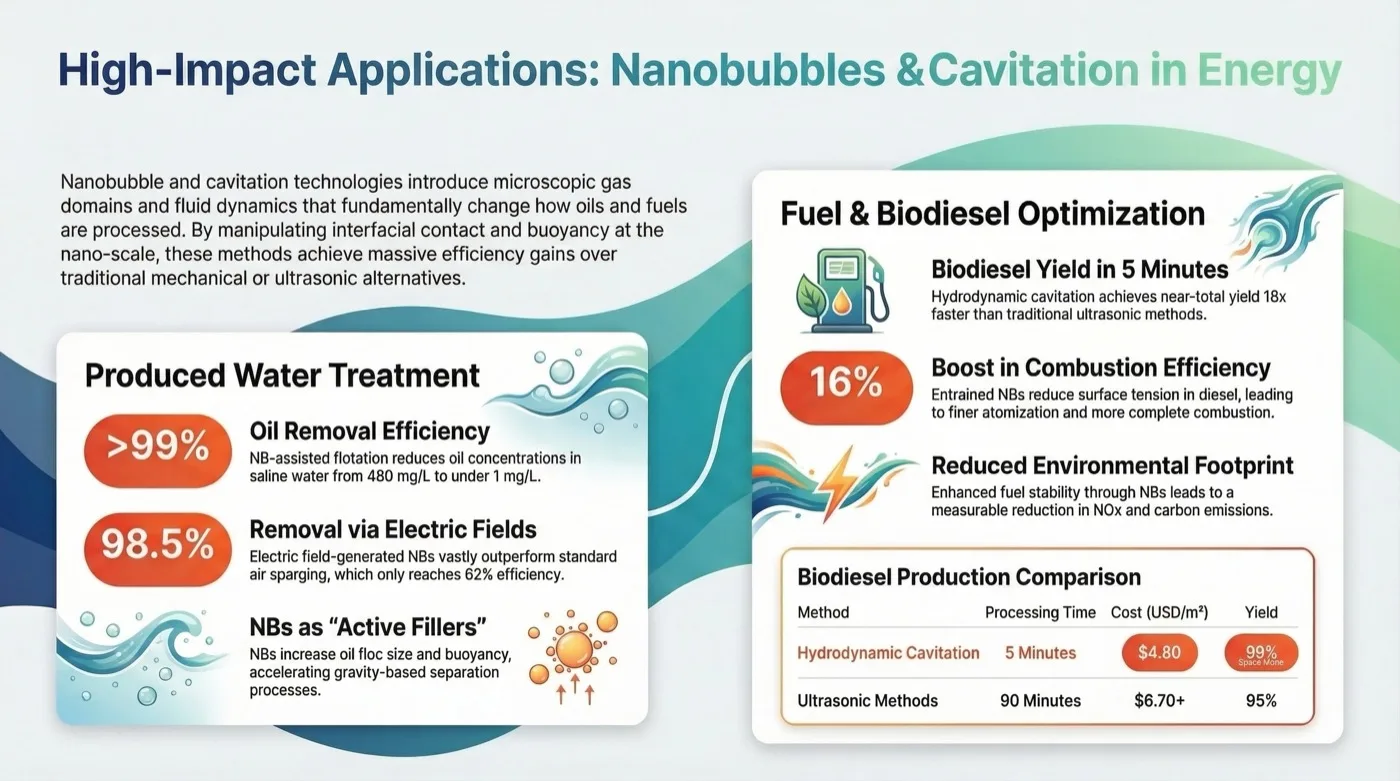
In laboratory flotation of oily saline water, adding micro- and nanobubbles removed more than 99% of the emulsified oil Etchepare et al., 2017. Produced water, the brine that comes up with oil and gas, has to be cleaned before it is discharged or reinjected, and fine oil droplets are the hardest part to separate.
The mechanism is floc aeration. Nanobubbles form or become trapped inside flocculated oil droplets, creating "aerated flocs" that are much less dense than the surrounding water and rise quickly. Their high surface area and hydrophobic surfaces make them nucleate preferentially on oil droplets, which raises the chance of collision and attachment compared with larger bubbles Shen et al., 2022.
In studies on saline produced water, oil content fell from starting concentrations of 334–484 mg/L to less than 1 mg/L, below the offshore discharge standard of 29 mg/L Etchepare et al., 2017. The bubbles in these studies were generated by depressurization, as in conventional flotation, or with a multiphase pump, and they improved adhesion between bubbles and oily flocs, which sped up separation Oliveira et al., 2017.
Nanobubbles alongside dissolved air flotation
Nanobubbles reached droplets that conventional dissolved air flotation tends to miss Oliveira et al., 2017. DAF releases air from pressurized water as microbubbles of roughly 30–100 µm. These work well on larger oil globules, but emulsified droplets smaller than about 20 µm tend to follow the water streamlines around the bubbles and escape capture.
Nanobubbles below 200 nm have little buoyancy and stay suspended for a long time, so they remain in the water column long enough to meet these fine droplets. Oliveira et al. showed that flocculation-column flotation with nanobubbles from a multiphase pump improved the separation of emulsified crude oil in saline water compared with conventional methods. The nanobubbles acted as "active fillers" inside the oil flocs, increasing their apparent size and buoyancy and reducing the hydraulic retention time required Oliveira et al., 2017.
Chemistry remained part of the process. In later trials with electric-field-generated air nanobubbles, oil removal rose to 98.5% with an optimized polymer dose of 0.2 wt%, against 62% for air sparging, a result reported as allowing reduced chemical use English, 2025. The bubbles worked with the flocculant, not in place of it.
Hydrodynamic cavitation in biodiesel production
In the studies reviewed, hydrodynamic cavitation shortened biodiesel reaction times Cako et al., 2022. Conventional production with mechanical stirring is limited by mass transfer between vegetable oil and alcohol, which do not mix. Collapsing cavitation bubbles create local hot spots of high temperature and pressure and fast micro-jets. The resulting turbulence emulsifies the two liquids, enlarging the contact area between them and speeding up the reaction Sun et al., 2023.
Reaction time, yield and cost
Cako et al. reported that multi-hole orifice-plate reactors reached 99% biodiesel yield within 5 minutes of processing. Ultrasonic bath methods needed 90 minutes to reach 95% yield. The processing cost with cavitation was estimated at 4.80 USD/m³, lower than acoustic cavitation (6.7–10.8 USD/m³) and mechanical stirring, which the review attributed to lower energy use and faster throughput Cako et al., 2022.
The intense shear also allowed lower catalyst concentrations and alcohol-to-oil ratios while the fuel still met the ASTM D6751 and EN 14214 quality standards, according to a second review Sun et al., 2023. Both sources are reviews that compare published processes rather than a single controlled trial.
Nanobubbles in liquid fuels
One article reported that electric-field-generated air nanobubbles in diesel fuel raised combustion efficiency by about 16% English, 2025. The proposed explanation starts with surface tension, which dropped by about 7% with air nanobubbles. Lower surface tension lets the injector break the fuel into finer droplets, which burn more fully.
Nanobubbles were also reported to stabilize water-in-diesel emulsions, an approach studied for its effect on nitrogen oxide (NOₓ) formation. The bubbles acted as a buffer that kept water droplets from coalescing, which supports the "secondary atomization" of emulsion droplets in the combustion chamber English, 2025. This lesson cites no emission measurements and makes no emissions claim.
What this means in practice
The flotation findings apply to emulsified crude oil in saline water, treated with a flocculant, at laboratory scale. A site that wants to test nanobubbles on produced water would run a flotation column or a side stream in parallel with its existing unit, at the same flocculant dose, and change one variable at a time.
Measure oil-in-water in mg/L at inlet and outlet with the method the discharge permit specifies, the droplet size distribution of the feed, flocculant or polymer dose, hydraulic retention time, and bubble size and concentration with gas-free controls. A result counts only if it holds across the range of feed concentrations the site actually sees.
For biodiesel, compare yield, reaction time, catalyst and alcohol-to-oil ratio, energy per cubic meter and fuel quality against ASTM D6751 or EN 14214, with cavitation and with the existing mixer. For fuels, measure surface tension and emulsion stability over time, then follow a standard engine-test protocol before drawing conclusions about combustion.
Limits and open questions
The flotation results come from laboratory studies with one kind of feed: emulsified crude oil in saline water, with flocculant. Performance with other oils, salinities, solids loads and flow rates is not shown here, and no offshore installation data are cited.
The biodiesel figures come from two reviews that compare published processes. Cost estimates such as 4.80 USD/m³ depend on energy prices, scale and the assumptions each study made, and they may not carry over to another plant.
The electric-field flotation and combustion figures rely on one article, English (2025), which should be checked against the primary data before they are relied on. No emission measurements are cited, so this lesson supports no claim that nanobubbles reduce NOₓ or carbon emissions. In every study cited, nanobubbles worked with chemistry, flocculants, catalysts or emulsifiers, rather than replacing it.
Questions
How do nanobubbles help remove oil from produced water?
They attach to or form inside flocculated oil droplets, making "aerated flocs" light enough to rise quickly. In laboratory flotation of saline water, micro- and nanobubbles lowered oil content from 334–484 mg/L to under 1 mg/L, a removal above 99% Etchepare et al., 2017.
Do nanobubbles replace flocculants in oily-water flotation?
Not in the studies cited. The flotation work used flocculated oil, and electric-field nanobubbles reached 98.5% oil removal with a 0.2 wt% polymer dose, against 62% for air sparging English, 2025. The bubbles improved what the chemistry did; they did not remove the need for it.
Why does hydrodynamic cavitation speed up biodiesel production?
Collapsing cavitation bubbles create turbulence that emulsifies oil and alcohol, which otherwise barely mix, so the reaction is no longer held back by mass transfer. A reviewed multi-hole orifice reactor reached 99% yield in 5 minutes, while an ultrasonic bath needed 90 minutes for 95% Cako et al., 2022.
References
- Etchepare, R., Oliveira, H., Azevedo, A., et al. (2017). Separation of emulsified crude oil in saline water by dissolved air flotation with micro and nanobubbles. Separation and Purification Technology, 186, 326-332. https://doi.org/10.1016/j.seppur.2017.06.007 ↩
- English, N. J. (2025). Environmentally Sustainable and Energy-Efficient Nanobubble Engineering: Applications in the Oil and Fuels Sector. Fuels, 6, 50. https://doi.org/10.3390/fuels6030050 ↩
- Cako, E., Wang, Z., Castro-Muñoz, R., et al. (2022). Cavitation based cleaner technologies for biodiesel production and processing of hydrocarbon streams: A perspective on key fundamentals, missing process data and economic feasibility – A review. Ultrasonics Sonochemistry, 88, 106081. https://doi.org/10.1016/j.ultsonch.2022.106081 ↩
- Shen, W., Mukherjee, D., Koirala, N., et al. (2022). Microbubble and nanobubble-based gas flotation for oily wastewater treatment: a review. Environmental Reviews, 30, 359-379. https://doi.org/10.1139/er-2021-0127 ↩
- Oliveira, H. A., Azevedo, A. C., Etchepare, R., et al. (2017). Separation of emulsified crude oil in saline water by flotation with micro- and nanobubbles generated by a multiphase pump. Water Science and Technology, 76, 2710-2718. https://doi.org/10.2166/wst.2017.441 ↩
- Sun, X., Liu, S., Manickam, S., et al. (2023). Intensification of biodiesel production by hydrodynamic cavitation: A critical review. Renewable and Sustainable Energy Reviews, 179, 113277. https://doi.org/10.1016/j.rser.2023.113277 ↩