How gases dissolve in water
How much gas can water hold, and what raises or lowers that amount?
On this page
Henry's law: a gas dissolves in proportion to its partial pressure
At equilibrium, the amount of a gas dissolved in water is proportional to the pressure of that gas above the water. This is Sander, 2023. Equilibrium means the water has stopped gaining or losing that gas.
The pressure that counts is the gas's own share of the total, its . Air at sea level presses with about 1 atmosphere (atm), and dry air is 20.946% oxygen, so oxygen supplies only about a fifth of that pressure. Dissolved oxygen () follows that fifth.
That is why the gas you supply matters as much as the water. Replace air with pure oxygen at the same pressure and the equilibrium rises about 4.8-fold, to about 43 mg/L at 20 °C instead of 9.09 mg/L (computed from Garcia & Gordon, 1992). That is a ceiling set by physics, not what a device reaches in practice.
The factor in Henry's law is called a constant, but it changes with temperature, and it is published in several units and inverse forms, so a value means little unless its form is stated Sander, 2023.
Temperature and salinity set the ceiling
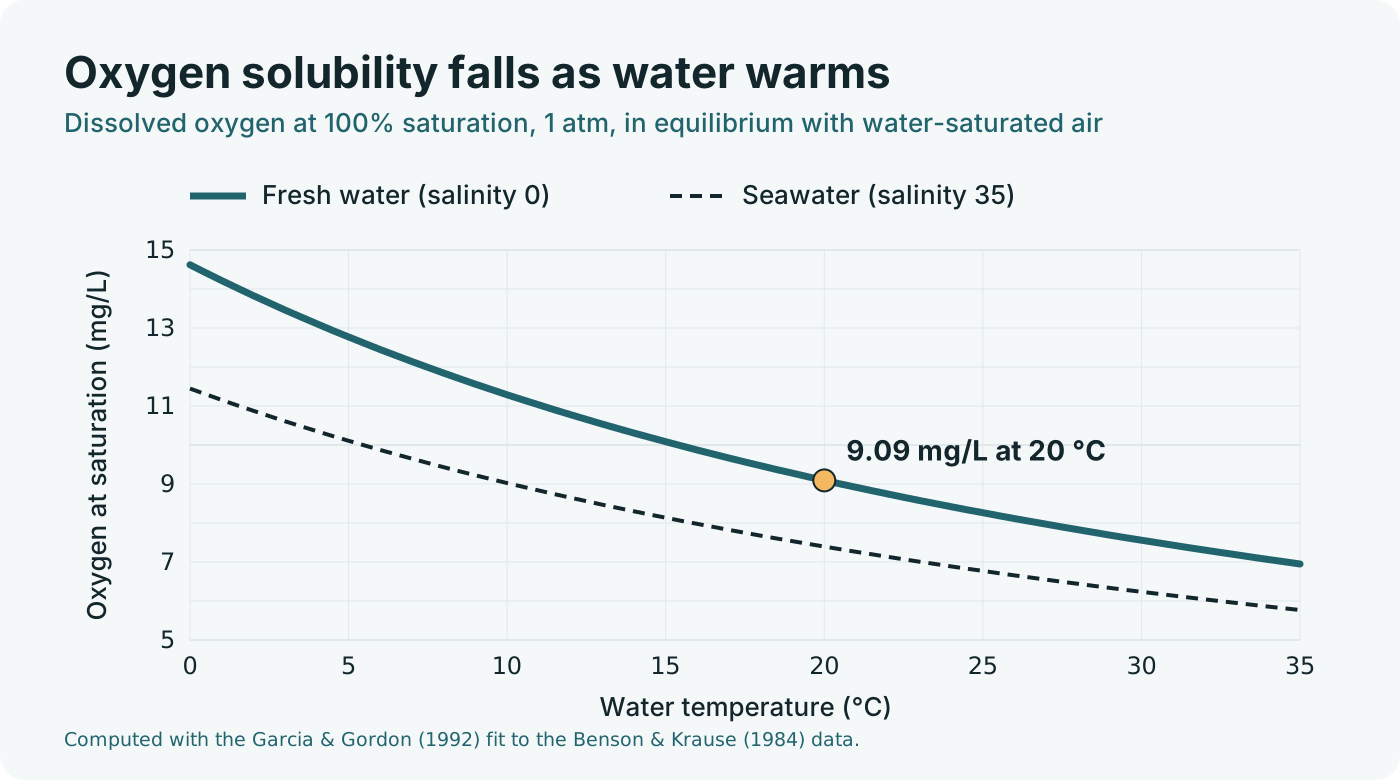
Warm water and salty water hold less gas. The table gives oxygen in equilibrium with moist air at 1 atm, which a meter reports as 100% . It was computed with the equation of Garcia & Gordon, 1992, fitted to measurements whose estimated error is 0.1% or less Benson & Krause, 1984.
| Water temperature | Fresh water (mg/L) | Seawater, salinity 35 (mg/L) |
|---|---|---|
| 0 °C | 14.62 | 11.45 |
| 5 °C | 12.77 | 10.11 |
| 10 °C | 11.29 | 9.02 |
| 15 °C | 10.08 | 8.13 |
| 20 °C | 9.09 | 7.40 |
| 25 °C | 8.26 | 6.77 |
| 30 °C | 7.56 | 6.24 |
| 35 °C | 6.95 | 5.77 |
Water at 0 °C holds about twice as much oxygen as water at 30 °C, and the loss per degree is steepest in cold water. A nutrient solution at 30 °C, or a pond in summer, starts with less oxygen than the same water in winter.
Salt pushes gas out of solution: seawater holds about 19% less oxygen than fresh water at 20 °C. The logarithm of solubility falls roughly in proportion to salinity, an empirical rule called the Setschenow relation Garcia & Gordon, 1992. Brackish water falls between the two columns.
Pressure and depth raise it
More pressure puts more gas into solution. At altitude, or when barometric pressure falls, the equilibrium drops; Benson & Krause, 1984 give procedures for correcting to pressures other than 1 atm.
Depth works the opposite way to altitude. Each meter of water adds about 9.8 kPa, roughly a tenth of an atmosphere, so at 10 m the total pressure is about 2 atm and gas held there can dissolve to roughly twice its surface equilibrium. Forcing air into water under pressure is one way to make it supersaturated.
Depth also protects fish from supersaturated water. Below a dam, juvenile salmon and steelhead migrated at average depths of 1.5 to 3.2 m, and this "hydrostatic compensation," with short exposure times, reduced the effects of the excess gas Beeman & Maule, 2006.
Saturation and supersaturation
Above 100% saturation, in , water holds more gas than equilibrium allows and slowly gives the excess back. A meter reading above 100% can be real. It arises in three common ways:
- Warming. Water saturated at 15 °C (10.08 mg/L) and warmed to 25 °C is at 122% saturation (computed from the table).
- Air under pressure. Water spilling from dams traps air in the plunge pools below and raises total dissolved gas (TDG), the sum of all dissolved gases Wang et al., 2018.
- Pure gas. Pure oxygen raises oxygen above 100% of air saturation, because its partial pressure is about 4.8 times higher.
Supersaturation from dams and warm-water discharges has caused fish mortalities in several cases Weitkamp & Katz, 1980. Excess dissolved gas can cause gas bubble disease, with gas emboli in the blood, heart and gills Wang et al., 2018. In that laboratory study, 2 hours at 130% TDG cut the critical swimming speed of juvenile Chinese sucker from 4.06 to 2.29 body lengths per second. These studies measured total dissolved gas, not oxygen alone.
Five gases, five behaviors
Each gas has its own solubility, and some react once dissolved Sander, 2023.
| Gas | Solubility at 25 °C (mol m⁻³ Pa⁻¹) | Relative to oxygen | What else happens |
|---|---|---|---|
| Oxygen (O₂) | 1.3 × 10⁻⁵ | 1 | Used by roots, fish and microbes |
| Nitrogen (N₂) | 6.4 × 10⁻⁶ | about 0.5 | Main gas in air; adds to total dissolved gas |
| Carbon dioxide (CO₂) | 3.4 × 10⁻⁴ | about 26 | Reacts with water and lowers pH |
| Ozone (O₃) | 1.0 × 10⁻⁴ | about 8 | Decomposes, faster at higher pH |
| Hydrogen (H₂) | 7.8 × 10⁻⁶ | about 0.6 | Least soluble by mass |
Carbon dioxide is the most soluble of the five; pure CO₂ at 1 atm and 25 °C dissolves to about 1.5 g/L (computed). Unlike oxygen it reacts, forming bicarbonate and hydrogen ions that acidify the water Randall et al., 1991, the process that lowers ocean pH as the ocean takes up CO₂ Zeebe, 2012. In a semi-commercial recirculating aquaculture system (RAS), low alkalinity (10 mg/L as calcium carbonate) gave the lowest pH, and a larger share of inorganic carbon left as CO₂ during stripping Summerfelt et al., 2015. Atlantic salmon post-smolts grew best below 12 mg/L CO₂ in a 12-week RAS trial Mota et al., 2019. See Carbon dioxide nanobubbles (CO₂).
Ozone dissolves about eight times better than oxygen but does not stay. Hydroxide ions start its decomposition, so it runs faster at higher pH, and hydrogen peroxide speeds it further Staehelin & Hoigné, 1982. Meanwhile it oxidizes other compounds directly or through hydroxyl radicals von Gunten, 2003; Advanced oxidation processes (AOPs) covers that chemistry.
Hydrogen is the least soluble by mass, about 1.6 mg/L under pure H₂ at 1 atm and 25 °C (computed), and its solubility changes least with temperature. Ozone and CO₂ lose solubility fastest as water warms Sander, 2023.
What this means in practice
- Record temperature, salinity or conductivity, and barometric pressure with every DO reading, and report both mg/L and % saturation.
- Compare readings with the table, or a calculator using the same equation. Above 100% means supersaturation: check calibration, then treat it as real.
- Supplying pure oxygen raises the ceiling about 4.8-fold, and the room for supersaturation with it.
- Where fish live in supersaturated water, measure total dissolved gas, not only oxygen.
- In recirculating water, track CO₂, pH and alkalinity together; for ozone, measure the residual where it is needed.
The next lesson, Diffusion and gas–liquid mass transfer, explains how fast water approaches these ceilings.
Limits and open questions
- Oxygen values assume equilibrium with moist air at 1 atm, freezing to 40 °C, salinity 0 to 42 as sea salt; nutrient solutions are only approximated. Real water is rarely at equilibrium.
- The other gases' constants are two-figure values for dilute solutions at 25 °C, for comparing gases, not sizing equipment; published ozone values vary by source.
- Pure-gas figures (43 mg/L oxygen, 1.6 mg/L hydrogen, 1.5 g/L CO₂) are equilibrium ceilings, not device results.
- Supersaturation effects come from a river study and a 2-hour laboratory test with wild species; the CO₂ growth result from one salmon trial.
Questions
Why can a dissolved oxygen meter read above 100%?
Percentage of saturation compares the measured oxygen with the equilibrium value at the water's temperature, salinity and pressure. Water that was warmed, received air under pressure, or received pure oxygen can hold more than that value for a while. The excess then leaves slowly, as bubbles or across the surface.
How much less oxygen does warm water hold?
In fresh water at 1 atm, equilibrium with air gives 14.62 mg/L at 0 °C, 9.09 mg/L at 20 °C and 7.56 mg/L at 30 °C. Warming from 20 to 30 °C lowers the ceiling by about 17%. Seawater at salinity 35 holds less again: 7.40 mg/L at 20 °C.
If ozone dissolves better than oxygen, why is dissolved ozone hard to keep?
Ozone is about eight times as soluble as oxygen at the same partial pressure, but it decomposes in water. Hydroxide ions start the breakdown, so it runs faster at higher pH, and hydrogen peroxide speeds it further. Its dissolved level balances supply against decomposition, so measure it where it is needed.
References
- Garcia, H. E., Gordon, L. I. (1992). Oxygen solubility in seawater: Better fitting equations. Limnology and Oceanography, 37, 1307-1312. https://doi.org/10.4319/lo.1992.37.6.1307 ↩
- Benson, B. B., Krause, D. (1984). The concentration and isotopic fractionation of oxygen dissolved in freshwater and seawater in equilibrium with the atmosphere1. Limnology and Oceanography, 29, 620-632. https://doi.org/10.4319/lo.1984.29.3.0620 ↩
- Sander, R. (2023). Compilation of Henry's law constants (version 5.0.0) for water as solvent. Atmospheric Chemistry and Physics, 23, 10901-12440. https://doi.org/10.5194/acp-23-10901-2023 ↩
- Beeman, J. W., Maule, A. G. (2006). Migration Depths of Juvenile Chinook Salmon and Steelhead Relative to Total Dissolved Gas Supersaturation in a Columbia River Reservoir. Transactions of the American Fisheries Society, 135, 584-594. https://doi.org/10.1577/t05-193.1 ↩
- Wang, Y., Li, Y., An, R., et al. (2018). Effects of Total Dissolved Gas Supersaturation on the Swimming Performance of Two Endemic Fish Species in the Upper Yangtze River. Scientific Reports, 8, 10063. https://doi.org/10.1038/s41598-018-28360-7 ↩
- Weitkamp, D. E., Katz, M. (1980). A Review of Dissolved Gas Supersaturation Literature. Transactions of the American Fisheries Society, 109, 659-702. https://doi.org/10.1577/1548-8659(1980)109<659:arodgs>2.0.co;2 ↩
- Randall, D., Lin, H., Wright, P. A. (1991). Gill Water Flow and the Chemistry of the Boundary Layer. Physiological Zoology, 64, 26-38. https://doi.org/10.1086/physzool.64.1.30158512 ↩
- Zeebe, R. E. (2012). History of Seawater Carbonate Chemistry, Atmospheric CO2, and Ocean Acidification. Annual Review of Earth and Planetary Sciences, 40, 141-165. https://doi.org/10.1146/annurev-earth-042711-105521 ↩
- Summerfelt, S. T., Zühlke, A., Kolarevic, J., et al. (2015). Effects of alkalinity on ammonia removal, carbon dioxide stripping, and system pH in semi-commercial scale water recirculating aquaculture systems operated with moving bed bioreactors. Aquacultural Engineering, 65, 46-54. https://doi.org/10.1016/j.aquaeng.2014.11.002 ↩
- Mota, V. C., Nilsen, T. O., Gerwins, J., et al. (2019). The effects of carbon dioxide on growth performance, welfare, and health of Atlantic salmon post-smolt (Salmo salar) in recirculating aquaculture systems. Aquaculture, 498, 578-586. https://doi.org/10.1016/j.aquaculture.2018.08.075 ↩
- Staehelin, J., Hoigne, J. (1982). Decomposition of ozone in water: rate of initiation by hydroxide ions and hydrogen peroxide. Environmental Science & Technology, 16, 676-681. https://doi.org/10.1021/es00104a009 ↩
- von Gunten, U. (2003). Ozonation of drinking water: Part I. Oxidation kinetics and product formation. Water Research, 37, 1443-1467. https://doi.org/10.1016/s0043-1354(02)00457-8 ↩