Hydrogen nanobubbles (H₂)
Where has research looked at hydrogen nanobubbles, and what did it measure?
On this page
What hydrogen nanobubbles do
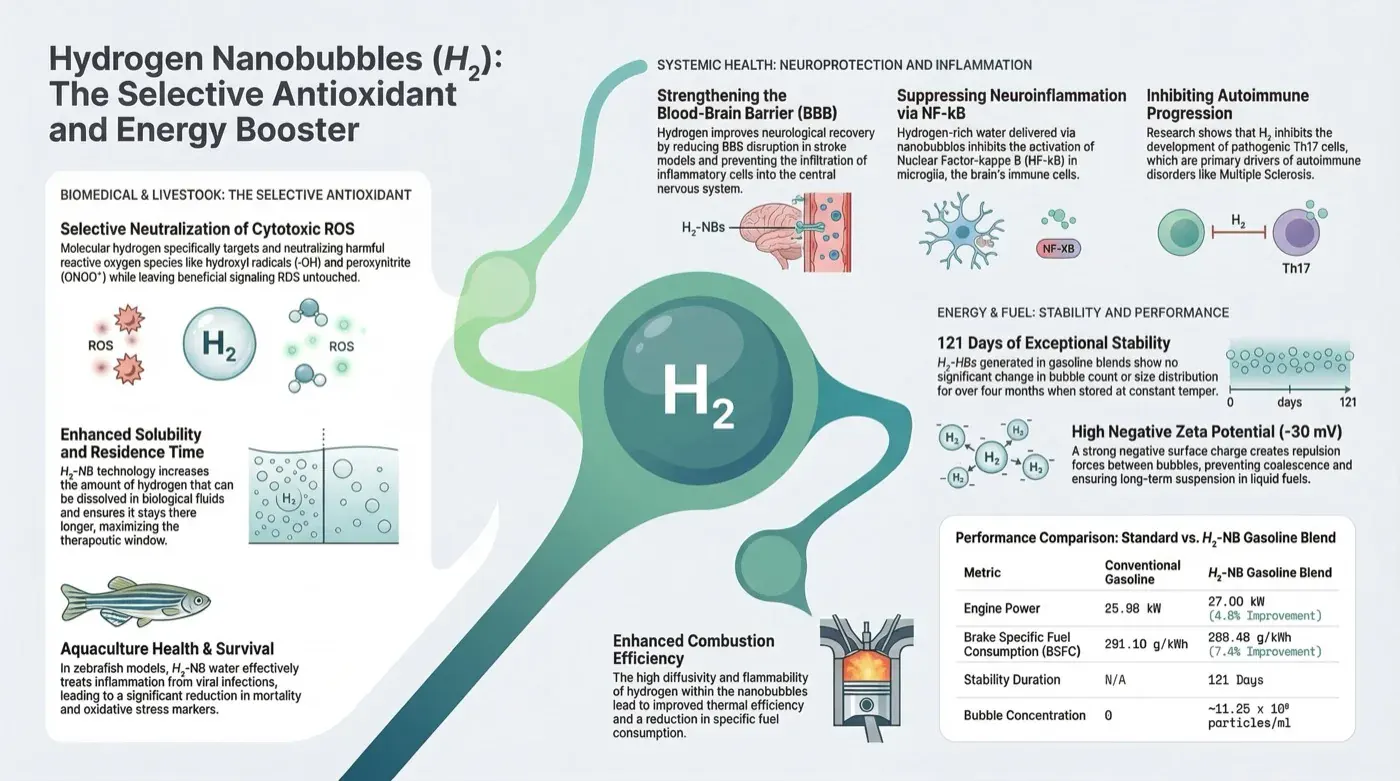
Hydrogen nanobubbles are a way to carry hydrogen gas inside a liquid at high concentration. In the published research cited here, their clearest use is as a fuel additive: hydrogen diffuses quickly and ignites easily, and nanobubbles let a liquid fuel hold it for months.
Fuel: stability in fuel blends
Stability is the key finding for energy applications. H₂-NBs generated in a gasoline blend remained stable for 121 days, with no significant change in bubble size distribution or count. The bubbles kept a high negative of about −30 mV throughout, and the authors attributed their resistance to coalescence to that surface charge Oh et al., 2015.
This matters because a fuel additive has to survive storage and distribution. A bubble population that merged or dissolved within days would be of little practical use.
Fuel: combustion
Adding H₂-NBs to gasoline improved combustion characteristics in an engine study. Thermal efficiency rose and specific fuel consumption fell, which the authors attributed to the high diffusivity and flammability of hydrogen Oh et al., 2013.
Early biological research
Hydrogen's biological effects are early-stage research, noted here only for context. In mice with experimental autoimmune encephalomyelitis, researchers reported that hydrogen-rich water improved neurological functional recovery Zhao et al., 2016. The study gave hydrogen-rich water to animals; it does not isolate a nanobubble effect, and it is not evidence of a health effect in people or livestock. This page makes no health claim.
How hydrogen compares with other gases
Oxygen and ozone are studied as oxidants; hydrogen is studied here as a fuel component. In fuels, a review of air nanobubbles generated with electric fields in diesel presented them as a simpler route than hydrogen injection English, 2025. No study cited here compares hydrogen and air nanobubbles in the same engine.
Limits and open questions
- The stability and combustion results come from two studies with the same lead author, both in gasoline; other fuels, storage temperatures and engines may behave differently.
- This profile gives no size for the combustion improvements, so the gain for a given engine is unknown.
- Stability was measured as bubble size distribution, count and zeta potential; the profile does not report how much hydrogen stayed in the fuel.
- The only biological study cited used hydrogen-rich water in mice. It does not isolate a nanobubble effect and does not show any effect in people or livestock.
Questions
How long do hydrogen nanobubbles last in fuel?
In one study, hydrogen nanobubbles generated in a gasoline blend remained stable for 121 days, with no significant change in bubble size distribution or count. The bubbles kept a negative zeta potential of about −30 mV, which the authors linked to the electrostatic repulsion that keeps bubbles from merging.
Do hydrogen nanobubbles improve engine performance?
An engine study reported that adding hydrogen nanobubbles to gasoline improved combustion, raising thermal efficiency and lowering specific fuel consumption. The authors attributed this to hydrogen's high diffusivity and flammability. The result comes from one gasoline engine study and has not been shown here across engines or fuels.
Do hydrogen nanobubbles have health effects?
That has not been shown. The one biological study cited here reported that hydrogen-rich water improved neurological functional recovery in mice with experimental autoimmune encephalomyelitis. It did not isolate nanobubbles, and an early animal result is not evidence of any effect in people or livestock. This page makes no health claim.
References
- Oh, S. H., Han, J. G., Kim, J. M. (2015). Long-term stability of hydrogen nanobubble fuel. Fuel, 158, 399-404. https://doi.org/10.1016/j.fuel.2015.05.072 ↩
- Oh, S. H., Yoon, S. H., Song, H., et al. (2013). Effect of hydrogen nanobubble addition on combustion characteristics of gasoline engine. International Journal of Hydrogen Energy, 38, 14849-14853. https://doi.org/10.1016/j.ijhydene.2013.09.063 ↩
- Zhao, M., Liu, M. D., Pu, Y. Y., et al. (2016). Hydrogen-rich water improves neurological functional recovery in experimental autoimmune encephalomyelitis mice. Journal of Neuroimmunology, 294, 6-13. https://doi.org/10.1016/j.jneuroim.2016.03.006 ↩
- English, N. J. (2025). Environmentally Sustainable and Energy-Efficient Nanobubble Engineering: Applications in the Oil and Fuels Sector. Fuels, 6, 50. https://doi.org/10.3390/fuels6030050 ↩