Oil-water separation and flotation
How does nanobubble flotation compare with dissolved air flotation for oily wastewater?
On this page
Why fine oil droplets escape conventional flotation
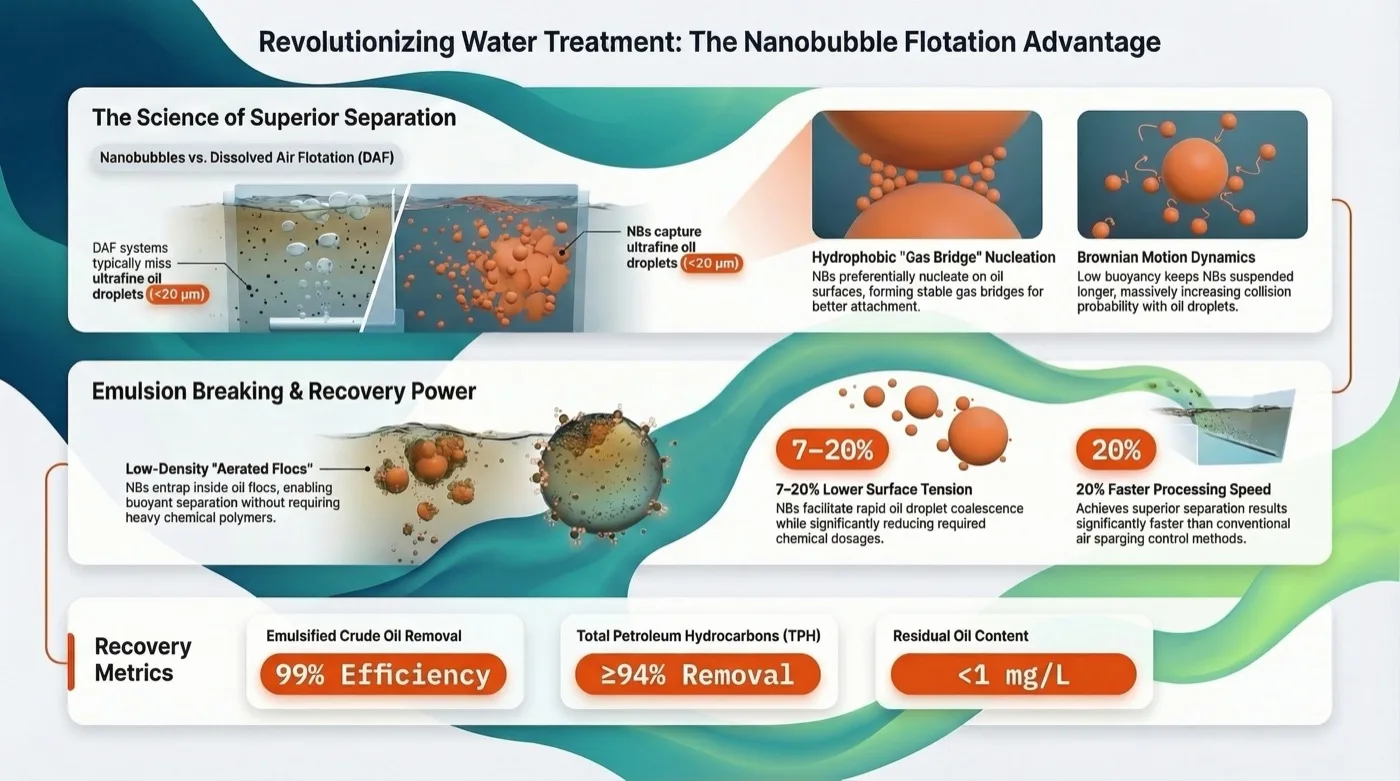
Conventional flotation loses the smallest oil droplets because they follow the water around the bubbles instead of meeting them. Dissolved air flotation () releases air from pressurized water as , typically 30 to 100 µm across. DAF separates free oil and larger suspended solids well but often struggles with emulsified droplets smaller than 20 µm, which travel along the streamlines around a rising microbubble, so collision efficiency is low Shen et al., 2022.
A is smaller than 1 µm; those used in oily-water flotation are typically 150–350 nm. At that size buoyancy is weak and Brownian motion dominates, so nanobubbles stay suspended in the water column for long periods. The review by Shen et al., 2022 links this to a much higher probability of collision with the ultrafine droplets that DAF misses.
How nanobubbles attach to oil droplets
Nanobubbles attach to oil because oil is hydrophobic, and once attached they make larger bubbles stick more readily.
- Nucleation on hydrophobic surfaces. Nanobubbles form preferentially on hydrophobic surfaces such as oil droplets, where the energy barrier is lower. Once attached, they form a gas bridge between droplets or act as a secondary collector.
- Larger contact angle. Attached nanobubbles increase the apparent contact angle of droplets and particles and extend the three-phase (gas, liquid, solid) contact line. The aggregate becomes more hydrophobic, and larger carrier microbubbles then attach to it and lift it more stably to the surface.
This "seeding" let nanobubbles turn hydrophilic or weakly hydrophobic impurities into aggregates that could be separated Oliveira et al., 2017; Shen et al., 2022.
Emulsion breaking with lower reagent doses
Nanobubbles worked alongside demulsifiers and polymers in the studies, lowering the doses needed rather than replacing them. Stable oil-in-water emulsions usually need high doses of chemical demulsifiers to overcome the electrostatic repulsion between droplets, which is measured as . Three physical effects were reported.
- Aerated flocs. Nanobubbles became trapped inside flocculated oil structures instead of only attaching to the outside. They lowered floc density without heavy polymer bridging and produced buoyant "aerated flocs" that resisted shear as they rose Etchepare et al., 2017.
- Lower surface tension. Nanobubbles lowered the surface tension of the water by about 7–20%, depending on the gas. This helped oil droplets coalesce and surfactants or polymers adsorb, so lower chemical doses achieved phase separation English, 2025.
- Zeta potential. Bubbles generally carry a negative charge. Their large specific surface and their interaction with ions in saline water can modulate the zeta potential of the system, reducing repulsion between droplets and helping them aggregate Shen et al., 2022.
Reported removal results
Adding nanobubbles to flotation gave higher oil removal than the conventional comparison in each study below, including in saline water.
- Emulsified crude oil in saline water. With initial oil concentrations of 334–484 mg/L, micro- and nanobubbles together removed more than 99% of the oil, leaving less than 1 mg/L. Even at a lower saturation pressure of 3.5 bar, the effluent met the offshore discharge standard of less than 29 mg/L Etchepare et al., 2017.
- Petroleum hydrocarbons in sand. In oil-contaminated sand and fluids, positively charged nanobubbles removed at least 94% of total petroleum hydrocarbons (TPH) under intermittent injection, more than under batch injection Bui et al., 2022.
- Flotation against a sparging control. Oil removal rose from 62% with standard air sparging to 98.5% with air-nanobubble flotation at an optimized polymer dose of 0.2 wt%, and the nanobubble process reached its result roughly 20% faster English, 2025.
- Oil and grease in municipal effluent. Oxygen nanobubbles reduced oil and grease in secondary effluent by 33%, from 9 to 6 mg/L, while air bubbles showed no significant effect over the same period Ahmed et al., 2023.
What this means in practice
The findings apply where emulsified oil droplets smaller than about 20 µm pass through conventional flotation, as in saline or produced water. They were obtained alongside demulsifier and polymer dosing, so a trial adjusts chemistry and bubbles together rather than removing one.
A site trial compares a control arm (existing DAF or air sparging) with a nanobubble arm on the same feed and at the same reagent dose, then lowers the dose step by step. Measure oil-in-water concentration in mg/L in feed and effluent against the discharge limit that applies to the site, droplet size distribution, zeta potential, polymer or demulsifier dose, saturation pressure and residence time. Characterize the bubbles with a gas-free water blank, so that particles in the water are not counted as bubbles.
Limits and open questions
- Two of the sources are reviews (Shen et al., 2022; English, 2025); the underlying studies' droplet sizes, salinity and residence times are not all given.
- The result above 99% used micro- and nanobubbles together, so it does not isolate the nanobubble contribution.
- The 98.5% result depended on an optimized polymer dose: nanobubbles worked with the chemistry, not in place of it.
- The TPH result concerns oil-contaminated sand, a solid matrix, not an emulsion in water.
- The oil-and-grease result started from 9 mg/L in municipal effluent, far below the 334–484 mg/L of the crude-oil tests.
- Full-scale, long-duration results are not reported here.
Questions
Why does dissolved air flotation miss fine oil droplets?
DAF bubbles are typically 30 to 100 µm. Emulsified oil droplets smaller than 20 µm follow the water streamlines around these rising bubbles, so few collide and attach. Nanobubbles of about 150–350 nm stay suspended, which a review linked to a much higher chance of collision Shen et al., 2022.
Do nanobubbles replace demulsifiers and polymers?
Not in the studies summarized here. Nanobubbles lowered surface tension by about 7–20% and helped polymers adsorb, so lower chemical doses achieved separation. The best reported result, 98.5% oil removal, used an optimized polymer dose of 0.2 wt% alongside air nanobubbles English, 2025.
What oil removal have studies reported for emulsified crude oil?
In saline water with 334–484 mg/L of emulsified crude oil, micro- and nanobubbles together removed more than 99% of the oil, leaving less than 1 mg/L. At a lower saturation pressure of 3.5 bar, the effluent still met the offshore discharge standard of less than 29 mg/L Etchepare et al., 2017.
References
- Etchepare, R., Oliveira, H., Azevedo, A., et al. (2017). Separation of emulsified crude oil in saline water by dissolved air flotation with micro and nanobubbles. Separation and Purification Technology, 186, 326-332. https://doi.org/10.1016/j.seppur.2017.06.007 ↩
- Shen, W., Mukherjee, D., Koirala, N., et al. (2022). Microbubble and nanobubble-based gas flotation for oily wastewater treatment: a review. Environmental Reviews, 30, 359-379. https://doi.org/10.1139/er-2021-0127 ↩
- English, N. J. (2025). Environmentally Sustainable and Energy-Efficient Nanobubble Engineering: Applications in the Oil and Fuels Sector. Fuels, 6, 50. https://doi.org/10.3390/fuels6030050 ↩
- Bui, T. T., Nguyen, C. D., Shim, N., et al. (2022). Total petroleum hydrocarbon removal from oil-sand by injecting charged nanobubbles. Environmental Nanotechnology, Monitoring & Management, 17, 100653. https://doi.org/10.1016/j.enmm.2022.100653 ↩
- Ahmed, A. K. A., Shalaby, M., Negim, O., et al. (2023). Eco-Friendly Enhancement of Secondary Effluent Characteristics with Air and Oxygen Nanobubbles Generated by Ceramic Membrane Filters. Environmental Processes, 10, 13. https://doi.org/10.1007/s40710-023-00628-9 ↩
- Oliveira, H. A., Azevedo, A. C., Etchepare, R., et al. (2017). Separation of emulsified crude oil in saline water by flotation with micro- and nanobubbles generated by a multiphase pump. Water Science and Technology, 76, 2710-2718. https://doi.org/10.2166/wst.2017.441 ↩