Abiotic stress mitigation
Do nanobubbles help plants cope with reduced irrigation, salinity and heavy-metal stress?
On this page
Reduced irrigation: yield held with less water
The strongest evidence in this lesson concerns water use efficiency (WUE), the ratio of crop yield or biomass to the volume of water applied. In the studies below, nanobubble irrigation produced more yield per unit of water than conventional irrigation.
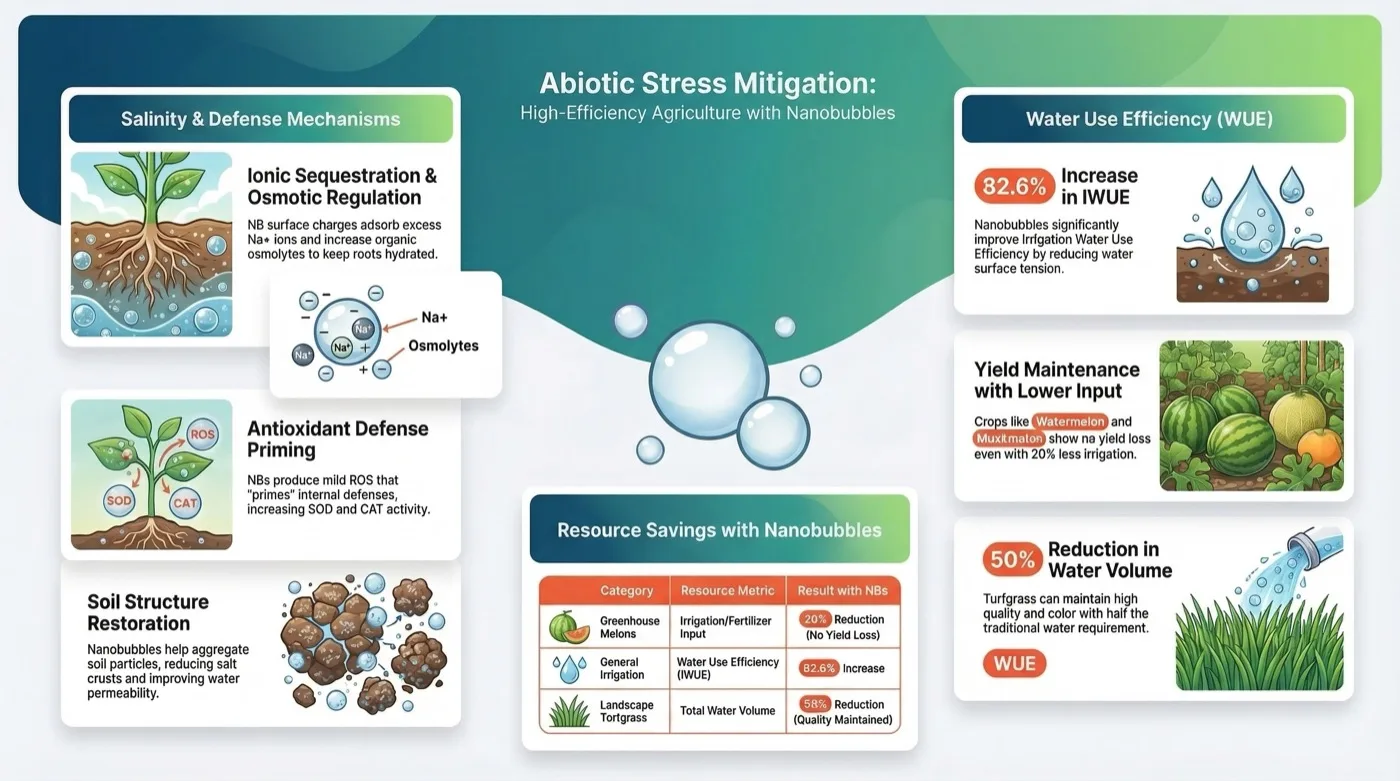
In a subsurface drip study on watermelon and muskmelon, irrigation volume was cut by 20% with nanobubble water and compared with full conventional irrigation He et al., 2022. The crops showed no yield loss. At 80% of the water, irrigation water use efficiency (IWUE) rose by 82.6% for watermelon and 70.2% for muskmelon, together with increases in fruit yield and vitamin C content.
In greenhouse tomatoes, micro-nano bubble oxygation increased WUE by 16.9% to 34.5% compared with non-aerated controls Zhou et al., 2022; Liu et al., 2019. The gain is attributed to more oxygen in the , which let the plants keep photosynthesis and dry matter accumulation high under lower water regimes.
One proposed mechanism is physical. Air nanobubble water is reported to lower the surface tension of water, improving infiltration and retention in the root zone, so that more of the applied water stays where roots can use it Arablousabet & Povilaitis, 2024.
These are single studies on specific crops and systems. The melon result was measured under subsurface drip, and the tomato range combines two greenhouse studies.
Salinity: osmolytes rose with oxygenated brackish water
The evidence on salinity in this lesson is narrow: one study on wheat irrigated with oxygenated brackish water Zhu et al., 2021. In that study, oxygenation increased the content of soluble sugars and proteins in leaves.
Salt stress disturbs a plant's osmotic balance: the saline soil solution makes it harder for root cells to draw in water. Soluble sugars and proteins act as osmolytes, solutes that help cells hold and absorb water despite the high osmotic pressure outside. Their rise with oxygenated water is consistent with better water relations under salinity Zhu et al., 2021.
The lesson has no study measuring sodium uptake, yield or soil structure under salinity with nanobubbles. A proposed ion-binding mechanism, in which charged bubbles hold sodium ions away from roots, is not supported by a study cited here.
Oxidative stress: antioxidant enzymes rose under metal and nanoparticle stress
Abiotic stresses such as drought, salinity and heavy metals cause plant cells to overproduce reactive oxygen species (), which damage lipids, proteins and DNA. The proposed role of nanobubbles is "priming": a mild, controlled dose of external ROS signals the plant to raise its own antioxidant defenses before stress does damage Yan et al., 2023.
In a cadmium phytoremediation study on Alternanthera philoxeroides, air nanobubble water at 25% concentration raised the activity of superoxide dismutase (SOD) and catalase (CAT) Yan et al., 2023. These enzymes remove excess superoxide anions (O₂•−) and hydrogen peroxide (H₂O₂). Malondialdehyde (MDA), a marker of cell membrane damage, fell.
In wheat seedlings exposed to zinc oxide nanoparticles, nanobubble irrigation raised root activity and regulated enzymes of the ascorbate–glutathione cycle, such as ascorbate peroxidase (APX) and glutathione reductase (GR) Zhang et al., 2024. The plants kept their cellular redox balance and continued to grow despite the stressor.
Both are specific stress models. They show a biochemical response in the plant, not a yield benefit in a commercial crop.
What this means in practice
These findings apply to irrigated crops where water is scarce or poor in quality, and where the irrigation system can deliver nanobubble water to the root zone, as subsurface drip did in the melon study. They are less relevant where water is plentiful and the root zone is already well aerated.
What to measure: applied water per zone with flow meters; soil moisture at root depth; yield per zone; and irrigation water use efficiency, calculated as yield divided by irrigation water applied. For salinity, track the electrical conductivity (EC) of irrigation water and soil. Check dissolved oxygen () in mg/L at the emitter. Enzyme assays such as SOD, CAT and MDA are research tools rather than farm metrics.
How to test it: compare a nanobubble zone and a control zone at the same reduced irrigation volume, alongside a full-irrigation control, so that a yield difference can be attributed to the treatment rather than to the water cut. Run the comparison for a full season, and keep salinity management, fertilization and crop protection unchanged.
Limits and open questions
- The water-saving result comes from one subsurface drip study on melons; the tomato WUE range combines two greenhouse studies.
- The salinity evidence is one wheat study measuring leaf osmolytes. No study cited here measured sodium uptake, soil structure or yield under salinity.
- Ahmed et al. reported better germination and growth of fava bean with nanobubbles than with tap water Ahmed et al., 2018, but the lesson cites no salinity data for fava bean or other legumes.
- The antioxidant results come from a cadmium phytoremediation species and wheat seedlings under nanoparticle stress; they may not transfer to field crops under drought or salinity.
- "Priming" by nanobubble ROS is a proposed mechanism.
- The surface-tension explanation for better infiltration comes from one study with air nanobubble water.
Questions
Can nanobubbles let me irrigate less?
In one subsurface drip study, watermelon and muskmelon kept their yield with 20% less water, and IWUE rose by 82.6% and 70.2%. That is one study on two crops. Test it with a full-irrigation control and a same-volume control before cutting water across a farm.
Do nanobubbles protect plants from salt?
The evidence here is limited. In a wheat study, oxygenated brackish water increased soluble sugars and proteins in leaves, osmolytes that help cells take in water. No study cited here measured sodium uptake or yield under salinity, so salinity management should continue as usual.
What does "priming" mean here?
Researchers propose that nanobubbles supply a small amount of reactive oxygen species that prompts the plant to raise its own antioxidant enzymes. In a cadmium study, SOD and CAT activity rose and the membrane-damage marker MDA fell with air nanobubble water.
References
- He, J., Liu, Y., Wang, T., et al. (2022). Effects of nanobubble in subsurface drip irrigation on the yield, quality, irrigation water use efficiency and nitrogen partial productivity of watermelon and muskmelon. International Agrophysics, 36, 163-171. https://doi.org/10.31545/intagr/150413 ↩
- Zhou, Y., Bastida, F., Liu, Y., et al. (2022). Impacts and mechanisms of nanobubbles level in drip irrigation system on soil fertility, water use efficiency and crop production: The perspective of soil microbial community. Journal of Cleaner Production, 333, 130050. https://doi.org/10.1016/j.jclepro.2021.130050 ↩
- Liu, Y., Zhou, Y., Wang, T., et al. (2019). Micro-nano bubble water oxygation: Synergistically improving irrigation water use efficiency, crop yield and quality. Journal of Cleaner Production, 222, 835-843. https://doi.org/10.1016/j.jclepro.2019.02.208 ↩
- Yan, D., Xue, S., Zhang, Z., et al. (2023). Air nanobubble water improves plant uptake and tolerance toward cadmium in phytoremediation. Environmental Pollution, 337, 122577. https://doi.org/10.1016/j.envpol.2023.122577 ↩
- Zhang, F., Li, S., Wang, L., et al. (2024). An Innovative Approach to Alleviate Zinc Oxide Nanoparticle Stress on Wheat through Nanobubble Irrigation. International Journal of Molecular Sciences, 25, 1896. https://doi.org/10.3390/ijms25031896 ↩
- Zhu, M., Wang, Q., Sun, Y., et al. (2021). Effects of oxygenated brackish water on germination and growth characteristics of wheat. Agricultural Water Management, 245, 106520. https://doi.org/10.1016/j.agwat.2020.106520 ↩
- Arablousabet, Y., Povilaitis, A. (2024). Assessing the Role of Air Nanobubble-Saturated Water in Enhancing Soil Moisture, Nutrient Retention, and Plant Growth. Sustainability, 16, 5727. https://doi.org/10.3390/su16135727 ↩
- Ahmed, A. K. A., Shi, X., Hua, L., et al. (2018). Influences of Air, Oxygen, Nitrogen, and Carbon Dioxide Nanobubbles on Seed Germination and Plant Growth. Journal of Agricultural and Food Chemistry, 66, 5117-5124. https://doi.org/10.1021/acs.jafc.8b00333 ↩