Leaching and tailings
Where can nanobubbles help in leaching and in tailings dewatering?
On this page
Why oxygen limits sulfide leaching
Oxygen supply sets the pace of sulfide leaching. In bioleaching of metal sulfides such as pyrite and chalcopyrite, oxygen dissolves poorly in the leach solution, and that low solubility restricts the oxidation rate.
Sulfide-rich concentrates have a very high oxygen demand. In that setting, conventional air sparging often failed to keep dissolved oxygen () above about 5 ppm without high energy costs Guezennec et al., 2017. Guezennec and colleagues addressed the problem with an oxygen-enriched atmosphere rather than with bubbles of a particular size.
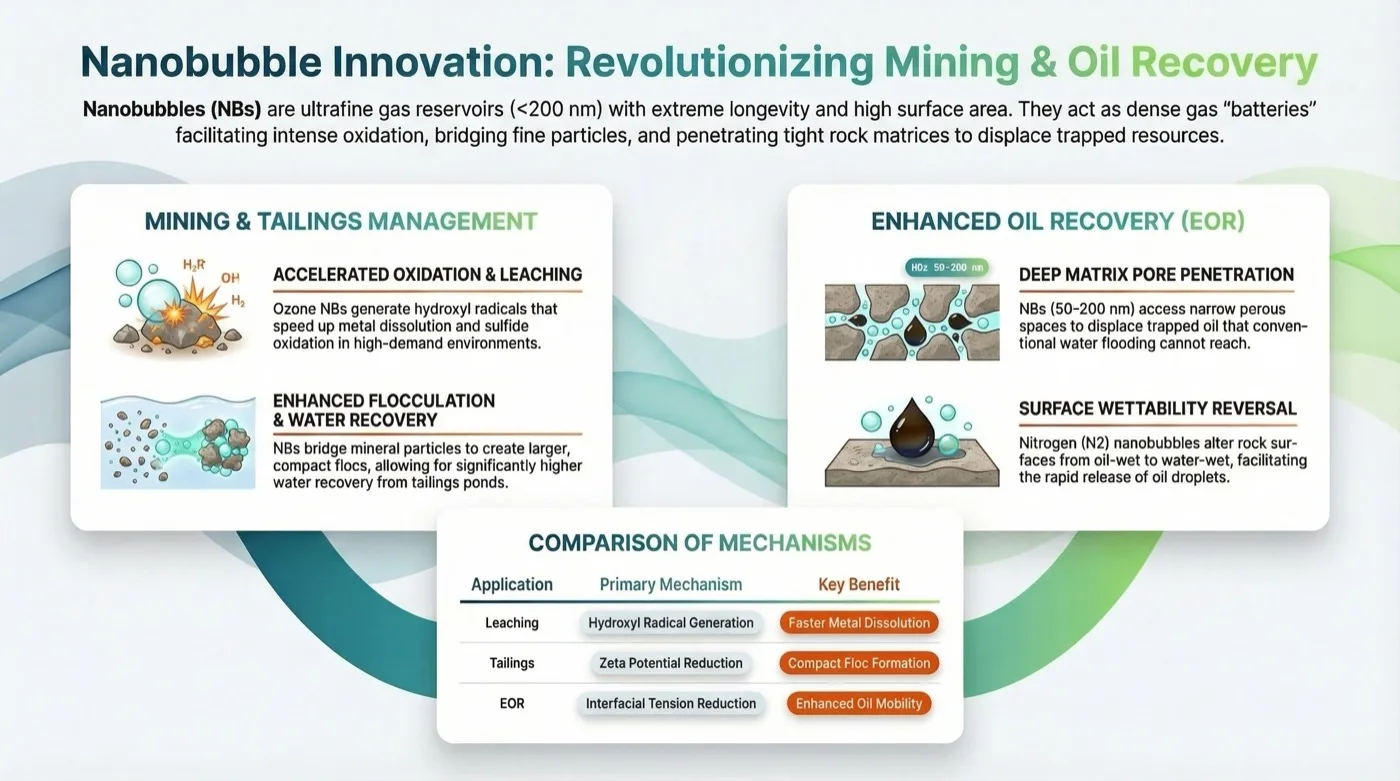
Nanobubbles have been proposed as another route. In a review of nanobubble flotation, Tao, 2022 proposed that the internal pressure and longevity of nanobubbles could sustain high dissolved oxygen or ozone levels and help oxidize refractory ores. The idea is that oxygen-enriched nanobubbles act as a gas reservoir that replenishes dissolved oxygen as microbes and sulfides consume it; the studies cited here do not measure that effect in a leach tank or heap.
Ozone bubbles in oxidative leaching
Ozone micro-nanobubbles (O₃-MNBs) accelerated oxidative leaching in the work reviewed by Fang et al., 2025, which examined the feasibility and challenges of in situ uranium leaching with ozone bubbles.
- Mass transfer. O₃-MNBs delivered a high of oxidant into the liquid phase. This accelerated the dissolution of target metals from sandstone uranium ores and the oxidation of associated sulfides such as pyrite.
- Oxidizing chemistry. The ozone bubbles generated hydroxyl radicals (•OH) and kept the oxidation-reduction potential () high, both of which drive sulfide oxidation.
The review links this to leaching operations where oxygen availability limits reaction rates, including heap leaching. Its evidence concerns in situ uranium leaching, so results for heap leaching of other ores remain to be shown.
Dissolved oxygen for bioleaching microbes
Bioleaching microbes need oxygen to work, and in the one study cited here their efficiency was supported across a DO range of 4 to 18 ppm. Chemolithotrophic bacteria such as Acidithiobacillus spp. use oxygen as the final electron acceptor when they oxidize ferrous iron (Fe²⁺) and reduced sulfur compounds.
Guezennec et al., 2017 showed that maintaining DO between 4 and 18 ppm under an oxygen-enriched atmosphere supported the bioleaching efficiency of mesophile and moderate thermophile consortia, including at a high solids loading of 20% w/w. That range is a reference point for testing any oxygen delivery method. Whether nanobubble oxygenation can hold DO in that range at such solids loadings has not been reported in the studies cited here.
Nanobubbles in tailings settling and dewatering
Fine clay suspensions settled and dewatered faster when were combined with a polymer flocculant than with the flocculant alone. Ultrafine particles smaller than about 20 µm settle slowly in tailings ponds, which limits water recovery.
- Settling. With cationic polyacrylamide (CPAM), bulk nanobubbles reduced settling time and supernatant zone height by more than 50% compared with CPAM alone in kaolin suspensions Li & Bu, 2024.
- Surface charge. Nanobubbles reduced the magnitude of the of kaolin particles, from −20 mV to −10 mV, which lowers electrostatic repulsion between particles Li & Bu, 2024.
- Bridging and ballast. Nanobubbles adsorbed onto mineral surfaces, bridged particles into larger, denser flocs, and acted as nucleation points for polymer attachment. With polyacrylamide (PAM), this "ballasting" produced aggregates that settled faster than those formed by PAM alone and left clearer supernatant water Li & Bu, 2024; Azevedo et al., 2019.
- Dewatering. Nanobubbles lowered filter cake resistance, which raised the dewatering rate and recovered more water from the sludge. The compact flocs drained and consolidated quickly. Water recovery from clay-rich tailings such as kaolin was significantly higher, and that water can be recycled to the plant Li & Bu, 2024.
What this means in practice
The leaching findings apply to tank or heap operations where oxygen supply limits sulfide oxidation, and the ozone findings to oxidative leaching of uranium ores. The tailings findings apply to fine, clay-rich tailings that settle slowly with flocculant alone.
For leaching, a test compares the current aeration with the alternative at the same solids loading. Measure DO in ppm or mg/L against the 4–18 ppm range reported by Guezennec et al., 2017, ORP, the Fe²⁺/Fe³⁺ ratio, metal extraction over time, and the energy used per unit of oxygen delivered.
For tailings, run settling-cylinder tests with flocculant alone and with flocculant plus nanobubbles at the same dose. Record settling rate, supernatant turbidity, zeta potential, underflow solids, filtration rate and the volume of water recovered, and characterize the nanobubbles as tracked particles per mL against a gas-free water blank.
Limits and open questions
- The bioleaching DO study used an oxygen-enriched atmosphere, not nanobubbles. The role of nanobubbles in leaching rests on a proposal in a flotation review and on a review of ozone bubbles, not on measured leach-tank or heap results.
- The ozone evidence concerns in situ uranium leaching and was framed by its authors as a question of feasibility and challenges; results for heap leaching of other ores are not reported here.
- The tailings results come from kaolin suspensions, a model clay. Results for real tailings with mixed mineralogy, and at pond or plant scale, are not reported here.
- Energy use for oxygen delivery is described qualitatively; the lesson gives no energy figures.
Questions
Why does dissolved oxygen matter in bioleaching?
Bioleaching bacteria such as Acidithiobacillus use oxygen as the final electron acceptor when they oxidize iron and sulfur, and oxygen dissolves poorly in leach solutions. Under an oxygen-enriched atmosphere, keeping dissolved oxygen between 4 and 18 ppm supported bioleaching efficiency even at 20% w/w solids Guezennec et al., 2017.
Have nanobubbles been shown to speed up leaching?
The evidence is at review level. A review of in situ uranium leaching reported that ozone micro-nanobubbles accelerated metal dissolution and pyrite oxidation through hydroxyl radicals and high ORP Fang et al., 2025. The main bioleaching oxygen study cited here used an oxygen-enriched atmosphere, not nanobubbles.
How do nanobubbles help tailings settle?
They reduce the surface charge that keeps fine particles apart, shifting kaolin's zeta potential from −20 mV to −10 mV, and bridge particles into denser flocs. Combined with cationic polyacrylamide, they cut settling time by more than 50% compared with the polymer alone and lowered filter cake resistance Li & Bu, 2024.
References
- Guezennec, A. G., Joulian, C., Jacob, J., et al. (2017). Influence of dissolved oxygen on the bioleaching efficiency under oxygen enriched atmosphere. Minerals Engineering, 106, 64-70. https://doi.org/10.1016/j.mineng.2016.10.016 ↩
- Fang, Z., Gan, M., Zhang, L., et al. (2025). Feasibility and Challenges of In Situ Uranium Leaching Using Ozone Bubbles: A Review. Minerals, 16, 2. https://doi.org/10.3390/min16010002 ↩
- Zhang, T., Chen, R., Wang, F., et al. (2024). Provenance of the Upper Carboniferous Yanghugou Formation in the Western Margin of the Ordos Basin, China: Constraints on Paleogeography and Basin Development. Minerals, 14, 78. https://doi.org/10.3390/min14010078 ↩
- Tao, D. (2022). Recent advances in fundamentals and applications of nanobubble enhanced froth flotation: A review. Minerals Engineering, 183, 107554. https://doi.org/10.1016/j.mineng.2022.107554 ↩
- Azevedo, A., Oliveira, H., Rubio, J. (2019). Bulk nanobubbles in the mineral and environmental areas: Updating research and applications. Advances in Colloid and Interface Science, 271, 101992. https://doi.org/10.1016/j.cis.2019.101992 ↩