Air nanobubbles
When is air enough, and when is a pure gas worth its cost?
On this page
What air nanobubbles do
Air nanobubbles are the lowest-cost option when a process needs the physical effects of nanobubbles, such as surface attachment, slippage at walls or gentle mechanical cleaning, but not the chemistry of a specific gas like ozone or hydrogen. They can be produced at large scale by hydrodynamic cavitation or hydraulic air compression Arablousabet & Povilaitis, 2024; Wang & Wang, 2023.
Flotation: separating oil from water
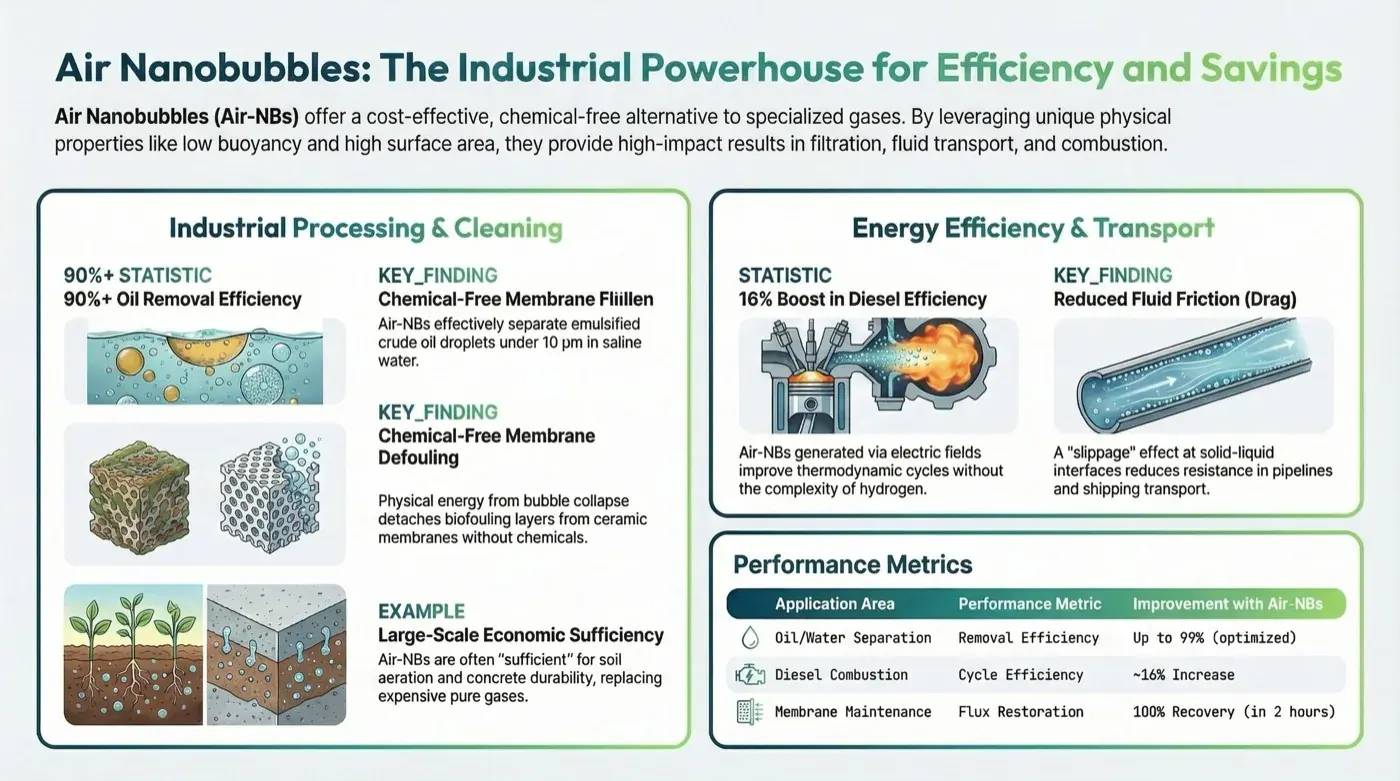
In (dissolved air flotation), air bubbles lift oil droplets to the surface. For emulsified crude oil in saline water, flotation with air nanobubbles outperformed conventional microbubbles. Their low buoyancy and high surface area let them attach to ultrafine droplets smaller than 10 µm that usually escape standard DAF. Oil removal exceeded 90%, and reached 99% under optimized conditions Etchepare et al., 2017; Shen et al., 2022.
Membrane cleaning
In a study of fouled ceramic membranes, air nanobubbles detached the biofouling layers without cleaning chemicals. The authors attributed the effect to the physical energy released as the bubbles collapsed Ghadimkhani et al., 2016.
Drag reduction in pipes and orifices
Nanobubbles in a liquid flowing through micro-orifices or pipes reduced frictional resistance (drag). The proposed mechanism is a slippage effect at the solid–liquid interface. The cited authors present this as a route to lower energy use in fluid transport, particularly pipelines and shipping. The evidence here is second-hand: Ushida et al. (2012), as cited by Nirmalkar et al., 2018, and Latorre (1997), as cited by Gurung et al., 2016.
Soil, water and concrete: when air is enough
Air nanobubble-saturated water was studied for soil moisture, nutrient retention and plant growth Arablousabet & Povilaitis, 2024. A review describes air as often sufficient for soil aeration, for basic water-quality improvement such as lowering chemical oxygen demand (COD), and for improving concrete durability Wang & Wang, 2023.
Fuel
A 2025 review reported that air nanobubbles generated with electric fields in diesel raised thermodynamic cycle efficiency by about 16%. The review presents this as a simpler route than injecting hydrogen English, 2025.
How air compares with pure gases
Air is the default when the benefit is physical. Oxygen is chosen when the aim is the highest dissolved oxygen for roots, fish or aerobic microbes; ozone when the aim is oxidation; hydrogen and carbon dioxide when their own chemistry is needed. A direct comparison of air and CO₂ nanobubbles in oil-recovery fluids is in Combining gases and cavitation.
Limits and open questions
- The 90–99% oil removal figures come from flotation of emulsified crude oil in saline water; other oils, salinities and plant designs may give different results.
- The membrane result comes from one study on ceramic membranes. It does not show that chemical cleaning can be dropped from a plant's maintenance program.
- The drag-reduction evidence is cited second-hand, and this profile gives no measured size of the effect.
- The 16% diesel figure comes from a single-author review, not from engine tests reported here.
- "Sufficient" is a judgment from review articles, not the result of a head-to-head cost study.
Questions
When is air enough instead of pure oxygen?
Reviews cited here describe air nanobubbles as often sufficient for soil aeration, basic water-quality improvement such as lowering chemical oxygen demand, and concrete durability, where the cost of pure oxygen or ozone is not justified. Where the goal is the highest dissolved oxygen or strong oxidation, pure gases are chosen instead.
How well do air nanobubbles separate oil from water?
In dissolved air flotation of emulsified crude oil in saline water, micro- and nanobubbles removed more than 90% of the oil, and up to 99% under optimized conditions. The nanobubbles attached to droplets smaller than 10 µm that conventional flotation tends to miss. Other oils and water chemistries may behave differently.
Do air nanobubbles reduce pipe friction?
Papers cited here report that nanobubbles in liquid flowing through micro-orifices or pipes reduced frictional drag through a slippage effect at the wall, and propose it as a way to save energy in pipelines and shipping. This profile gives no measured size of the effect, so savings at a given site are unknown.
References
- Etchepare, R., Oliveira, H., Azevedo, A., et al. (2017). Separation of emulsified crude oil in saline water by dissolved air flotation with micro and nanobubbles. Separation and Purification Technology, 186, 326-332. https://doi.org/10.1016/j.seppur.2017.06.007 ↩
- Shen, W., Mukherjee, D., Koirala, N., et al. (2022). Microbubble and nanobubble-based gas flotation for oily wastewater treatment: a review. Environmental Reviews, 30, 359-379. https://doi.org/10.1139/er-2021-0127 ↩
- English, N. J. (2025). Environmentally Sustainable and Energy-Efficient Nanobubble Engineering: Applications in the Oil and Fuels Sector. Fuels, 6, 50. https://doi.org/10.3390/fuels6030050 ↩
- Arablousabet, Y., Povilaitis, A. (2024). Assessing the Role of Air Nanobubble-Saturated Water in Enhancing Soil Moisture, Nutrient Retention, and Plant Growth. Sustainability, 16, 5727. https://doi.org/10.3390/su16135727 ↩
- Wang, Y., Wang, T. (2023). Preparation Method and Application of Nanobubbles: A Review. Coatings, 13, 1510. https://doi.org/10.3390/coatings13091510 ↩
- Ghadimkhani, A., Zhang, W., Marhaba, T. (2016). Ceramic membrane defouling (cleaning) by air Nano Bubbles. Chemosphere, 146, 379-384. https://doi.org/10.1016/j.chemosphere.2015.12.023 ↩
- Nirmalkar, N., Pacek, A. W., Barigou, M. (2018). On the Existence and Stability of Bulk Nanobubbles. Langmuir, 34, 10964-10973. https://doi.org/10.1021/acs.langmuir.8b01163 ↩
- Gurung, A., Dahl, O., Jansson, K. (2016). The fundamental phenomena of nanobubbles and their behavior in wastewater treatment technologies. Geosystem Engineering, 19, 133-142. https://doi.org/10.1080/12269328.2016.1153987 ↩