Water as a gas carrier
How does dissolved gas travel with water to roots, gills and microbes, and what does it lose on the way?
On this page
Water carries gas by flowing, not by diffusing
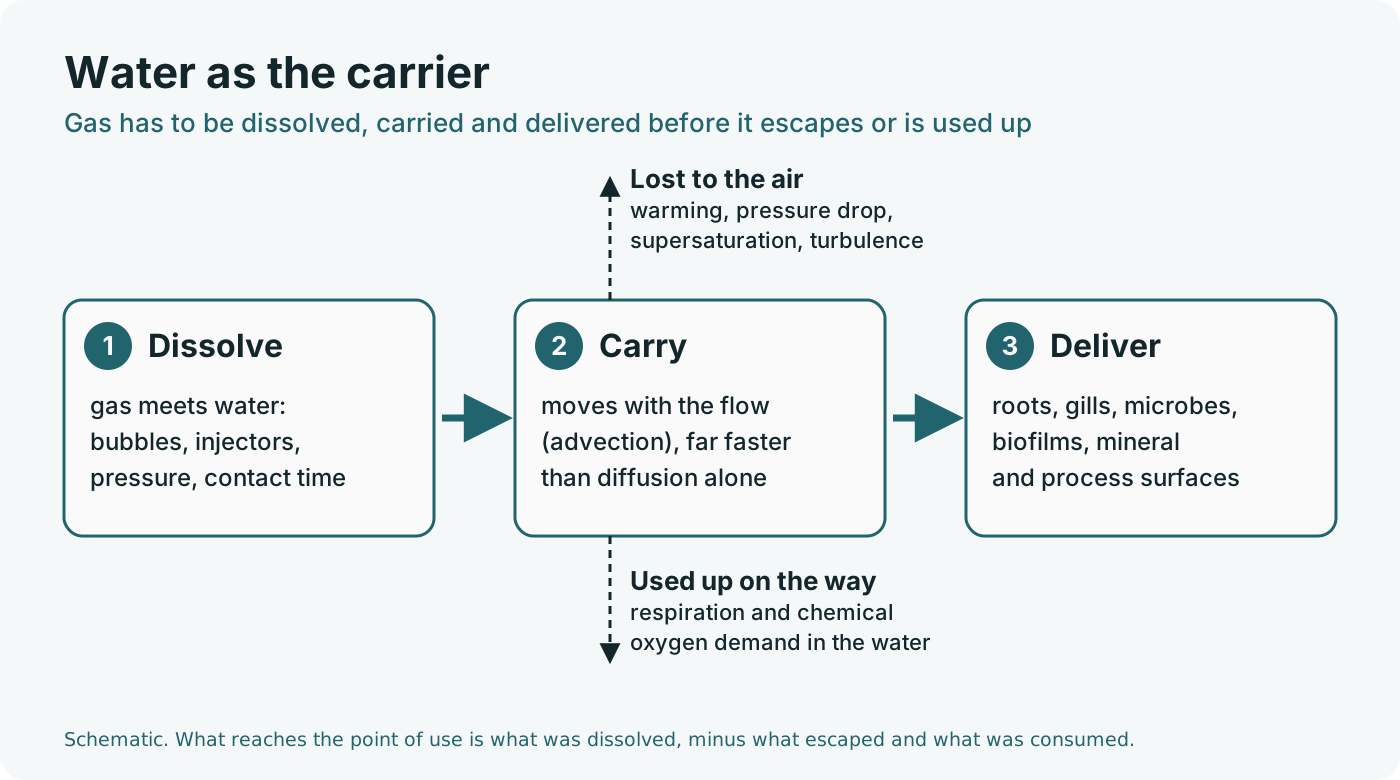
Dissolved gas moves in two ways: carried along as the water flows (advection), and spreading through still water by diffusion. Gases diffuse about 10,000 times more slowly in water than in air Mommer & Visser, 2005. By diffusion alone, oxygen takes about 7 hours to cross 1 cm of still water (see Diffusion and gas–liquid mass transfer); water flowing at 0.1 m/s carries it that far in a tenth of a second. Over meters of pipe, channel or pond, only flow and mixing move gas at a useful speed.
Water is also a thin carrier. A liter of air at 20 °C holds about 279 mg of oxygen; a liter of air-saturated fresh water holds 9.09 mg, about 30 times less (computed from Garcia & Gordon, 1992). The oxygen delivered is concentration times flow. Delivering more means raising the concentration, with colder water, pure oxygen or supersaturation, or moving more water past the point of use.
Movement matters right at the surface too. Submerged plants in stirred water kept their internal oxygen stable, while in unstirred water it fell quickly Mommer & Visser, 2005.
Delivery happens in the last millimeter
At every surface where gas is used, the final step is diffusion across a thin layer of slower water. Flow past the surface decides how thin that layer is, and so how fast gas arrives.
Roots in soil. Oxygen reaches roots mainly by diffusion from the soil surface through air-filled pores, and root respiration is usually limited by that diffusion and by the resistance of the mucilage layer around roots Ben-Noah & Friedman, 2018. Roots and soil microbes consume oxygen at roughly the same rate, and soils respire several to tens of grams of oxygen per square meter per day Ben-Noah & Friedman, 2018.
Compare that with what irrigation water carries. Ten millimeters of air-saturated water at 20 °C holds about 0.09 g of oxygen per square meter; saturated with pure oxygen, about 0.43 g, an equilibrium ceiling (computed). Dissolved oxygen in irrigation water is therefore a supplement to soil air, not a substitute. Its value depends on how restricted the soil's own air exchange is: low root-zone oxygen is linked mostly with wet, warm, fine-textured soils under intensive irrigation Ben-Noah & Friedman, 2018. Trial results in heavy soils are in Root zone mechanisms.
Roots in soilless systems. In nutrient film technique (NFT) channels, the roots' oxygen supply depends on the film's hydraulics: shallow, fast films expose more surface and renew it faster, while root mats, warmer solution and rising oxygen demand erode that supply over a crop cycle Scott & Villouta, 2026. Urrestarazu et al. (2005), as reviewed by Scott & Villouta, 2026, recorded dissolved oxygen falling from 6.2 to 2.9 mg/L along a conventional NFT channel. See Hydroponics and soilless culture.
Gills. Fish pump water over their gills, and the transfer of oxygen, carbon dioxide and ammonia depends on that water flow, oxygen most of all Randall et al., 1991. The same water carries carbon dioxide away: as it forms bicarbonate and hydrogen ions, it acidifies the water next to the gills Randall et al., 1991.
Biofilms. Biofilms, the slimy microbial layers on pipes, filters and roots, are not flat slabs. Water-filled voids through them carried about half of the oxygen the cells consumed, and the real exchange surface was twice the flat-surface estimate de Beer et al., 1994.
Mineral surfaces. In bioleaching, microbes oxidize sulfide minerals to release metals. In a 21 L stirred reactor at 42 °C with 20% pyrite-rich tailings, dissolution improved as dissolved oxygen rose from 4 to 13 ppm, which the authors linked to the oxygen transfer rate rather than the oxygen level; at 17 ppm, microbial activity fell significantly Guezennec et al., 2017. Delivery rate matters, and more is not automatically better. See Leaching and tailings.
What the water loses on the way
- Warming. Water saturated at 15 °C and warmed to 25 °C is at 122% saturation and tends to lose gas (see How gases dissolve in water). Demand rises at the same time: a 10 °C rise increased soil oxygen consumption two- to threefold Ben-Noah & Friedman, 2018.
- Pressure release. Water that took up gas under pressure becomes supersaturated when the pressure drops. In laboratory tests, supersaturated gas left water at rates different from ordinary reaeration, and the authors suggested that more turbulence or shallower water would speed its loss Li et al., 2013. Below a dam, total dissolved gas fell with distance downstream Beeman & Maule, 2006.
- Consumption. Roots, microbes and fish draw oxygen from the water they touch, as the falling oxygen along an NFT channel shows.
Fine bubbles as a reservoir in the flow
Undissolved gas can travel with the water and keep dissolving downstream. Bubbles do not always travel evenly with the water: in drip lines with injected air, bubbles reached the emitters unevenly, and in an open-end line 1.2 ppm of a nonionic surfactant raised the uniformity coefficient from 20% to 80% Torabi et al., 2014.
Smaller bubbles rise slowly and follow the water. A review describes micro- and nanobubbles as releasing oxygen continuously, and reports that combined with subsurface drip they increased soil aeration by 5% Zheng et al., 2025. In one study, oxygen nanobubbles raised dissolved oxygen, and bubble size and concentration in distilled water stored at 4 °C stayed relatively stable for 70 days Ebina et al., 2013; the conditions and pond results are in Oxygen management and sediment. How fine bubbles are made is the subject of the next course: What hydrodynamic cavitation is and Cavitation, gas dissolution and fine bubbles.
What this means in practice
Measure where the gas is used, not only where it goes in.
- Dissolved oxygen () in mg/L and % saturation, with water temperature, at the point of use: the emitter and root depth, the far end of an NFT channel, the tank outlet or pond bottom, the reactor. Compare it with the reading at the injector.
- Timing. Log through the day and across the crop or production cycle, since temperature and demand change.
- Total dissolved gas where fish meet supersaturated water; CO₂, pH and alkalinity in recirculating water; the ozone residual at the point of use if ozone is dosed.
- A fair test. Run a treated and an untreated line with the same water, crop or stock, and management.
Oxygen supports root health and beneficial aerobic microbes; it does not replace sanitation, clean water or crop protection.
Limits and open questions
- The irrigation comparison, diffusion times and air-versus-water figure are computed and approximate; soil respiration varies with soil, crop and climate.
- The review behind the soil findings also notes that active soil aeration methods gave mainly positive results but are not yet widely used, for lack of profitability, field-scale proof and a field protocol Ben-Noah & Friedman, 2018.
- The NFT gradient is reported through a review; the original channel conditions are not given there.
- The gill and biofilm findings come from mechanism studies and give no thresholds for particular species or systems.
- The bioleaching result is from one reactor and one microbial consortium at 42 °C.
- The drip-line bubbles were injected air of unreported size, not micro- or nanobubbles, and the cited work does not establish how long nanobubbles persist in working systems.
Questions
Can irrigation water supply all the oxygen roots need?
Not by itself. Ten millimeters of air-saturated water holds about 0.09 g of oxygen per square meter, while soils respire several grams or more per day. Roots and microbes draw most of their oxygen from soil air, so dissolved oxygen matters most where soil air exchange is restricted, as in wet, warm, heavy soils.
Why measure dissolved oxygen at the roots and not only at the tank?
Water loses oxygen on the way: it warms, degasses and meets roots and microbes that consume it. In one study, dissolved oxygen fell from 6.2 to 2.9 mg/L along a single NFT channel. A reading at the injector says what went in, not what the roots receive.
Why does supersaturated water lose its gas?
Supersaturated water holds more gas than equilibrium allows, so the excess leaves as bubbles or across the surface. Laboratory authors suggested that turbulence and shallower water speed that loss, and below a dam total dissolved gas fell with distance downstream. Measure it where fish or roots actually meet the water.
Do fine bubbles keep oxygen in the water longer?
Fine bubbles rise slowly and travel with the flow, and a review describes micro- and nanobubbles as releasing oxygen continuously. In one study, they stayed relatively stable for 70 days in distilled water stored at 4 °C. How long they persist with roots, microbes and warm water has not been established.
References
- MOMMER, L., VISSER, E. J. W. (2005). Underwater Photosynthesis in Flooded Terrestrial Plants: A Matter of Leaf Plasticity. Annals of Botany, 96, 581-589. https://doi.org/10.1093/aob/mci212 ↩
- Ben-Noah, I., Friedman, S. P. (2018). Review and Evaluation of Root Respiration and of Natural and Agricultural Processes of Soil Aeration. Vadose Zone Journal, 17, 1-47. https://doi.org/10.2136/vzj2017.06.0119 ↩
- Garcia, H. E., Gordon, L. I. (1992). Oxygen solubility in seawater: Better fitting equations. Limnology and Oceanography, 37, 1307-1312. https://doi.org/10.4319/lo.1992.37.6.1307 ↩
- Scott, S., Villouta, C. (2026). Dissolved oxygen limitation and Pythium root rot in strawberry NFT systems: mechanisms, research gaps, and prospects for substrate-free production. Frontiers in Plant Science, 17, 1829367. https://doi.org/10.3389/fpls.2026.1829367 ↩
- de Beer, D., Stoodley, P., Roe, F., et al. (1994). Effects of biofilm structures on oxygen distribution and mass transport. Biotechnology and Bioengineering, 43, 1131-1138. https://doi.org/10.1002/bit.260431118 ↩
- Guezennec, A. G., Joulian, C., Jacob, J., et al. (2017). Influence of dissolved oxygen on the bioleaching efficiency under oxygen enriched atmosphere. Minerals Engineering, 106, 64-70. https://doi.org/10.1016/j.mineng.2016.10.016 ↩
- Randall, D., Lin, H., Wright, P. A. (1991). Gill Water Flow and the Chemistry of the Boundary Layer. Physiological Zoology, 64, 26-38. https://doi.org/10.1086/physzool.64.1.30158512 ↩
- Li, R., Hodges, B. R., Feng, J., et al. (2013). Comparison of Supersaturated Total Dissolved Gas Dissipation with Dissolved Oxygen Dissipation and Reaeration. Journal of Environmental Engineering, 139, 385-390. https://doi.org/10.1061/(asce)ee.1943-7870.0000598 ↩
- Beeman, J. W., Maule, A. G. (2006). Migration Depths of Juvenile Chinook Salmon and Steelhead Relative to Total Dissolved Gas Supersaturation in a Columbia River Reservoir. Transactions of the American Fisheries Society, 135, 584-594. https://doi.org/10.1577/t05-193.1 ↩
- Torabi, M., Midmore, D. J., Walsh, K. B., et al. (2014). Improving the Uniformity of Emitter Air Bubble Delivery during Oxygation. Journal of Irrigation and Drainage Engineering, 140, 06014002. https://doi.org/10.1061/(asce)ir.1943-4774.0000735 ↩
- Zheng, K., Zeng, H., Liu, R., et al. (2025). Research Progress on the Regulation of Plant Rhizosphere Oxygen Environment by Micro-Nano Bubbles and Their Application Prospects in Alleviating Hypoxic Stress. Agronomy, 15, 2620. https://doi.org/10.3390/agronomy15112620 ↩
- Ebina, K., Shi, K., Hirao, M., et al. (2013). Oxygen and Air Nanobubble Water Solution Promote the Growth of Plants, Fishes, and Mice. PLoS ONE, 8, e65339. https://doi.org/10.1371/journal.pone.0065339 ↩