Manure management and cavitation
What have studies measured when hydrodynamic cavitation was applied to sludge, and when stored liquid manure was treated to cut odor gases?
On this page
How hydrodynamic cavitation breaks up sludge
Hydrodynamic cavitation is a mechanical pretreatment: it breaks up solids so that a later biological step can digest them. It has been studied mainly on wastewater sludge, and proposed for liquid manure (slurry) ahead of anaerobic digestion.
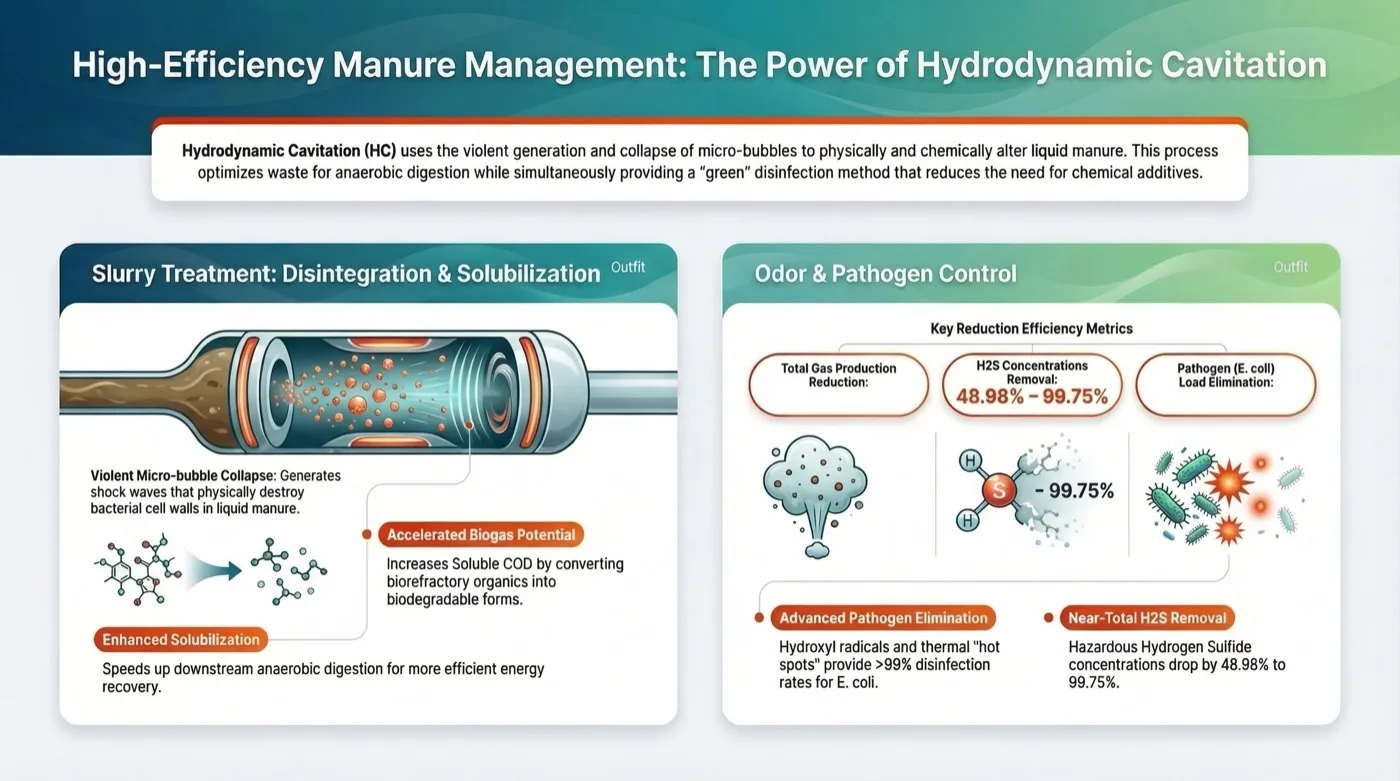
The mechanism is pressure. When a liquid passes through a constriction such as a venturi or an orifice plate, its local pressure drops, small vapor cavities form, and they collapse violently as pressure recovers. The collapse produces shock waves and shear forces strong enough to break bacterial cell walls and disintegrate sludge flocs, releasing intracellular organic matter into the liquid Mancuso et al., 2020.
Solubilization and biogas potential
Breaking up particles moves organic matter from the solid phase into solution. That shows up as a rise in soluble chemical oxygen demand (SCOD), the share of chemical oxygen demand (COD) that is dissolved. Cavitation also converts some biorefractory compounds, which microbes digest poorly, into more biodegradable forms.
In activated-sludge studies, cavitation pretreatment improved sludge solubilization and biodegradability, which is the basis for expecting faster biogas production in a subsequent digestion step Mancuso et al., 2017. The swirling-jet study measured aerobic biodegradability of activated sludge; this lesson reports no digester biogas yields from manure. The lesson on biogas and biomethane covers digestion in more detail.
Odor gases: what a nanoparticle study measured
The only manure gas measurements in this lesson come from nanoparticles, not from cavitation or nanobubbles. They are included because they show what has been measured in stored manure, and they do not transfer to other technologies.
In liquid dairy manure stored under anaerobic conditions, nanoparticle treatments reduced total gas production by 92–95%. Hydrogen sulfide (H₂S) concentrations fell by 48.98%–99.75%, and methane (CH₄) concentrations by more than 99%, in the treated samples Sarker et al., 2019.
The authors linked the reductions to higher pH, which limits the build-up of volatile fatty acids (VFA), and to suppression of methane-producing and sulfur-reducing bacteria Sarker et al., 2019. A treatment that suppresses methanogens in storage works against the aim of a downstream digester, which depends on them, so the two uses would need to be weighed against each other.
Bacterial reductions reported for cavitation
Reviews of hydrodynamic cavitation report lower bacterial counts in treated water and wastewater effluents, including E. coli Mancuso et al., 2020; Sun et al., 2020.
Two mechanisms are described. Collapsing cavities create localized hot spots of high temperature and pressure, and they generate hydroxyl radicals (•OH) that react with cell components; shear and shock waves can also rupture cell membranes. This lesson gives no reduction figures for manure, where conditions differ from those in clean water.
What this means in practice
The cavitation findings come from wastewater sludge and water, and the gas findings from a nanoparticle study. A farm or digester operator considering hydrodynamic cavitation for slurry would run a bench or pilot test on its own manure before drawing conclusions, and would keep its manure-handling and biosecurity rules in place.
Useful measurements before and after treatment:
- Solubilization: total COD and SCOD, to see how much organic matter moved into solution.
- Biogas: gas volume and methane content from a digester or a laboratory biogas potential test on treated and untreated slurry.
- Storage chemistry: pH and VFA, and H₂S and methane in the storage headspace.
- Bacteria: E. coli counts in treated and untreated samples, taken on the same day.
- Energy: the electrical energy the cavitation unit uses per cubic meter treated, so any gain can be set against its cost.
Limits and open questions
- The cavitation evidence in this lesson comes from activated sludge, water and effluents, much of it through reviews. It reports no study that applied nanobubbles to livestock manure; cavitation studies on cattle manure and dairy-farm waste are summarized in Hydrodynamic cavitation in agriculture and food.
- The gas reductions came from nanoparticle additives, not from nanobubbles or cavitation, and should not be read as results for either.
- The more-than-99% methane reduction was measured in stored manure samples under anaerobic conditions; it is not a farm emissions figure.
- The swirling-jet study measured aerobic biodegradability of activated sludge, not biogas yield from manure.
- Bacterial reductions for cavitation are reported here without figures and without manure data.
Questions
Does hydrodynamic cavitation increase biogas from manure?
In activated-sludge studies, cavitation pretreatment improved solubilization and biodegradability, which is why faster biogas production is expected in a following digestion step. This lesson has no digester yield figure for manure, so a laboratory biogas potential test on a farm's own slurry is the way to find out.
Do nanobubbles reduce hydrogen sulfide in stored manure?
The hydrogen sulfide reductions reported here, 48.98%–99.75%, came from nanoparticle treatments of liquid dairy manure stored under anaerobic conditions, not from nanobubbles or cavitation. No cited study measured hydrogen sulfide after nanobubble treatment of manure, so the question remains open and would need its own storage trial.
Does cavitation reduce E. coli in manure?
Reviews report lower bacterial counts, including E. coli, in water and wastewater effluents treated with hydrodynamic cavitation, through hot spots, shear and hydroxyl radicals. This lesson gives no manure data, so a site would need before-and-after counts, and it would keep its usual manure-handling rules.
References
- Mancuso, G., Langone, M., Andreottola, G. (2020). A critical review of the current technologies in wastewater treatment plants by using hydrodynamic cavitation process: principles and applications. Journal of Environmental Health Science and Engineering, 18, 311-333. https://doi.org/10.1007/s40201-020-00444-5 ↩
- Mancuso, G., Langone, M., Andreottola, G. (2017). A swirling jet-induced cavitation to increase activated sludge solubilisation and aerobic sludge biodegradability. Ultrasonics Sonochemistry, 35, 489-501. https://doi.org/10.1016/j.ultsonch.2016.11.006 ↩
- Sarker, N. C., Rahman, S., Borhan, M. S., et al. (2019). Nanoparticles in mitigating gaseous emissions from liquid dairy manure stored under anaerobic condition. Journal of Environmental Sciences, 76, 26-36. https://doi.org/10.1016/j.jes.2018.03.014 ↩
- Sun, X., Liu, J., Ji, L., et al. (2020). A review on hydrodynamic cavitation disinfection: The current state of knowledge. Science of The Total Environment, 737, 139606. https://doi.org/10.1016/j.scitotenv.2020.139606 ↩