Diffusion and gas–liquid mass transfer
How fast does gas move from a bubble or a surface into water, and what controls that speed?
On this page
- Key takeaways
- Diffusion: why gas moves slowly through still water
- The two-film model: where the resistance sits
- kLa: the number engineers measure
- Bubble size, rise speed and contact time
- Why smaller is not always better
- Transfer runs both ways
- What this means in practice
- Limits and open questions
- Questions
- References
Diffusion: why gas moves slowly through still water
In still water, dissolved gas spreads only by diffusion, the random motion of molecules, and diffusion is slow. Fick's law describes it: the flow of a dissolved gas is proportional to how steeply its concentration changes with distance Fick, 1855. The proportionality constant is the , D.
For oxygen in clean water at 20 °C, D was measured at 1.98 × 10⁻⁹ m²/s Jamnongwong et al., 2010. Gases diffuse about 10,000 times faster in air Mommer & Visser, 2005. Salt, sugar and surfactants each lowered D further in the same laboratory tests Jamnongwong et al., 2010.
The time diffusion needs grows with the square of the distance, roughly t = x²/2D Einstein, 1905. With D = 2 × 10⁻⁹ m²/s:
| Distance in still water | Approximate time for oxygen to diffuse |
|---|---|
| 0.1 mm | a few seconds |
| 1 mm | about 4 minutes |
| 1 cm | about 7 hours |
| 10 cm | about a month |
| 1 m | about 8 years |
Across the last fraction of a millimeter, at a bubble wall, a root or a gill, diffusion is fast enough. Across centimeters of still water it is not; flow and mixing must do that work, as the next lesson shows.
The two-film model: where the resistance sits
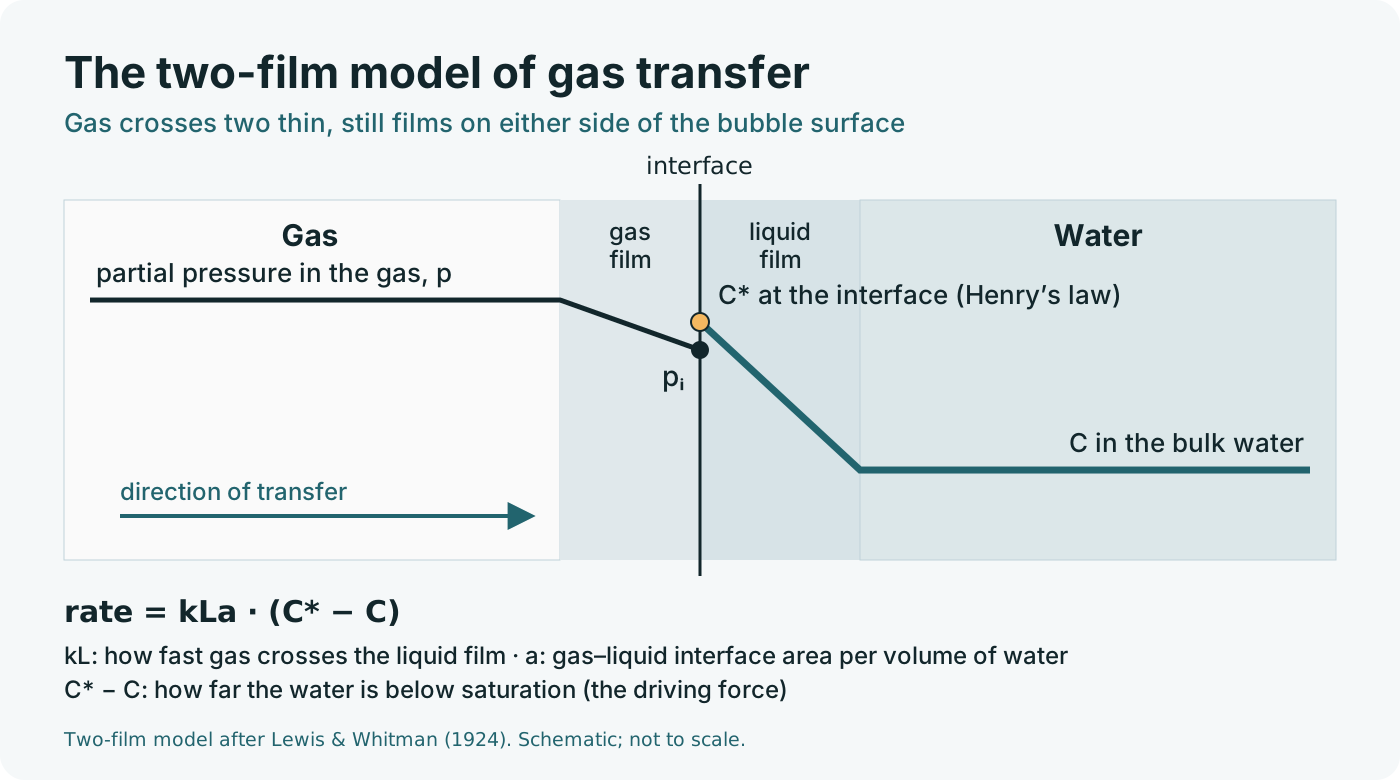
Gas crossing into water meets resistance in two thin films, one on each side of the surface, and for oxygen the water-side film is the bottleneck. The two-film model Lewis & Whitman, 1924 treats gas and water as being in equilibrium only at the interface itself; on each side, gas crosses a thin, poorly mixed film by diffusion Kraakman et al., 2011.
Because oxygen is poorly soluble, the gas-side film offers no significant resistance Kraakman et al., 2011. Nitrogen and hydrogen are less soluble still (see How gases dissolve in water), so the same reasoning applies to them.
Transfer therefore speeds up when something thins or renews the water film (mixing, turbulence, flow), when there is more interface area, or when the gap between saturation and the actual concentration is larger Kraakman et al., 2011. Plants show the film at work: submerged plants in stirred water kept their internal oxygen stable, while in unstirred water it fell quickly Mommer & Visser, 2005.
kLa: the number engineers measure
Transfer rate = × (saturation concentration − actual concentration) Kraakman et al., 2011. kLa combines two things measured together: kL, how fast gas crosses the water film, and a, the interface area per volume of water Jamnongwong et al., 2010. It is usually reported per hour or per minute.
The bracket is the driving force, and it explains two practical rules. First, transfer slows as water approaches saturation, so the last few percent come slowest. Second, anything that raises the saturation value, such as pure oxygen instead of air, widens the gap and speeds transfer.
Clean-water tests give a standard kLa and a standard oxygen transfer efficiency (), the share of supplied oxygen that dissolves. Real water transfers differently, and engineers correct with an α-factor, the ratio of kLa in process water to kLa in clean water Jamnongwong et al., 2010.
Bubble size, rise speed and contact time
Smaller bubbles offer more surface per liter of gas and rise more slowly, so they give gas more area and more time. A sphere's surface per unit volume is 6 divided by its diameter.
| Bubble diameter | Surface per liter of gas, relative to 4 mm | Rise speed in still water | Time to rise 1 m |
|---|---|---|---|
| about 4 mm | 1× | 0.29 m/s (measured) | about 3 seconds |
| 100 µm | 40× | about 5 mm/s (computed) | about 3 minutes |
| 10 µm | 400× | about 0.05 mm/s (computed) | about 5 hours |
The 3.9 mm bubbles rose at 0.29 m/s with a kL of 4.6 × 10⁻⁴ m/s Jamnongwong et al., 2010. The smaller speeds are computed with Stokes' law for a rigid sphere, the slow limit for small bubbles Manor & Chan, 2009. Measured rise speeds of 20 to 1,000 µm bubbles fell between the rigid-surface and fluid-surface predictions Detsch, 1991, and trace surfactants shift them Manor & Chan, 2009. Small bubbles also shrink as their gas dissolves.
Water chemistry changes bubble size. In a laboratory column with membrane diffusers, salt up to 15 g/L stopped bubbles from merging, and the smaller bubbles more than doubled kLa compared with tap water Behnisch et al., 2018.
At bench scale, bubbles of 100 nm to 2 µm, at 10⁸ to 10⁹ per mL, reached a kLa of 0.4204 min⁻¹ at 0.5 L/min of air in 25 L of water, with SOTE up to 54.33%, about twice the diffuser's at the best airflow Kizhisseri et al., 2025.
Why smaller is not always better
- Surfactants. Surface-active substances collect on bubbles and reduce transfer, more for fine-bubble aerators than for others Rosso et al., 2006. They act two ways: they keep bubbles small, which adds area, but stiffen the surface, which lowers kL Jamnongwong et al., 2010.
- Driving force. No bubble size escapes the bracket: near saturation, transfer slows whatever the bubbles.
- Energy. Aeration accounts for the largest share of energy costs in wastewater treatment plants Rosso et al., 2006. SOTE counts oxygen per oxygen supplied, not per kilowatt-hour. The bench generator above ran a pump at 3.5 to 4.5 bar, and the study did not report energy per kilogram of oxygen Kizhisseri et al., 2025. More turbulence can offset contamination, at the expense of efficiency Rosso et al., 2006.
How cavitation devices break gas into fine bubbles is covered in Cavitation, gas dissolution and fine bubbles.
Transfer runs both ways
The same film physics removes gas. Recirculating fish farms strip carbon dioxide by trickling water through air. In full-scale cascade columns, CO₂ removal was 21–24% at air-to-water ratios of 2.2:1 to 3.4:1 and rose to 35.8–37.2% at 9.5:1 to 9.9:1 Summerfelt et al., 2003. Supersaturated water losing its excess gas is the same process, covered in Water as a gas carrier.
What this means in practice
- Measure oxygen transfer in the water the system will actually treat, not only in clean water, because real water transfers differently (the α-factor).
- Log dissolved oxygen recovery over time with temperature, against a control, and report bubble size together with the method used to measure it.
- Compare aeration options on kilograms of oxygen transferred per kilowatt-hour and per unit of gas, at the dissolved oxygen you actually operate at, because transfer shrinks near saturation.
- In still tanks and slow channels, expect surface transfer to be limited by the water film; mixing and flow help.
Limits and open questions
- The diffusion coefficient comes from clean-water laboratory tests at 20 °C; other temperatures and liquids differ.
- Diffusion times and Stokes rise speeds are computed for still water and rigid, non-dissolving spheres; treat them as orders of magnitude.
- The salt result comes from one laboratory column with NaCl up to 15 g/L; the micro-nanobubble result from one 25 L bench study that did not report energy use.
- The surfactant finding is reported as a direction, without α values here.
- The stripping result comes from one coldwater recirculating system with 1 m of packing.
- The lesson gives no kLa values for full-scale aeration or for any specific device.
Questions
Why is oxygen transfer controlled by the water side?
Oxygen is poorly soluble, so the gas side of the interface offers no significant resistance and the slow step is diffusion through the thin water film. That is why mixing, turbulence and flow, which thin and renew the water film, speed oxygen transfer, while enriching the gas raises the driving force.
Do smaller bubbles always transfer more oxygen?
Not always. Smaller bubbles give more surface per liter of gas and rise more slowly, but surfactants stiffen their surfaces and reduce transfer, more for fine bubbles than coarse. Transfer also slows near saturation whatever the bubble size, and making small bubbles takes energy that SOTE does not count.
What does kLa tell me, and what does it leave out?
kLa measures how fast a system moves gas into water per unit of driving force, combining film speed and interface area. It does not show the energy used, and a clean-water value can differ from the value in real process water, which engineers correct with the α-factor.
References
- Jamnongwong, M., Loubiere, K., Dietrich, N., et al. (2010). Experimental study of oxygen diffusion coefficients in clean water containing salt, glucose or surfactant: Consequences on the liquid-side mass transfer coefficients. Chemical Engineering Journal, 165, 758-768. https://doi.org/10.1016/j.cej.2010.09.040 ↩
- MOMMER, L., VISSER, E. J. W. (2005). Underwater Photosynthesis in Flooded Terrestrial Plants: A Matter of Leaf Plasticity. Annals of Botany, 96, 581-589. https://doi.org/10.1093/aob/mci212 ↩
- Einstein, A. (1905). Über die von der molekularkinetischen Theorie der Wärme geforderte Bewegung von in ruhenden Flüssigkeiten suspendierten Teilchen. Annalen der Physik, 322, 549-560. https://doi.org/10.1002/andp.19053220806 ↩
- Behnisch, J., Ganzauge, A., Sander, S., et al. (2018). Improving aeration systems in saline water: measurement of local bubble size and volumetric mass transfer coefficient of conventional membrane diffusers. Water Science and Technology, 78, 860-867. https://doi.org/10.2166/wst.2018.358 ↩
- kizhisseri, M. I., Sakr, M., Maraqa, M., et al. (2025). A comparative bench scale study of oxygen transfer dynamics using micro-nano bubbles and conventional aeration in water treatment systems. Heliyon, 11, e41687. https://doi.org/10.1016/j.heliyon.2025.e41687 ↩
- Summerfelt, S. T., Davidson, J., Waldrop, T. (2003). Evaluation of full-scale carbon dioxide stripping columns in a coldwater recirculating system. Aquacultural Engineering, 28, 155-169. https://doi.org/10.1016/s0144-8609(03)00026-8 ↩
- Fick, A. (1855). Ueber Diffusion. Annalen der Physik, 170, 59-86. https://doi.org/10.1002/andp.18551700105 ↩
- Lewis, W. K., Whitman, W. G. (1924). Principles of Gas Absorption.. Industrial & Engineering Chemistry, 16, 1215-1220. https://doi.org/10.1021/ie50180a002 ↩
- Kraakman, N. J. R., Rocha-Rios, J., van Loosdrecht, M. C. M. (2011). Review of mass transfer aspects for biological gas treatment. Applied Microbiology and Biotechnology, 91, 873-886. https://doi.org/10.1007/s00253-011-3365-5 ↩
- Manor, O., Chan, D. Y. C. (2009). Terminal Velocity and Mobile Surface Species in Rising Microbubbles. Langmuir, 25, 8899-8902. https://doi.org/10.1021/la901958t ↩
- Detsch, R. M. (1991). Small air bubbles in reagent grade water and seawater: 1. Rise velocities of 20‐ to 1000‐μm‐diameter bubbles. Journal of Geophysical Research: Oceans, 96, 8901-8906. https://doi.org/10.1029/91jc00484 ↩
- Rosso, D., Larson, L., Stenstrom, M. (2006). Surfactant effects on alpha factors in full-scale wastewater aeration systems. Water Science and Technology, 54, 143-153. https://doi.org/10.2166/wst.2006.768 ↩