Carbon dioxide nanobubbles (CO₂)
What does CO₂ bring as a nanobubble gas: viscosity, pH or carbon?
On this page
What CO₂ nanobubbles do
CO₂ nanobubbles act through dissolution. CO₂ dissolves readily in both water and oil, and in water it changes pH and carbonate chemistry. That gives it two distinct roles: in oil, it swells the crude and thins it; in water, it acidifies alkaline conditions and supplies carbon for photosynthesis.
Oil recovery in tight reservoirs
In extra-low-permeability (tight) reservoirs, injecting gas directly tends to channel through the most permeable paths and bypass oil. Laboratory work on (enhanced oil recovery) tested CO₂-NB systems as an alternative Cai et al., 2024:
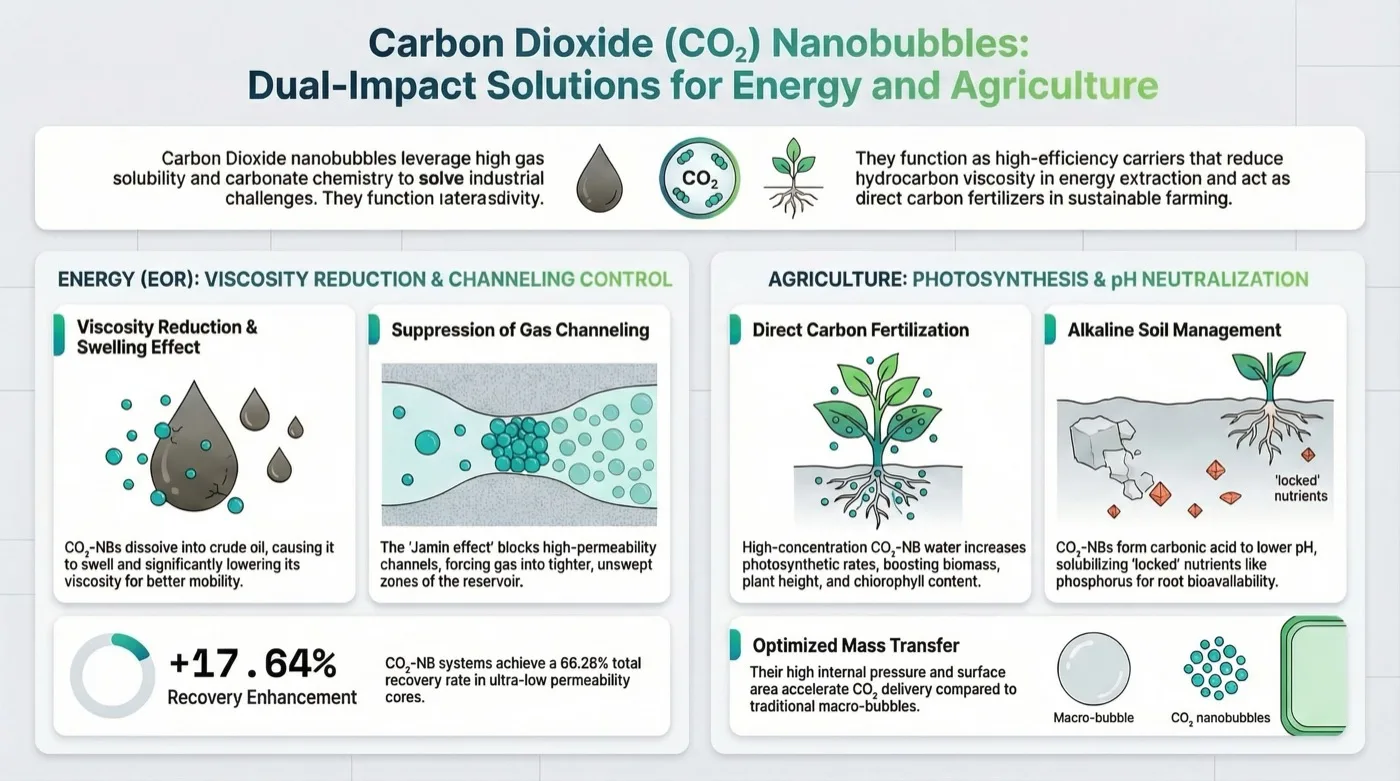
- Swelling and viscosity: CO₂-NBs dissolved into the crude oil, which swelled and became markedly less viscous. This improved the mobility ratio between the displacing fluid and the oil.
- Channeling control: CO₂-NB systems stabilized with modified nano-silica (SiO₂) blocked high-permeability channels and diverted flow into tighter, unswept zones. The mechanism is the Jamin effect, in which bubbles lodged in pore throats resist flow and force the gas into the low-permeability matrix.
- Recovery: in core floods, the CO₂-NB system raised oil recovery by 17.64% beyond water flooding followed by conventional CO₂ flooding, reaching a total of 66.28% in ultra-low-permeability cores.
Agriculture: carbon supply and pH
CO₂-NBs can act as a direct carbon source for plants. A review reports that high-concentration CO₂-NB water, applied by foliar spray or in hydroponics, raised the photosynthetic rate and improved biomass accumulation, plant height and chlorophyll content Pal & Anantharaman, 2022.
CO₂-NBs also change soil and water chemistry. In alkaline soils or water, the released CO₂ forms carbonic acid (H₂CO₃) and lowers the pH. That can dissolve nutrients such as phosphorus and micronutrients that are held in insoluble forms at high pH, making them available to plant roots Wang et al., 2021; Pal & Anantharaman, 2022.
How CO₂ compares with other gases
CO₂ is chosen when its own chemistry is wanted: dissolving into oil, lowering pH or feeding photosynthesis. In oil recovery, nitrogen nanobubbles worked mainly through physical effects such as lower interfacial tension and slippage, while CO₂ swelled and thinned the oil. Oxygen serves root respiration rather than photosynthesis. A direct comparison of CO₂ and air nanobubbles in oil-recovery fluids is in Combining gases and cavitation.
Limits and open questions
- The oil-recovery figures come from laboratory core floods in one study; they do not show performance in a reservoir.
- The channeling control used nano-silica stabilization, a chemical additive; the result applies to that system, not to CO₂ bubbles alone.
- The agricultural evidence comes mainly from a review; this profile gives no doses, crops or yield figures.
- The size and duration of the pH change in a given soil or water are not reported here.
Questions
How do CO₂ nanobubbles help recover oil?
In laboratory core floods, CO₂ nanobubbles dissolved into crude oil, swelling it and lowering its viscosity, while nano-silica-stabilized bubbles blocked high-permeability channels and diverted flow into unswept zones. Recovery rose 17.64% beyond water flooding followed by conventional CO₂ flooding, to a total of 66.28% in ultra-low-permeability cores.
Can CO₂ nanobubble water feed plants?
A review of CO₂ nanobubbles in agriculture reports that CO₂ nanobubble water applied by foliar spray or in hydroponics raised the photosynthetic rate, with gains in biomass, plant height and chlorophyll. This profile gives no doses or yield figures, so results for a particular crop need a side-by-side trial.
Why do CO₂ nanobubbles lower pH?
Dissolved CO₂ forms carbonic acid (H₂CO₃), which lowers the pH of alkaline water or soil solution. At lower pH, nutrients such as phosphorus and micronutrients that are held in insoluble forms at high pH can become more available to roots. How large and how lasting the change is depends on the site.
References
- Cai, L., Wu, J., Zhang, M., et al. (2024). Investigating the Potential of CO2 Nanobubble Systems for Enhanced Oil Recovery in Extra-Low-Permeability Reservoirs. Nanomaterials, 14, 1280. https://doi.org/10.3390/nano14151280 ↩
- Pal, P., Anantharaman, H. (2022). CO2 nanobubbles utility for enhanced plant growth and productivity: Recent advances in agriculture. Journal of CO2 Utilization, 61, 102008. https://doi.org/10.1016/j.jcou.2022.102008 ↩
- Wang, B., Lu, X., Tao, S., et al. (2021). Preparation and Properties of CO2 Micro-Nanobubble Water Based on Response Surface Methodology. Applied Sciences, 11, 11638. https://doi.org/10.3390/app112411638 ↩