Nanobubbles in oral-health research
What have periodontal and oral-care studies reported about nanobubbles, and what related systemic research exists?
On this page
Ozone nanobubble water in periodontal research
Ozone nanobubble water has been studied as an addition to mechanical cleaning in chronic periodontitis, and researchers reported both laboratory and clinical effects Hayakumo et al., 2014; Hayakumo et al., 2012. Periodontitis is a gum disease in which bacteria in deep pockets between tooth and gum break down the tissue and bone that hold teeth in place. Mechanical debridement, scraping plaque from the root surfaces, has trouble reaching the deepest pockets.
Laboratory tests
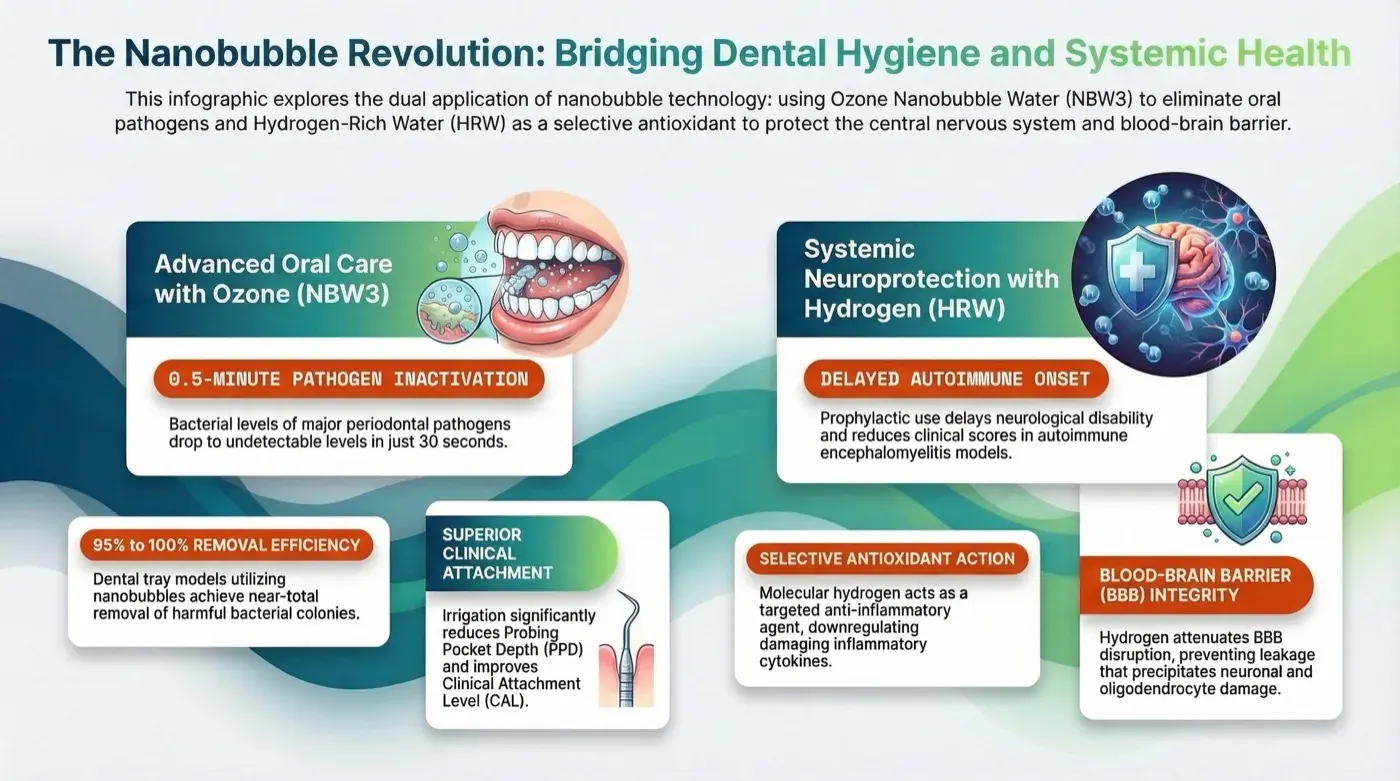
Hayakumo et al. tested ozone nanobubble water, which they called NBW3, against major periodontal bacteria, Porphyromonas gingivalis and Aggregatibacter actinomycetemcomitans. In in vitro time-kill assays, colony-forming units (CFU) of these bacteria fell to undetectable levels, below 10 CFU/mL, within 0.5 minutes of exposure. A fast effect matters for irrigation, where contact time in the mouth is short Hayakumo et al., 2014.
A randomized clinical trial
In a randomized controlled trial, periodontitis patients received subgingival irrigation with NBW3 alongside mechanical debridement, or water irrigation alongside the same debridement. The NBW3 group showed greater reductions in probing pocket depth (PPD) and larger gains in clinical attachment level (CAL), two common clinical measures of periodontal status. NBW3 also gave a statistically significant reduction in total bacterial count in subgingival plaque and kept P. gingivalis at low levels for up to 8 weeks Hayakumo et al., 2012.
This is one trial of an ozone product used together with standard cleaning. The ozone, a strong oxidant, is an active chemical in the water; the nanobubbles are its delivery form.
Nanobubbles for mechanical cleaning
Nanobubbles have also been studied as a physical cleaning aid, separate from any ozone chemistry Lin, 2020.
In experimental dental tray models, nanobubbles generated with high-density stainless-steel mesh nozzles removed between 95% and 100% of bacteria, under optimized flow and mesh conditions. The proposed explanation is that the bubbles are small enough to reach irregular surfaces and deep pockets that brushes miss, and that fluid flow and the energy of bubble collapse detach biofilm Lin, 2020.
A review of carbonated-water applications described nanobubbles in carbonated water used with ultrasonic scaler tips to clean dental implants. The intensified cavitation around the tip was reported to remove more biofilm from implant surfaces than standard water, which the review presented as a possible way to help prevent peri-implantitis without damaging the implant surface Lian et al., 2024. The finding is cited from a broad review, not a dedicated clinical study.
Related systemic research in animal models
Some research on gas-enriched water looks beyond the mouth. This work is early, comes from animal models, and does not involve ozone or dental use.
Zhao et al. studied hydrogen-rich water (HRW) in mice with experimental autoimmune encephalomyelitis (EAE), a model of multiple sclerosis. Given before disease onset, HRW delayed onset, lowered the maximal and cumulative clinical scores of neurological disability and shortened the duration of symptoms compared with controls. The researchers reported that HRW inhibited the development of Th17 cells, T helper cells that drive autoimmune inflammation in the central nervous system (CNS), reduced the infiltration of CD4+ T lymphocytes into the CNS and lowered reactive oxygen species there, which they linked to protection of neurons and oligodendrocytes Zhao et al., 2016. The study describes hydrogen-rich water; as summarized here, it does not establish that nanobubbles were involved.
Separately, Ebina et al. reported that water with oxygen nanobubbles promoted growth in mice and fish; better blood oxygenation and metabolic efficiency have been suggested as reasons, but the lesson's sources do not establish them Ebina et al., 2013.
Limits and open questions
This is early-stage research. The strongest oral evidence is a single randomized trial of ozone nanobubble water used with mechanical debridement; the lesson does not give its sample size, and with water irrigation as the comparison, the effect of the ozone is not separated from that of the nanobubbles.
The bacterial results come from in vitro assays and dental tray models, not from the mouths of patients over time, and the implant-cleaning finding comes from a broad review of carbonated-water uses rather than a clinical study.
The systemic findings come from mice with an induced disease and from animal growth studies. They concern hydrogen-rich water and oxygen nanobubble water, not ozone or oral use, and results in mice often do not carry over to people. Safety and dosing in people are not established by the work summarized here.
References
- Hayakumo, S., Arakawa, S., Takahashi, M., et al. (2014). Effects of ozone nano-bubble water on periodontopathic bacteria and oral cells -in vitrostudies. Science and Technology of Advanced Materials, 15, 055003. https://doi.org/10.1088/1468-6996/15/5/055003 ↩
- Hayakumo, S., Arakawa, S., Mano, Y., et al. (2012). Clinical and microbiological effects of ozone nano-bubble water irrigation as an adjunct to mechanical subgingival debridement in periodontitis patients in a randomized controlled trial. Clinical Oral Investigations, 17, 379-388. https://doi.org/10.1007/s00784-012-0711-7 ↩
- Lin, P. J. (2020). Study on oral hygiene by nanobubbles from high-density nozzle. Journal of Applied Biomaterials & Functional Materials, 18, 2280800020919881. https://doi.org/10.1177/2280800020919881 ↩
- Zhao, M., Liu, M. D., Pu, Y. Y., et al. (2016). Hydrogen-rich water improves neurological functional recovery in experimental autoimmune encephalomyelitis mice. Journal of Neuroimmunology, 294, 6-13. https://doi.org/10.1016/j.jneuroim.2016.03.006 ↩
- Lian, J. Z., Dimitrova, Y., Fasano, M., et al. (2024). Valorization of large-scale supply of carbonated water: A review. Journal of CO2 Utilization, 85, 102884. https://doi.org/10.1016/j.jcou.2024.102884 ↩
- Ebina, K., Shi, K., Hirao, M., et al. (2013). Oxygen and Air Nanobubble Water Solution Promote the Growth of Plants, Fishes, and Mice. PLoS ONE, 8, e65339. https://doi.org/10.1371/journal.pone.0065339 ↩