Remediation of lakes and rivers
What does research show about oxygen nanobubbles in lakes, rivers and their sediments?
On this page
Oxygen at the sediment–water interface
Oxygen nanobubbles () can deliver oxygen to lake-bottom sediment when they ride down on a carrier, which conventional aeration struggles to do. Internal nutrient loading, the release of nutrients from sediment back into the water, happens in the benthic layer, and aeration of the water column has difficulty reaching it.
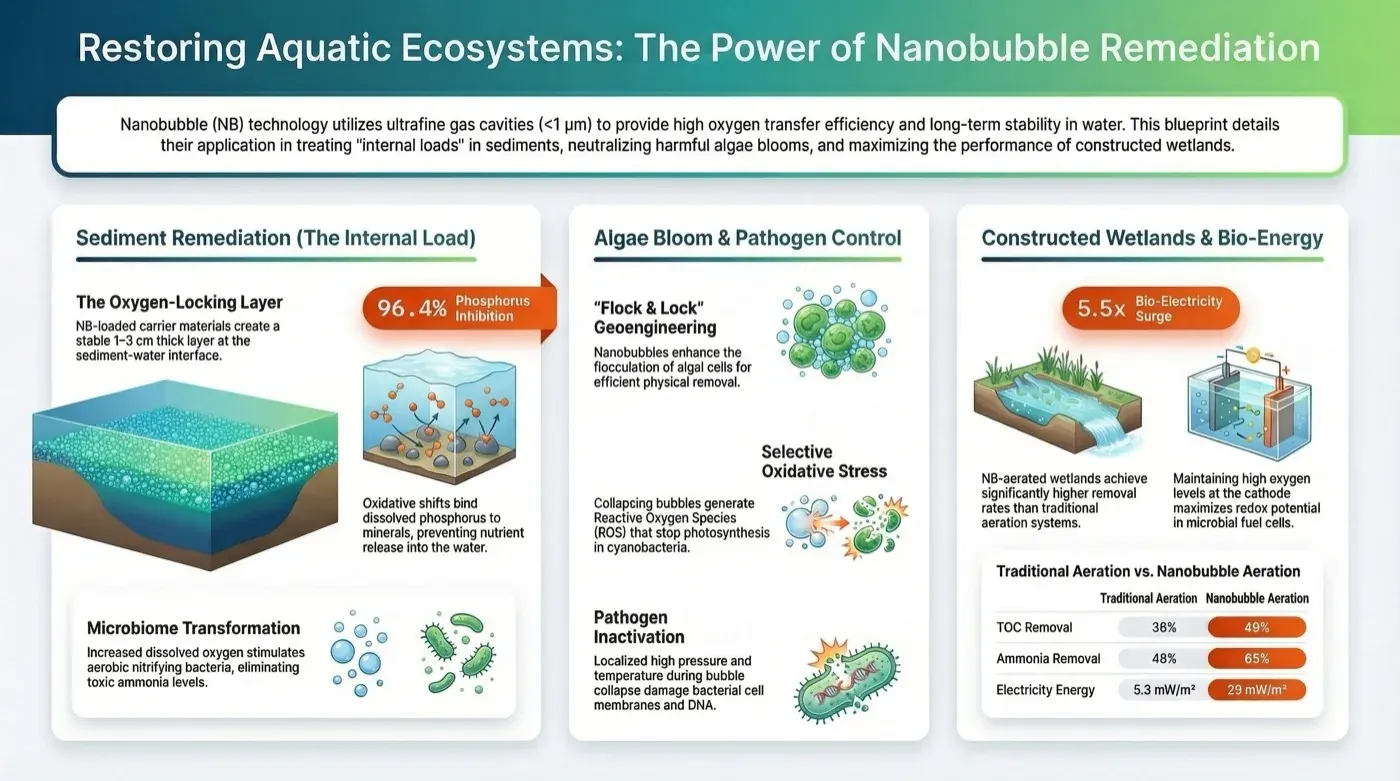
In the cited studies, carrier materials such as modified zeolites or local soils were loaded with ONBs and allowed to settle by gravity. They crossed the sediment–water interface (SWI) and delivered oxygen directly to anoxic zones. The result was an "oxygen-locking layer" about 1–3 cm thick that persisted for weeks to months and separated the anoxic deeper sediment from the water column Ali et al., 2023; Zhang et al., 2020.
Phosphorus, nitrogen and arsenic in sediment
Once the interface is oxidizing, sediment chemistry and its microbes change, and several pollutants moved into less mobile or less toxic forms in the studies.
- Phosphorus. ONB treatment shifted the oxidation-reduction potential () at the SWI from reducing to oxidizing. Soluble ferrous iron (Fe²⁺) was oxidized to ferric iron (Fe³⁺), which binds dissolved phosphorus into iron-phosphate precipitates, and the internal release of phosphorus from the sediment into the overlying water was inhibited Zhang et al., 2018; Zhang et al., 2020.
- Nitrogen. Restored aerobic conditions support ammonia-oxidizing bacteria (AOB), which convert ammonium (NH₄⁺) into nitrate (NO₃⁻) through nitrification. The source for this link is a study of nanobubble-aerated constructed wetlands, where high oxygen transfer supported this activity Lyu et al., 2023.
- Arsenic. In arsenic-contaminated sediments, interfacial ONBs stimulated microbial oxidizers that converted As(III) into the less toxic As(V) and into methylated species Tang et al., 2021.
The oxygenation of reduced substances in sediment, such as humic acids, was also reported to generate hydroxyl radicals (•OH), which contributed to the oxidative transformation of pollutants Tang et al., 2021; Ali et al., 2023. In each case the pollutant changed form; the arsenic stayed in the sediment as As(V) and methylated species.
Algal blooms
Research on bubbles and harmful algal blooms follows two routes: cutting the nutrient supply described above and acting on the algal cells directly, by flocculation or by oxidation. The oxidation studies cited here used ozone, not oxygen alone.
- Flocculation and separation. Combined with "Flock & Lock" geoengineering approaches that use modified soils, nanobubbles improved the flocculation of algal cells. Nanobubbles can attach to hydrophobic cell surfaces, aiding aggregation and then settling or separation, depending on the setup Ali et al., 2023. In a related study, ozonated microbubbles enhanced the removal of algae and algae-derived organic matter Wang et al., 2023.
- Oxidative stress. Collapsing bubbles generate reactive oxygen species (), such as hydroxyl radicals and superoxide anions. In the cited work, ROS caused oxidative stress in cyanobacteria such as Microcystis aeruginosa, damaging cell membranes and inhibiting photosynthesis. The study by Zhang et al., 2021 used ozone microbubbles, which its authors call "micro-bombs", to remove bloom-forming cyanobacteria and degrade the toxins known as microcystins in place.
Aquatic plants respond to nanobubble dose as well. In a macrophyte study, moderate nanobubble levels supported plant growth, while concentrations above 3.45 × 10⁷ particles/mL inhibited the growth of Iris pseudacorus Wang et al., 2020. Whether a dose exists that suppresses algae while sparing aquatic plants has not been shown.
Constructed wetlands and microbial fuel cells
Nanobubble aeration raised both treatment performance and electricity output in constructed wetlands (CWs) coupled with microbial fuel cells (CW-MFC), which address the low oxygen availability of conventional subsurface-flow wetlands Lyu et al., 2023.
- Pollutant removal. In trials treating livestock wastewater, nanobubble-aerated wetlands achieved significantly higher removal of total organic carbon (TOC) and ammonium nitrogen (NH₄⁺-N) than conventionally aerated ones. The authors attributed this to high oxygen supporting aerobic biofilm growth on the wetland substrate.
- Bioelectricity. In a CW-MFC, bacteria oxidize organic matter at the anode and pass electrons to the cathode, where oxygen is the electron acceptor. Nanobubble aeration kept dissolved oxygen () high at the cathode, widening the redox potential difference; power density was higher and operation more stable than with conventional aeration.
What this means in practice
The sediment findings apply to eutrophic lakes where anoxic sediment releases phosphorus and ammonium back into the water. The wetland findings apply to subsurface-flow constructed wetlands limited by oxygen. Because treatment adds material to a water body, check which approvals apply before any trial.
A site test compares treated and untreated areas, or treated areas against a pre-treatment baseline, over the weeks to months the oxygenated layer persisted in the studies. Measure DO and ORP profiles across the sediment–water interface, soluble phosphorus and ammonium in overlying water and pore water, iron species, and, for bloom questions, chlorophyll or cyanobacterial counts and microcystin levels. Report bubble dose as tracked particles per mL with gas-free water blanks, and watch aquatic plants, given the growth inhibition reported above 3.45 × 10⁷ particles/mL Wang et al., 2020. In wetlands, record effluent TOC and NH₄⁺-N, cathode DO and power density against a conventionally aerated cell.
Limits and open questions
- Study scale is not given for most results; one sediment study describes itself as preliminary, and effects beyond weeks to months are not reported.
- The phosphorus, nitrogen and arsenic findings are described as mechanisms and directions of change; the lesson gives no measured concentrations for whole lakes or rivers.
- The sediment studies concern lakes; results for rivers are not reported here. The nitrification link rests on a constructed-wetland study, not on lake-sediment measurements.
- The studies that oxidized algal cells used ozone microbubbles or ozonated microbubbles. No measured reduction in algal biomass is given here, and oxygen nanobubbles alone were not shown to reduce blooms.
- Arsenic was transformed, not removed: As(V) and methylated species remained in the sediment.
- The wetland results come from livestock wastewater, and "significantly higher" is reported here without the underlying values.
Questions
How do oxygen nanobubbles reach lake sediment?
In the cited studies they were loaded onto carrier materials, such as modified zeolites or local soils, that settled by gravity through the sediment–water interface. The carriers delivered oxygen to anoxic zones and formed an oxygenated layer about 1–3 cm thick that persisted for weeks to months Zhang et al., 2020.
Can nanobubbles control harmful algal blooms?
The evidence is indirect. Oxygenated sediment held back phosphorus release, which feeds blooms, and bubbles improved algal flocculation. The studies that oxidized algal cells used ozone microbubbles, which removed bloom-forming cyanobacteria and degraded microcystins Zhang et al., 2021. Measured reductions in algal biomass are not reported here.
What did nanobubble aeration change in constructed wetlands?
In wetlands treating livestock wastewater, nanobubble aeration gave significantly higher removal of total organic carbon and ammonium nitrogen than conventional aeration. In wetlands coupled with microbial fuel cells, it kept dissolved oxygen high at the cathode and produced more electricity, more stably Lyu et al., 2023.
References
- Zhang, H., Chen, J., Han, M., et al. (2020). Anoxia remediation and internal loading modulation in eutrophic lakes using geoengineering method based on oxygen nanobubbles. Science of The Total Environment, 714, 136766. https://doi.org/10.1016/j.scitotenv.2020.136766 ↩
- Ali, J., Yang, Y., Pan, G. (2023). Oxygen micro-nanobubbles for mitigating eutrophication induced sediment pollution in freshwater bodies. Journal of Environmental Management, 331, 117281. https://doi.org/10.1016/j.jenvman.2023.117281 ↩
- Zhang, H., Lyu, T., Bi, L., et al. (2018). Combating hypoxia/anoxia at sediment-water interfaces: A preliminary study of oxygen nanobubble modified clay materials. Science of The Total Environment, 637-638, 550-560. https://doi.org/10.1016/j.scitotenv.2018.04.284 ↩
- Tang, Y., Zhang, M., Zhang, J., et al. (2021). Reducing arsenic toxicity using the interfacial oxygen nanobubble technology for sediment remediation. Water Research, 205, 117657. https://doi.org/10.1016/j.watres.2021.117657 ↩
- Wang, S., Liu, Y., Lyu, T., et al. (2020). Aquatic Macrophytes in Morphological and Physiological Responses to the Nanobubble Technology Application for Water Restoration. ACS ES&T Water, 1, 376-387. https://doi.org/10.1021/acsestwater.0c00145 ↩
- Lyu, T., Wu, Y., Zhang, Y., et al. (2023). Nanobubble aeration enhanced wastewater treatment and bioenergy generation in constructed wetlands coupled with microbial fuel cells. Science of The Total Environment, 895, 165131. https://doi.org/10.1016/j.scitotenv.2023.165131 ↩
- Wang, Y., Xue, J., Sun, W., et al. (2023). Efficiency and mechanism of ozonated microbubbles for enhancing the removal of algae and algae-derived organic matter. Chemosphere, 312, 137220. https://doi.org/10.1016/j.chemosphere.2022.137220 ↩
- Zhang, M., Wang, Y., Wu, X., et al. (2021). Potential of ozone micro-bombs in simultaneously fast removing bloom-forming cyanobacteria and in situ degrading microcystins. Chemical Engineering Journal, 407, 127186. https://doi.org/10.1016/j.cej.2020.127186 ↩