How the gas changes the application
Why does the choice of gas (air, oxygen, ozone or CO₂) change what nanobubbles do?
On this page
The gas sets the chemistry
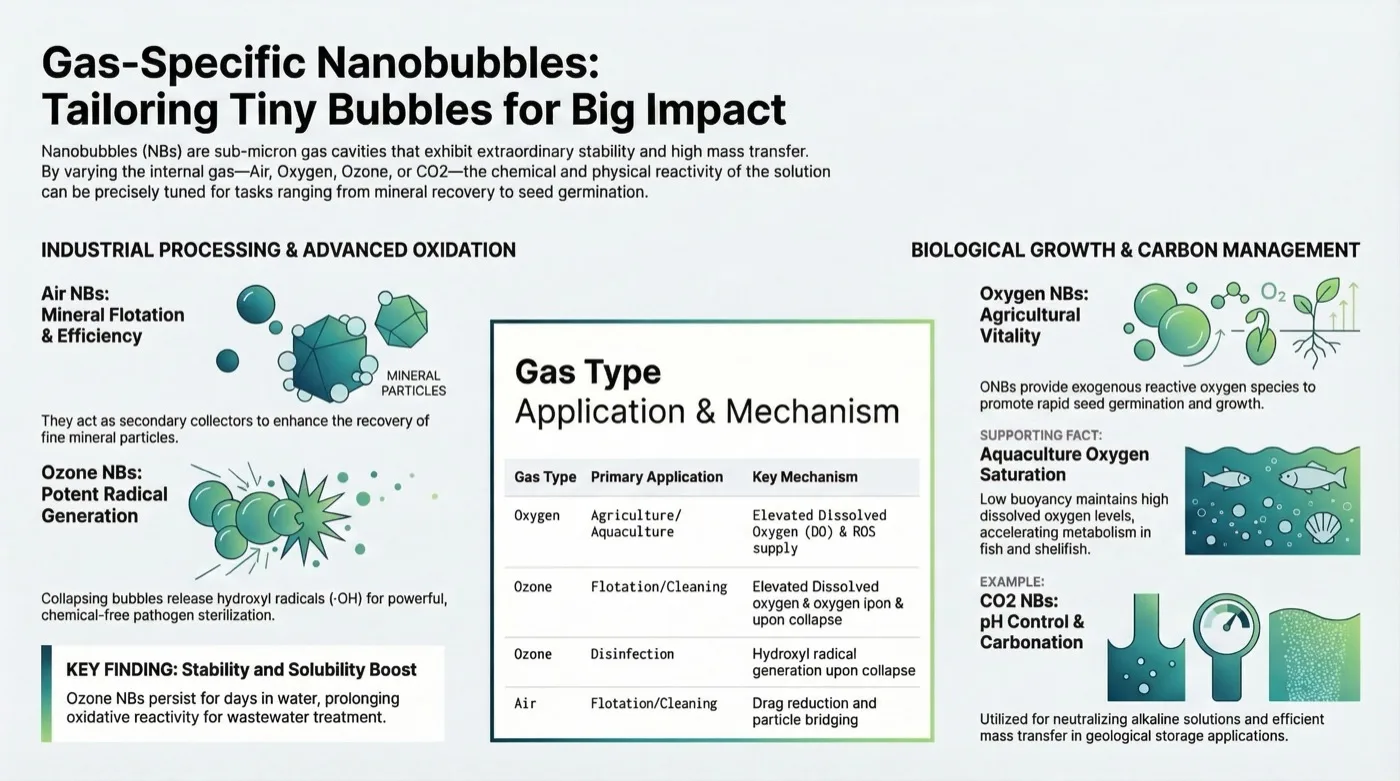
A nanobubble's size and persistence come from physics, but what it does in an application depends on the gas it carries. Air and oxygen deliver oxygen; oxygen nanobubbles also supply reactive oxygen species; ozone adds strong oxidation through hydroxyl radicals; and carbon dioxide acidifies water. The gas also changes the bubble itself: surface charge differed between air, oxygen and nitrogen nanobubbles Ahmed et al., 2018.
| Gas | What it brings | Applications studied |
|---|---|---|
| Air | Physical effects: bridging, aeration, drag reduction | Mineral flotation, aeration, surface cleaning |
| Oxygen | Oxygen supply and exogenous ROS | Seed germination, plant growth, aquaculture |
| Ozone | Hydroxyl radicals and prolonged oxidation | Organic pollutants in wastewater and groundwater |
| Carbon dioxide | Acidity and gas transfer | pH control, food processing, CO₂ storage research |
Each row is discussed, with its sources, below. The Gas Library has a profile for each gas: oxygen, ozone, air and carbon dioxide.
Air nanobubbles
Air nanobubbles have been studied mainly for their physical effects. In mineral processing, including coal, phosphate and quartz, they improved the recovery of fine particles. They act as a secondary collector, bridging particles to larger bubbles and increasing the contact angle, and so the hydrophobicity, of mineral surfaces Tao, 2022; Azevedo et al., 2019.
Air nanobubbles are also used for general water aeration. Reviews report that they reduced fluid friction (drag) in pipes and have been applied to surface cleaning Agarwal et al., 2011; Nirmalkar et al., 2018.
Oxygen nanobubbles
(ONBs) have been studied for their effects on plants and aquatic animals. In agriculture, ONBs promoted the germination of seeds, including barley and vegetables, and plant growth. The proposed mechanism combines a supply of exogenous (ROS) with greater oxygen availability for root respiration Liu et al., 2015; Liu et al., 2016; Ahmed et al., 2018.
In aquaculture, ONBs maintained high (DO) levels for extended periods, which the sources attribute to their low buoyancy and high mass transfer efficiency. Researchers reported improved survival rates and faster metabolism in fish and shellfish Ebina et al., 2013; Agarwal et al., 2011.
Ozone nanobubbles
Ozone nanobubbles bring oxidation. They have been studied for decomposing organic pollutants in wastewater, and when they collapse they generate hydroxyl radicals (·OH), the reactive species behind (AOPs) Sakr et al., 2022; Agarwal et al., 2011. Measured results for oxidation are covered in Advanced oxidation.
Their small size also changes how long ozone stays active. Compared with macrobubbles, ozone micro-nano-bubbles have a much higher internal pressure and surface area, which raises solubility. In studies of organics-contaminated wastewater and groundwater remediation, they persisted for days rather than minutes, prolonging the oxidative reactivity of ozone in the water Xia and Hu, 2018; Hu and Xia, 2018.
Carbon dioxide nanobubbles
Carbon dioxide nanobubbles are used for their acidity and their gas transfer. They have been applied to pH control, neutralizing alkaline solutions, and have shown potential for promoting plant growth and in food processing Ahmed et al., 2018; Phan et al., 2021.
They are also being investigated for mineral carbonation and geological CO₂ storage, because of their high mass transfer efficiency into liquids. That work is summarized in a review, and this lesson reports no field-scale result Li et al., 2023.
What this means in practice
In practice, the gas should follow the result a site needs, and each gas points to a different measurement. For air and oxygen, log dissolved oxygen in mg/L against an untreated or conventionally aerated control. For seeds and crops, keep germination and yield records against an untreated block. For ozone, measure the target compound and oxidation-reduction potential () against an untreated control. For carbon dioxide, log pH. For flotation, compare fine-particle recovery with the existing baseline.
Oxygen delivery is not a sanitation step. Where water hygiene matters, the existing hygiene program continues alongside any oxygen treatment.
Because studies used specific gases, generators and waters, a site test should run long enough to see the variable it cares about change, with a control running in parallel.
Limits and open questions
Most of the application evidence here comes from review articles, and the lesson reports no effect sizes: no recovery percentages, germination rates, growth figures or pollutant reductions.
Effects may depend on dose. One of the germination studies reports both positive and negative effects of nanobubble ROS on vegetable seed germination, so more is not necessarily better, and the lesson gives no doses.
The ozone persistence of days was reported for micro-nano-bubbles in specific wastewater and groundwater studies; it may not transfer to other waters. The aquaculture findings are given without species, doses or durations, and the CO₂ storage work comes from a review of research, not from a field practice reported here.
Questions
Which gas should be used in nanobubbles?
It depends on the result needed. In the cited research, air nanobubbles were used for flotation and aeration, oxygen nanobubbles for germination, plant growth and aquaculture, ozone nanobubbles for oxidizing organic pollutants, and carbon dioxide nanobubbles for pH control. Each choice should be tested at the site against a control.
Do ozone nanobubbles last longer than ordinary ozone bubbles?
In studies of wastewater and groundwater treatment, ozone micro-nano-bubbles persisted for days rather than minutes, which prolonged ozone's oxidative reactivity in the water. The sources attribute this to higher internal pressure and surface area than macrobubbles. The finding comes from specific waters and may not transfer to others.
Why do oxygen nanobubbles affect seed germination?
Researchers attribute the effect to two things: a supply of reactive oxygen species from the nanobubbles, and more oxygen available for respiration. Studies reported that germination and plant growth were promoted, but one also reported negative effects of the same reactive species, so dose may matter.
References
- Tao, D. (2022). Recent advances in fundamentals and applications of nanobubble enhanced froth flotation: A review. Minerals Engineering, 183, 107554. https://doi.org/10.1016/j.mineng.2022.107554 ↩
- Azevedo, A., Oliveira, H., Rubio, J. (2019). Bulk nanobubbles in the mineral and environmental areas: Updating research and applications. Advances in Colloid and Interface Science, 271, 101992. https://doi.org/10.1016/j.cis.2019.101992 ↩
- Liu, S., Oshita, S., Kawabata, S., et al. (2016). Identification of ROS Produced by Nanobubbles and Their Positive and Negative Effects on Vegetable Seed Germination. Langmuir, 32, 11295-11302. https://doi.org/10.1021/acs.langmuir.6b01621 ↩
- Ahmed, A. K. A., Shi, X., Hua, L., et al. (2018). Influences of Air, Oxygen, Nitrogen, and Carbon Dioxide Nanobubbles on Seed Germination and Plant Growth. Journal of Agricultural and Food Chemistry, 66, 5117-5124. https://doi.org/10.1021/acs.jafc.8b00333 ↩
- Sakr, M., Mohamed, M. M., Maraqa, M. A., et al. (2022). A critical review of the recent developments in micro–nano bubbles applications for domestic and industrial wastewater treatment. Alexandria Engineering Journal, 61, 6591-6612. https://doi.org/10.1016/j.aej.2021.11.041 ↩
- Agarwal, A., Ng, W. J., Liu, Y. (2011). Principle and applications of microbubble and nanobubble technology for water treatment. Chemosphere, 84, 1175-1180. https://doi.org/10.1016/j.chemosphere.2011.05.054 ↩
- Xia, Z., Hu, L. (2018). Treatment of Organics Contaminated Wastewater by Ozone Micro-Nano-Bubbles. Water, 11, 55. https://doi.org/10.3390/w11010055 ↩
- Hu, L., Xia, Z. (2018). Application of ozone micro-nano-bubbles to groundwater remediation. Journal of Hazardous Materials, 342, 446-453. https://doi.org/10.1016/j.jhazmat.2017.08.030 ↩
- Phan, K. K. T., Truong, T., Wang, Y., et al. (2020). Formation and Stability of Carbon Dioxide Nanobubbles for Potential Applications in Food Processing. Food Engineering Reviews, 13, 3-14. https://doi.org/10.1007/s12393-020-09233-0 ↩
- Li, X., Peng, B., Liu, Q., et al. (2023). Micro and nanobubbles technologies as a new horizon for CO2-EOR and CO2 geological storage techniques: A review. Fuel, 341, 127661. https://doi.org/10.1016/j.fuel.2023.127661 ↩
- Khaled Abdella Ahmed, A., Sun, C., Hua, L., et al. (2018). Colloidal Properties of Air, Oxygen, and Nitrogen Nanobubbles in Water: Effects of Ionic Strength, Natural Organic Matters, and Surfactants. Environmental Engineering Science, 35, 720-727. https://doi.org/10.1089/ees.2017.0377 ↩
- Nirmalkar, N., Pacek, A. W., Barigou, M. (2018). On the Existence and Stability of Bulk Nanobubbles. Langmuir, 34, 10964-10973. https://doi.org/10.1021/acs.langmuir.8b01163 ↩
- Liu, S., Oshita, S., Makino, Y., et al. (2015). Oxidative Capacity of Nanobubbles and Its Effect on Seed Germination. ACS Sustainable Chemistry & Engineering, 4, 1347-1353. https://doi.org/10.1021/acssuschemeng.5b01368 ↩
- Ebina, K., Shi, K., Hirao, M., et al. (2013). Oxygen and Air Nanobubble Water Solution Promote the Growth of Plants, Fishes, and Mice. PLoS ONE, 8, e65339. https://doi.org/10.1371/journal.pone.0065339 ↩