Nanobubble-enhanced flotation
Why do nanobubbles help recover fine and ultrafine mineral particles in flotation?
On this page
Why fine particles are hard to float
Fine particles are lost in flotation because they rarely meet a bubble and, when they do, they detach easily. Recovery of particles smaller than about 20 µm in conventional flotation is limited by low collision probability and high detachment rates.
act on this problem as a "secondary collector": they coat the particle with gas before a flotation bubble arrives, so the particle behaves as if it were more hydrophobic. The mechanisms below explain how that coating forms and why it helps.
How nanobubbles help particles attach
Nanobubbles form preferentially on hydrophobic mineral surfaces and then serve as footholds for larger bubbles.
- Selective nucleation. Nanobubbles generated by hydrodynamic cavitation () nucleated preferentially on hydrophobic mineral surfaces. This happens because the work of adhesion between a solid and water is lower than the work of cohesion of water, particularly on hydrophobic surfaces Nazari et al., 2022.
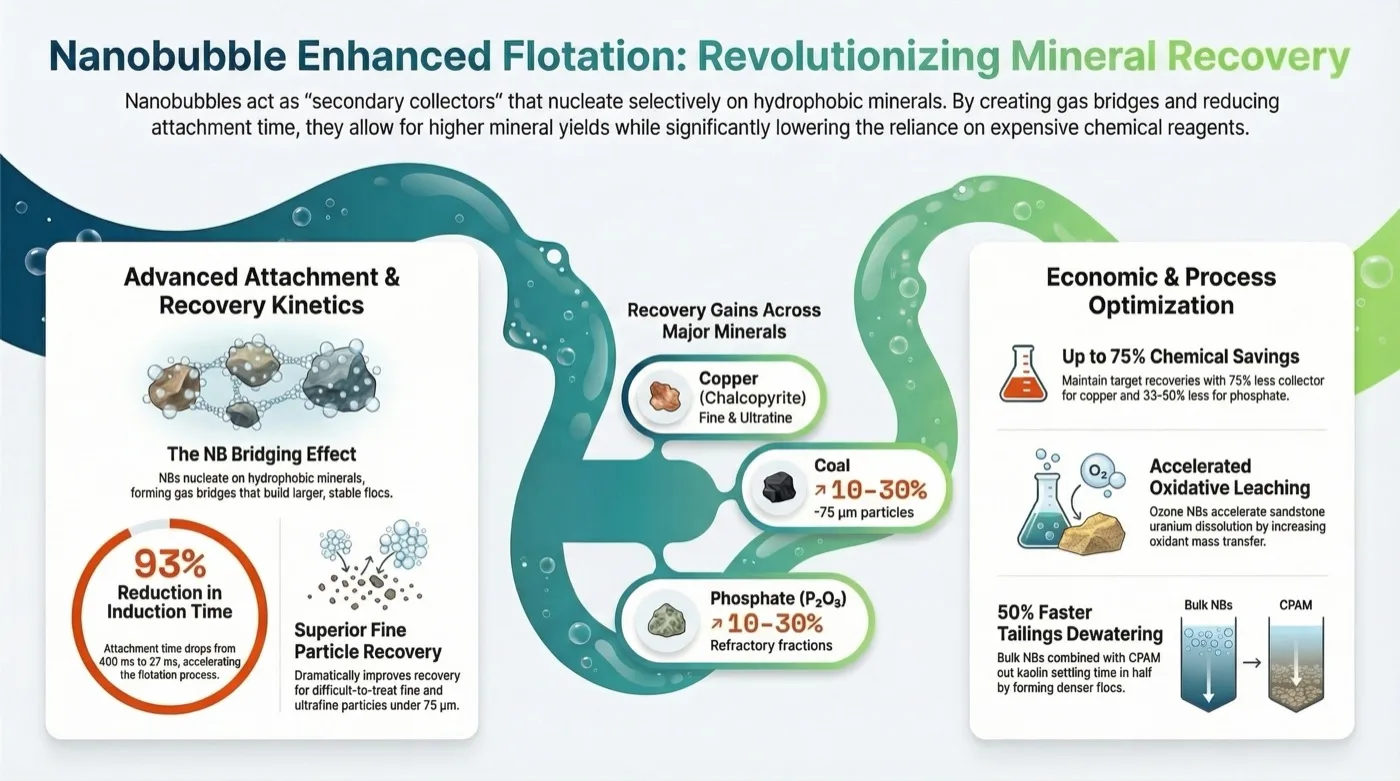
- Bridging and seeding. Once attached, nanobubbles increase the apparent hydrophobicity of the particle. They act as gas (capillary) bridges between fine particles, building larger agglomerates that float more easily, and they serve as seeds for the attachment of conventional flotation bubbles. Attachment of a nanobubble-coated particle to a large bubble is thermodynamically more favorable than attachment of a bare particle Rosa & Rubio, 2018; Azevedo et al., 2019.
Induction time is the contact time a bubble needs to thin and rupture the water film and adhere to a particle. When a large bubble approaches a surface "frosted" with nanobubbles, the film ruptures faster because the bubble merges with gas already on the surface rather than meeting a bare solid–liquid interface. In lignite flotation studies, interfacial nanobubbles reduced the induction time from 400 ms to 27 ms and the attachment time from 208 ms to 128 ms, raising the flotation rate Tao, 2022.
Recovery results by mineral
Recovery gains were reported for copper, coal and phosphate, but they depended on ore type, and one clay-rich ore did worse.
Copper and molybdenum
- Chalcopyrite. In laboratory-scale tests, flotation recovery of fine (14–38 µm) and ultrafine (5–14 µm) chalcopyrite rose by about 16–21% with nanobubbles compared with conventional flotation Azevedo et al., 2019.
- Chilean porphyry ores. On copper sulfide ores, nanobubbles raised copper recovery by up to 7.5% and molybdenum recovery by 20% in a low-clay ore (M1). In a high-clay ore (M2), recovery fell by about 5%, because nanobubbles intensified non-selective slime coatings Ramírez-Madrid et al., 2025.
- Molybdenite separation. Preconditioning with ozone nanobubbles was studied as a way to separate molybdenite from chalcopyrite by selective flotation Li et al., 2025.
Coal
- Recovery. In column flotation of fine coal, nanobubbles increased combustible recovery by 10–30%, and by up to 50% in some fine fractions, compared with conventional flotation. They recovered particles finer than 75 µm that are usually lost Peng & Yu, 2015; Tao, 2022.
- Selectivity. Recovery rose while grade was maintained or improved: from a feed with 29.6% ash, combustible recovery reached 85–90% at a clean-coal ash content of 10–11% Peng & Yu, 2015.
Phosphate
- Coarse particles. In flotation of coarse phosphate (−1.18 + 0.425 mm), nanobubbles raised P₂O₅ recovery by 10–30% at a given acid-insoluble rejection. Coarse phosphate is often lost in conventional circuits because it detaches easily from bubbles Fan et al., 2010.
- Tailings reprocessing. On apatite tailings, nanobubbles used with a frother improved mass recovery compared with conventional bubbles, suggesting a possible route to reprocess tailings without regrinding Chipakwe et al., 2021.
Collector and frother doses
Nanobubbles lowered the reagent doses needed for a given recovery in several studies; the collectors and frothers were still used.
- Collector. In chalcopyrite flotation, nanobubbles reduced collector consumption by up to 75% Azevedo et al., 2019. In phosphate flotation, collector dosage fell by one-third to one-half, for example from 0.7 kg/t to 0.4 kg/t, for similar recovery targets Fan et al., 2010.
- Collector and frother together. In fine-particle flotation, nanobubbles combined with 50% less collector and 60% less frother still achieved recoveries above 75%. The authors attributed this to a longer three-phase contact line and stronger capillary attraction Dutta et al., 2025.
The mechanism is the secondary-collector effect described above. By raising the contact angle of the mineral surface, nanobubbles take on part of the work that chemical collectors do to make the surface hydrophobic.
What this means in practice
The findings apply to circuits that lose fine particles (below about 20 µm, or below 75 µm for coal) or coarse particles that detach, such as coarse phosphate. Ore mineralogy decides the outcome: the same nanobubble treatment helped a low-clay copper ore and hurt a high-clay one, so each ore type needs its own test.
A bench test floats the same ore with and without nanobubbles at the current reagent dose, then lowers collector and frother step by step. Record recovery and grade by size fraction, reagent doses in kg/t, clay or slime content of the feed, and flotation rate. Characterize the nanobubbles with a gas-free water blank, so that fine particles in the process water are not counted as bubbles.
Limits and open questions
- Most results come from laboratory cells and columns or from review articles (Azevedo et al., 2019; Nazari et al., 2022; Tao, 2022); plant-scale results are not reported here.
- The effect depended on the ore: recovery fell by about 5% in a high-clay copper ore.
- Several gains are given as percentages without saying whether they are percentage points or relative changes.
- Reagent savings were measured at similar recovery targets; grade at the reduced dose is not reported for every study.
- The gas used is not stated for most results. The ozone nanobubbles in the molybdenite study changed surface chemistry by oxidation, a different mechanism from the gas bridging described above.
Questions
Why do fine particles float poorly?
Particles smaller than about 20 µm rarely collide with flotation bubbles and detach easily when they do. Nanobubbles nucleate on hydrophobic particle surfaces and act as a secondary collector, so larger bubbles attach faster: in lignite flotation, induction time fell from 400 ms to 27 ms Tao, 2022.
Do nanobubbles reduce reagent use in flotation?
In several studies they lowered the doses needed. Collector consumption in chalcopyrite flotation fell by up to 75% Azevedo et al., 2019, and phosphate collector dosage fell from 0.7 to 0.4 kg/t for similar recovery Fan et al., 2010. The reagents were reduced, not removed.
Do nanobubbles improve recovery on every ore?
No. On Chilean porphyry ores, nanobubbles raised copper recovery by up to 7.5% in a low-clay ore but lowered recovery by about 5% in a high-clay ore, where they intensified non-selective slime coatings Ramírez-Madrid et al., 2025. Each ore type needs its own test.
References
- Tao, D. (2022). Recent advances in fundamentals and applications of nanobubble enhanced froth flotation: A review. Minerals Engineering, 183, 107554. https://doi.org/10.1016/j.mineng.2022.107554 ↩
- Azevedo, A., Oliveira, H., Rubio, J. (2019). Bulk nanobubbles in the mineral and environmental areas: Updating research and applications. Advances in Colloid and Interface Science, 271, 101992. https://doi.org/10.1016/j.cis.2019.101992 ↩
- Ramírez-Madrid, A., Araya, N., Gutierrez, L., et al. (2025). Application of Nanobubbles in the Flotation of Sulfide Minerals from Chilean Copper Porphyry Deposits. Minerals, 15, 1124. https://doi.org/10.3390/min15111124 ↩
- FAN, M., TAO, D., HONAKER, R., et al. (2010). Nanobubble generation and its applications in froth flotation (part III): specially designed laboratory scale column flotation of phosphate. Mining Science and Technology (China), 20, 317-338. https://doi.org/10.1016/S1674-5264(09)60205-2 ↩
- Dutta, N., Sharma, H., Yadav, G., et al. (2025). Understanding the role of nanobubbles on reducing collector and frother dosages in fine particle flotation. Separation and Purification Technology, 378, 134519. https://doi.org/10.1016/j.seppur.2025.134519 ↩
- Nazari, S., Hassanzadeh, A., He, Y., et al. (2022). Recent Developments in Generation, Detection and Application of Nanobubbles in Flotation. Minerals, 12, 462. https://doi.org/10.3390/min12040462 ↩
- Rosa, A., Rubio, J. (2018). On the role of nanobubbles in particle–bubble adhesion for the flotation of quartz and apatitic minerals. Minerals Engineering, 127, 178-184. https://doi.org/10.1016/j.mineng.2018.08.020 ↩
- Li, Y., Zhang, M., Fan, R. (2025). Selective flotation separation of molybdenite from chalcopyrite by ozone nanobubbles preconditioning. Separation and Purification Technology, 359, 130507. https://doi.org/10.1016/j.seppur.2024.130507 ↩
- Peng, F. F., Yu, X. (2015). Pico–nano bubble column flotation using static mixer-venturi tube for Pittsburgh No. 8 coal seam. International Journal of Mining Science and Technology, 25, 347-354. https://doi.org/10.1016/j.ijmst.2015.03.004 ↩
- Chipakwe, V., Jolsterå, R., Chelgani, S. C. (2021). Nanobubble-Assisted Flotation of Apatite Tailings: Insights on Beneficiation Options. ACS Omega, 6, 13888-13894. https://doi.org/10.1021/acsomega.1c01551 ↩