Disease control and biosecurity
What did published studies measure when ozone and oxygen nanobubbles were tested against aquaculture bacteria and biofilm, and on fish immune markers?
On this page
Measured reductions in aquaculture bacteria
Ozone nanobubbles produced large, fast reductions in culturable bacteria in laboratory and pond-water tests. Oxygen nanobubbles, where they were compared, produced much smaller ones. The studies below report counts before and after treatment; they measured bacteria in water, not disease outcomes on farms.
Vibrio parahaemolyticus
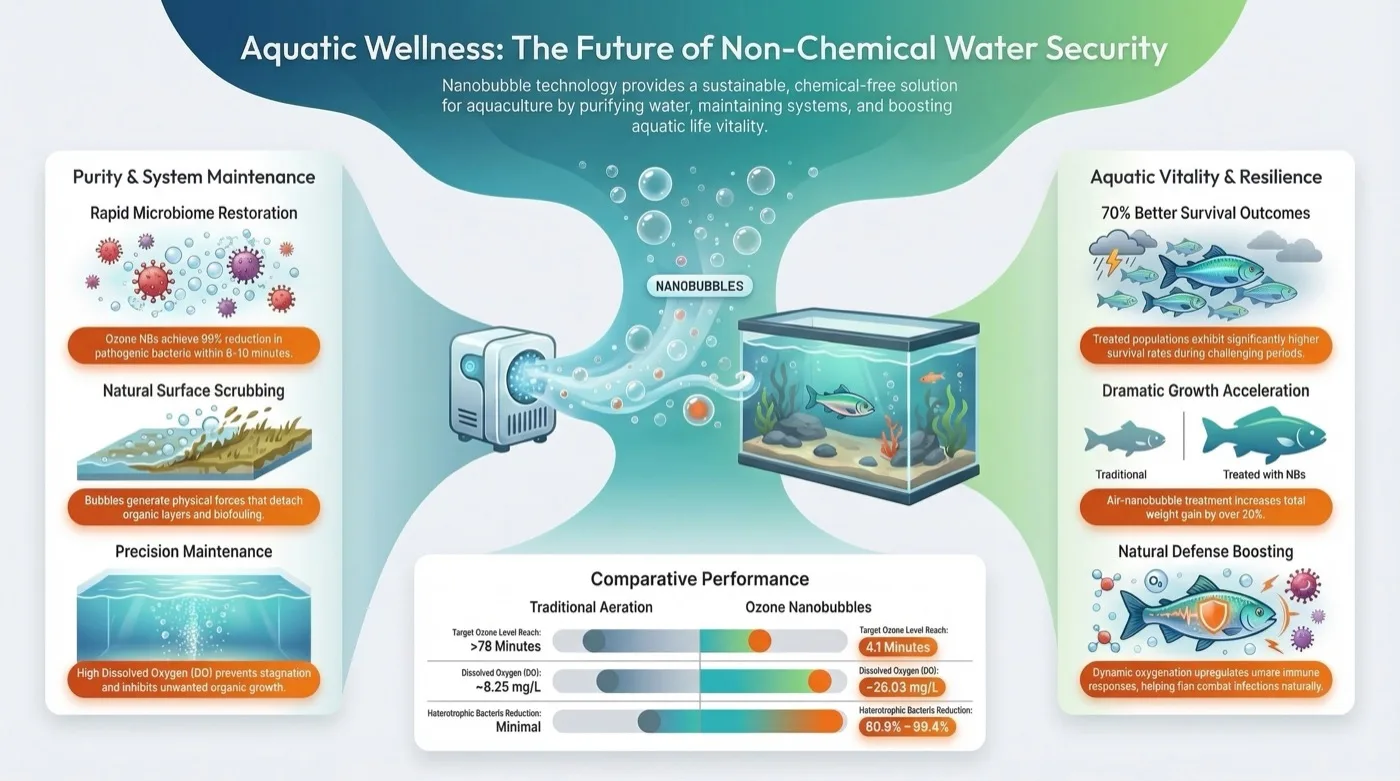
Certain V. parahaemolyticus strains cause early mortality syndrome, also called acute hepatopancreatic necrosis disease (EMS/AHPND), in shrimp. In laboratory tests, ozone nanobubble treatment reduced V. parahaemolyticus from 10⁶ CFU/mL to undetectable levels within 6 minutes. Oxygen nanobubbles, tested alongside, reduced it by 31% over one week Nghia et al., 2022.
A second study with an EMS/AHPND strain found that ozone nanobubbles reduced culturable V. parahaemolyticus in seawater by more than 99.99% within 1 minute of exposure. Researchers reported that the treatment delayed mortality in infected shrimp Imaizumi et al., 2018.
Streptococcus and Aeromonas in fresh water
In fresh water, a 10-minute exposure to ozone nanobubbles reduced Streptococcus agalactiae by 96.11% and Aeromonas veronii by 97.92%. Organic matter, as found in culture water, lowered the effect about 1.6-fold. Repeated ozone nanobubble treatments kept bacterial numbers down, and the authors reported the treatment as safe for Nile tilapia under the trial conditions Jhunkeaw et al., 2021.
Total bacteria in pond water
Ozone nanobubbles at 0.15 mg/L reduced total heterotrophic bacteria in pond water by 90.9% to 99.4% Huang et al., 2023. A reduction of that size can reset the microbial community. Whether that creates a useful window to reintroduce beneficial microbes (probiotics) before other species re-establish is an open question the cited work does not test.
How the reductions are explained
The explanation offered is oxidative, with a possible physical component. It is a proposed mechanism, drawn partly from a review of industrial wastewater treatment.
Ozone nanobubbles are associated with reactive oxygen species (), in particular hydroxyl radicals (•OH). These radicals have a high redox potential (2.80 V) and react non-selectively: they oxidize polyunsaturated fatty acids in bacterial membranes (lipid peroxidation) and damage DNA, and cell contents leak out Mukherjee et al., 2023; Huang et al., 2023.
A physical contribution has also been proposed: shock waves from collapsing bubbles may rupture cell membranes. The clearest evidence for combined effects involved another energy source. In laboratory tests with Aeromonas hydrophila and V. parahaemolyticus, oxygen nanobubbles combined with ultrasonication gave more than a 6 log CFU/mL reduction Rafeeq et al., 2020.
Biofilm on surfaces and pipes
Biofilms on tank walls and pipes can harbor pathogens, and nanobubbles have been studied as a way to loosen them. The evidence comes from food-contact surfaces, water lines and filters rather than aquaculture tanks.
Biofilms are held together by extracellular polymeric substances (EPS). Nanobubbles, and ozone nanobubbles in particular, are thought to penetrate this matrix and generate hydroxyl radicals that break down its proteins and polysaccharides, so the biofilm loses structure and detaches Shiroodi et al., 2021. In laboratory tests, nanobubbles alone or combined with neutral electrolyzed water reduced E. coli O157:H7, V. parahaemolyticus and Listeria innocua biofilms on plastic and stainless steel Shiroodi et al., 2021.
Physical forces play a part as well. Nanobubbles lowered the contact angle of water on surfaces (greater wettability), and their movement and collapse create local shear forces that can scour biofilm layers Shiroodi et al., 2021. A study of a biological aerated filter examined how shear stress from nanobubble aeration shapes biofilm structure and the microbial community Xiao et al., 2021.
Nanobubbles also mitigated biofouling in agricultural water distribution systems. The explanation offered is that higher dissolved oxygen () and ROS make stagnant zones less favorable for anaerobic biofilms Xiao et al., 2020.
Fish immune and stress markers
Researchers also measured how fish responded to ozone nanobubble exposure. These are gene-expression, enzyme and challenge results in single species, reported here as research findings.
In Nile tilapia, researchers reported that ozone nanobubble exposure raised expression of the cytokine genes TNF-α (tumor necrosis factor alpha), IL-1β and IL-2β in the gills, head kidney and spleen within 15 minutes. This pattern was read as a sign that ozone nanobubbles act as a mild stressor that primes the innate immune response. Tilapia pre-treated with ozone nanobubbles and then challenged with S. agalactiae showed a relative percent survival (RPS) of 60–70% compared with untreated controls Linh et al., 2021.
In jade perch, superoxide dismutase (SOD) activity rose one day after ozone nanobubble treatment, to 8.0 units against 4.5 in controls, and returned to baseline within 48 hours Huang et al., 2023.
A different gas gave a related result in a laboratory model. Researchers reported that hydrogen nanobubble water reduced ROS accumulation, lowered inflammatory markers and improved survival in zebrafish infected with a virus Li et al., 2022.
What this means in practice
These findings describe what researchers measured with ozone, oxygen and hydrogen nanobubbles under test conditions. They are not a description of what any installation does, and oxygenation does not replace sanitation or a biosecurity plan. Two conditions matter most: the gas (ozone and oxygen gave very different results) and the water (organic matter lowered the ozone effect about 1.6-fold).
A site assessing ozone nanobubbles would work with an aquatic animal health professional, follow the rules that apply to ozone use, and measure rather than assume:
- Oxidant exposure: dissolved ozone residual and oxidation-reduction potential () during and after each treatment.
- Bacteria: counts in CFU/mL of the target organisms before and after treatment, against an untreated control unit.
- Water quality: organic load, since it changed the result in the freshwater study.
- Animals: behavior, feeding and survival in treated and control units, observed through and after treatment.
- Surfaces: biofilm on removable pipe or tank coupons, checked on a schedule.
Limits and open questions
- Most results are laboratory or small-volume tests with exposure times of minutes; this lesson reports no disease outcomes measured across a commercial production cycle.
- Organic matter lowered the ozone effect about 1.6-fold, so clean-water results may overstate what happens in culture water.
- The more-than-6-log reduction involved ultrasonication as well as nanobubbles, and one biofilm study also combined nanobubbles with neutral electrolyzed water.
- Biofilm evidence comes from plastic and stainless steel surfaces, a biological aerated filter and agricultural water lines, not aquaculture tanks.
- The oxidative mechanism is partly drawn from a review of industrial wastewater treatment, not from aquaculture measurements.
- Immune and enzyme findings come from single species (Nile tilapia, jade perch) and a zebrafish laboratory model; they do not show protection for other species or farm stocks.
Questions
Do oxygen nanobubbles reduce Vibrio as ozone nanobubbles did?
Not in the study that compared them. Ozone nanobubbles reduced Vibrio parahaemolyticus from 10⁶ CFU/mL to undetectable levels within 6 minutes, while oxygen nanobubbles reduced it by 31% over one week. Oxygenation does not replace sanitation or a biosecurity plan.
How did fish respond to ozone nanobubble treatment?
Researchers reported that Nile tilapia tolerated repeated ozone nanobubble treatments in fresh water, and that superoxide dismutase activity in jade perch rose for a day before returning to baseline within 48 hours. These are specific species, doses and exposure times, so they do not settle safety at other conditions.
Does water quality change the result?
Yes. In the freshwater study, organic matter lowered the ozone nanobubble effect on Streptococcus and Aeromonas about 1.6-fold, and repeated treatments were used to keep bacterial numbers down. Laboratory results in clean water may therefore overstate the reduction in culture water carrying feed and waste.
References
- Nghia, N. H., Nguyen, N. T., Binh, P. T., et al. (2022). Effect of nanobubbles (oxygen, ozone) on the Pacific white shrimp (Penaeus vannamei), Vibrio parahaemolyticus and water quality under lab conditions. Fisheries and Aquatic Sciences, 25, 429-440. https://doi.org/10.47853/FAS.2022.e39 ↩
- Jhunkeaw, C., Khongcharoen, N., Rungrueng, N., et al. (2021). Ozone nanobubble treatment in freshwater effectively reduced pathogenic fish bacteria and is safe for Nile tilapia (Oreochromis niloticus). Aquaculture, 534, 736286. https://doi.org/10.1016/j.aquaculture.2020.736286 ↩
- Huang, Q., Ng, P. H., Marques, A. R. P., et al. (2023). Effect of ozone nanobubbles on the microbial ecology of pond water and safety for jade perch (Scortum barcoo). Aquaculture, 576, 739866. https://doi.org/10.1016/j.aquaculture.2023.739866 ↩
- Linh, N. V., Dien, L. T., Panphut, W., et al. (2021). Ozone nanobubble modulates the innate defense system of Nile tilapia (Oreochromis niloticus) against Streptococcus agalactiae. Fish & Shellfish Immunology, 112, 64-73. https://doi.org/10.1016/j.fsi.2021.02.015 ↩
- Imaizumi, K., Tinwongger, S., Kondo, H., et al. (2018). Disinfection of an EMS/AHPND strain of Vibrio parahaemolyticus using ozone nanobubbles. Journal of Fish Diseases, 41, 725-727. https://doi.org/10.1111/jfd.12783 ↩
- Mukherjee, J., Lodh, B. K., Sharma, R., et al. (2023). Advanced oxidation process for the treatment of industrial wastewater: A review on strategies, mechanisms, bottlenecks and prospects. Chemosphere, 345, 140473. https://doi.org/10.1016/j.chemosphere.2023.140473 ↩
- Rafeeq, S., Shiroodi, S., Schwarz, M. H., et al. (2020). Inactivation of Aeromonas hydrophila and Vibrio parahaemolyticus by Curcumin-Mediated Photosensitization and Nanobubble-Ultrasonication Approaches. Foods, 9, 1306. https://doi.org/10.3390/foods9091306 ↩
- Shiroodi, S., Schwarz, M. H., Nitin, N., et al. (2021). Efficacy of Nanobubbles Alone or in Combination with Neutral Electrolyzed Water in Removing Escherichia coli O157:H7, Vibrio parahaemolyticus, and Listeria innocua Biofilms. Food and Bioprocess Technology, 14, 287-297. https://doi.org/10.1007/s11947-020-02572-0 ↩
- Xiao, W., Xu, G., Li, G. (2021). Role of shear stress in biological aerated filter with nanobubble aeration: Performance, biofilm structure and microbial community. Bioresource Technology, 325, 124714. https://doi.org/10.1016/j.biortech.2021.124714 ↩
- Xiao, Y., Jiang, S. C., Wang, X., et al. (2020). Mitigation of biofouling in agricultural water distribution systems with nanobubbles. Environment International, 141, 105787. https://doi.org/10.1016/j.envint.2020.105787 ↩
- Li, C., Cao, Y., Kohei, F., et al. (2022). Nano-bubble hydrogen water: An effective therapeutic agent against inflammation related disease caused by viral infection in zebrafish model. Virologica Sinica, 37, 277-283. https://doi.org/10.1016/j.virs.2022.01.023 ↩